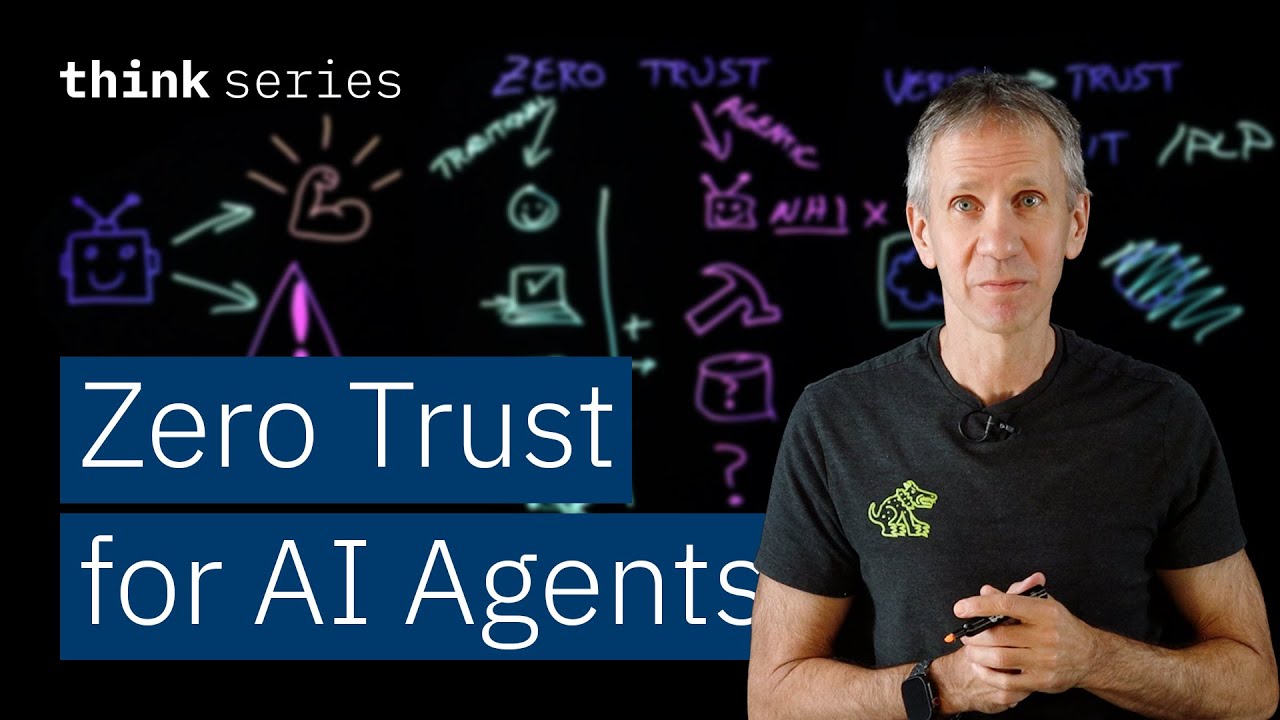
The video discusses the emergence of agentic AI—systems that not only process information but also take actions such as calling APIs, moving data, and even creating sub-agents. With these new capabilities comes an expanded attack surface, making security more challenging. The speaker argues that the best way to secure this evolving ecosystem is by applying zero trust principles, which emphasize “never trust, always verify.” While the term “zero trust” has been overused in marketing, its core security concepts are more relevant than ever in the context of autonomous AI agents.
Zero trust is distinguished by several key principles. First, trust is only granted after verification, not before. Second, access rights are provided “just in time” rather than “just in case,” adhering to the principle of least privilege—users and agents only get the access they need, for as long as they need it. Third, security controls are pervasive throughout the system, not just at the perimeter. Most importantly, zero trust operates under the assumption of breach, designing security as if attackers are already inside the system, which fundamentally changes the security paradigm.
In traditional environments, zero trust involves securing users through strong authentication and access controls, ensuring device integrity, encrypting sensitive data, and segmenting networks to limit the spread of breaches. As we move into agentic AI environments, these principles must be extended. AI agents, which use non-human identities, proliferate rapidly and require the same—if not greater—levels of control and visibility as human users. Tools, data sources, and the intentions of agents must also be secured and monitored to prevent tampering and misuse.
The attack surface in agentic systems is broad. Threats include prompt injection attacks, poisoning of policy or preference data, manipulation of APIs and tools, and credential theft or privilege escalation. Attackers can exploit any of these vectors to compromise the system. Therefore, zero trust must be applied rigorously: every agent and sub-agent must have unique, dynamically managed credentials stored securely, with no static secrets embedded in code. Tools and APIs must be vetted and registered, and an inspection layer—such as an AI firewall—should monitor for improper inputs and outputs.
Finally, comprehensive logging and traceability are essential, with immutable logs to prevent tampering. Continuous scanning for vulnerabilities across networks, endpoints, and AI models is necessary. Human oversight remains critical, with mechanisms like kill switches, throttling, and canary deployments to maintain control. In summary, while agentic AI amplifies both power and risk, zero trust provides a robust framework to ensure that autonomous systems act in alignment with user intent and not malicious actors, requiring continuous verification and justification for every action.