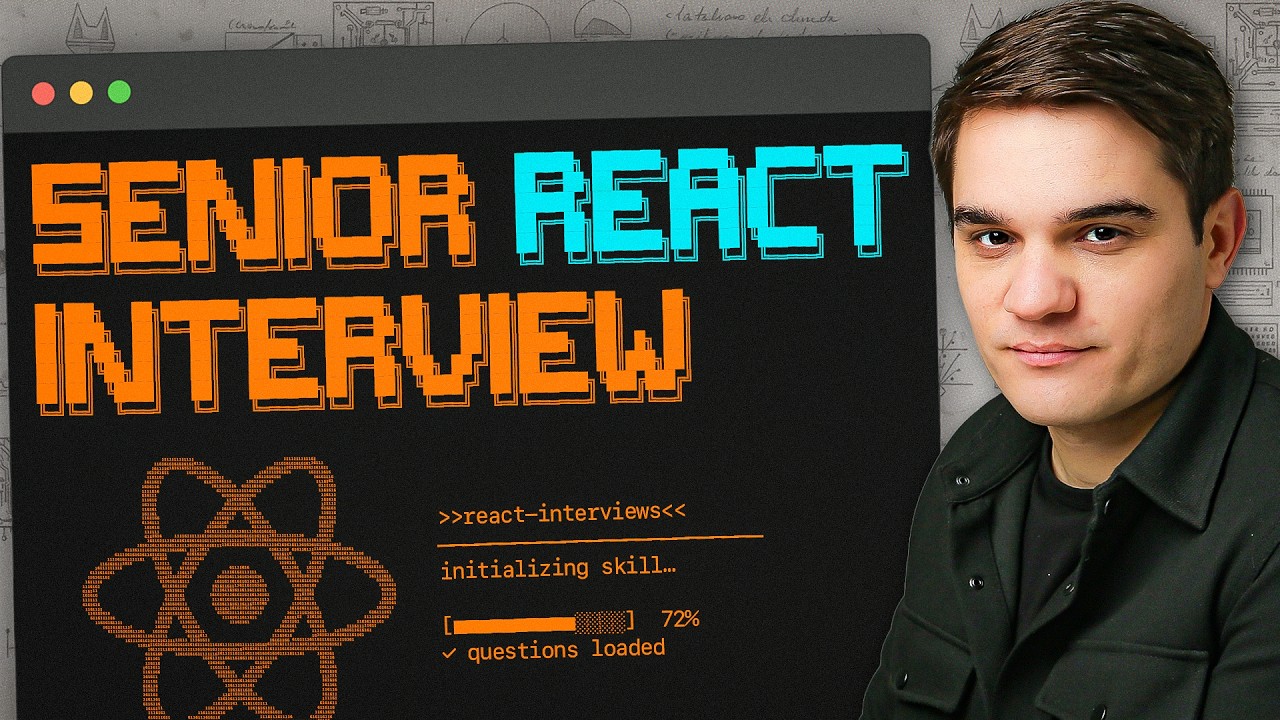
The video features a senior React.js interview where developer Bogdan answers AI-generated questions from Claude Code on topics like hooks, performance, and accessibility, highlighting both the benefits and limitations of AI-driven technical assessments. Bogdan achieves a perfect score after multiple attempts, advising viewers to combine such tools with solid foundational knowledge and practice to effectively prepare for senior-level React interviews.
The video showcases a senior React.js technical interview where a developer named Bogdan is interviewed by an AI tool called Claude Code using a newly launched “senior dev skill.” This skill is designed to simulate real interview questions based on React documentation and best practices, covering topics such as hooks, state management, performance, and accessibility. The interview consists of 10 questions of varying difficulty, and the AI provides feedback on the answers, highlighting strengths and gaps. The tool is nondeterministic, meaning it offers variability in questions but can sometimes produce confusing or inaccurate prompts, which requires the interviewee to rely on their own understanding.
Throughout the interview, Bogdan tackles questions ranging from basic React concepts like the correct use of hooks and state derivation to more complex topics such as performance optimization with useCallback, architectural decisions involving global state management, and accessibility concerns. He discusses the nuances of patterns like compound components versus headless components with hooks, emphasizing the importance of flexibility and reusability in UI design. The conversation also touches on browser internals, explaining how animations can be optimized by leveraging the compositor thread to avoid jank during heavy main thread work.
The interview highlights the challenges of using AI-driven tools for technical assessments, noting that while the AI can generate a broad range of questions, it sometimes struggles with precision and context. Bogdan advises developers to use such tools as a supplement rather than a replacement for studying official documentation and gaining hands-on experience. He stresses the importance of understanding underlying principles to apply deductive reasoning effectively during interviews and real-world problem-solving.
In the latter part of the video, Bogdan reflects on his performance, achieving a perfect score of 10 out of 10 after multiple attempts. He encourages viewers to start with junior or mid-level questions if they score low initially and progressively work their way up to senior-level challenges. The hosts also recommend practicing timed assessments and recording oneself to simulate real interview conditions, which helps improve verbalizing technical knowledge and thinking under pressure.
Finally, the video concludes with an invitation for viewers to try the skill themselves, provide feedback, and consider more structured mentorship options offered by the hosts. They emphasize that while AI tools are becoming part of the interview landscape, fundamental knowledge and critical thinking remain paramount. The hosts express openness to creating more content in this format and improving the skill based on community input, aiming to help developers prepare comprehensively for senior React and full-stack engineering roles.