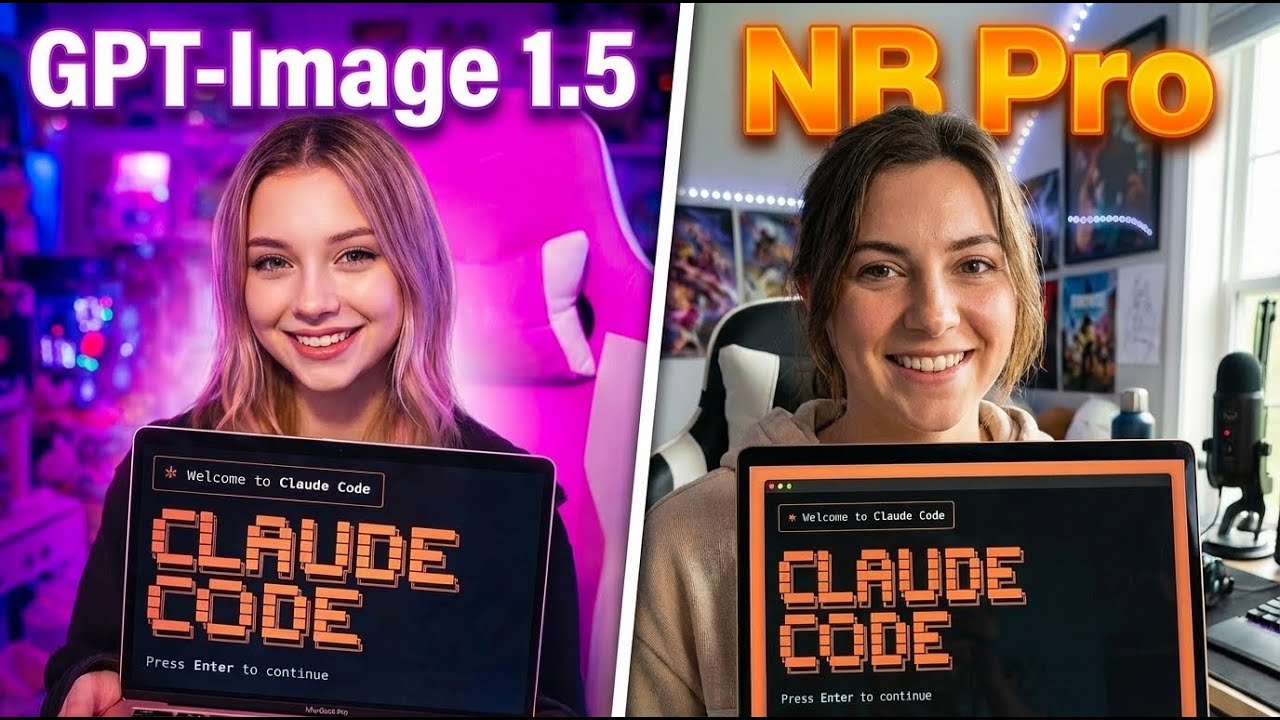
In this video, the creator tests OpenAI’s newly released image model, GPT-Image 1.5, and compares it to Nano Banana Pro, a model they frequently use for generating images. The goal is to evaluate the models based on typical use cases, such as creating workflow images, and to observe differences in speed, quality, and usability. The creator emphasizes that this is not an in-depth technical comparison but rather a practical exploration to help viewers decide which model might suit their needs.
The first test involves generating a simple workflow image with minimal text and a black background. The creator runs parallel prompts on both models and notes that GPT-Image 1.5 is about four times faster than before, showing a significant speed improvement. However, while GPT-Image 1.5 produced a quicker result, the image had some cropping issues and awkward elements like a strange arrow. In contrast, Nano Banana Pro delivered a cleaner, better-cropped image that the creator preferred for this task.
Next, the creator performs a series of iterative image generation tests using a source image of a person. The prompts involve placing the person in a coffee shop setting with specific details like a red button and text on the wall, followed by instructions to depict the person standing next to the button, pressing it dramatically, and then creating a creative next scene after the button press. Both models performed well in following instructions, with GPT-Image 1.5 excelling in dramatic and creative interpretations, while Nano Banana Pro produced more straightforward but still impressive results. The creator ultimately favored GPT-Image 1.5 for creativity but acknowledged both models’ strengths.
The video also includes a test of infographic generation, where the prompt was to explain how a large language model (LLM) works in a Minecraft-themed, easy-to-understand style. Both models produced clear and visually appealing infographics, with GPT-Image 1.5 impressing the creator with its graphic style and text clarity. This was a notable success for GPT-Image 1.5, showing it can handle complex, text-heavy images effectively, a task that is often challenging for image generation models.
Finally, the creator tests background removal capabilities, a feature they frequently use. Both models performed well, but GPT-Image 1.5 produced a cleaner, more transparent background removal, albeit at a slightly slower speed compared to Nano Banana Pro. The creator concludes that GPT-Image 1.5 shows promising improvements in speed, creativity, and quality, making it a viable option to include in workflows. However, they note that further testing is needed for more complex tasks, and they encourage viewers to try the model themselves.