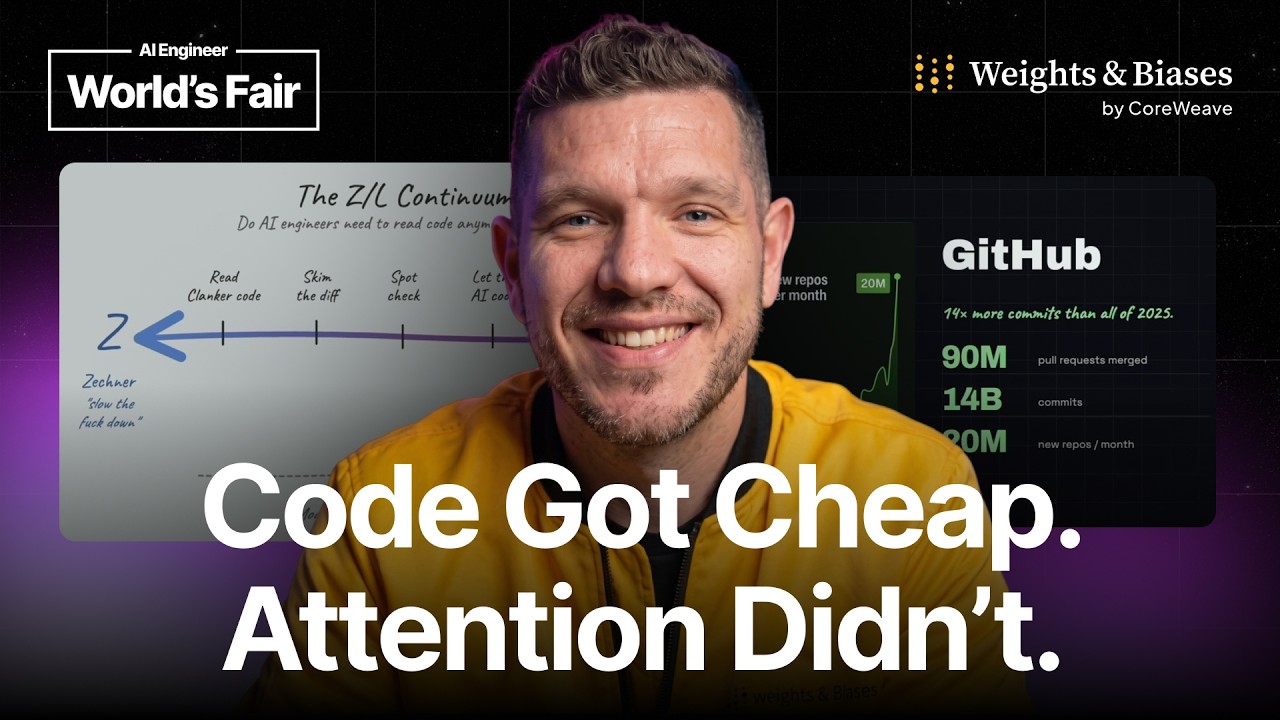
In the evolving landscape of AI engineering, a significant debate has emerged about whether engineers should still read the code generated by AI agents in 2026. Alex Volkov, host of the Thursday AI podcast, highlights this tension by referencing two contrasting viewpoints presented at the AI Engineer Europe conference. One speaker, Ryan LeFebvre from OpenAI, argues that “code is free” and that humans no longer need to focus on the implementation details but rather on crafting effective prompts and guardrails. Conversely, Mario Zechner, creator of Pi, insists on the importance of reading every line of critical code to avoid compounding errors and delayed issues in production. This debate encapsulates a broader anxiety within the AI engineering community about balancing speed and quality in AI-generated code.
Volkov explains that since December 2025, AI engineering has undergone a dramatic shift, with AI models now capable of completing tasks that previously took engineers many hours. This has led to a surge in AI-assisted code commits, with platforms like GitHub experiencing a 14-fold increase in commits, most of which are AI-generated. Despite this productivity boost, the quality and stability of code have become concerns, as evidenced by increased incidents and bugs per developer. Companies like Anthropic, heavily reliant on AI-generated code, have faced operational challenges, underscoring that rapid output does not guarantee reliability.
The key insight Volkov offers is that the debate should not be about whether to read code at all but about determining the level of scrutiny each change requires. He introduces the “Z/L Continuum,” a framework positioning engineers between two extremes: those who trust AI outputs without detailed review and those who meticulously inspect every line of code. Importantly, this continuum applies to tasks rather than individuals; the same engineer might adopt different approaches depending on the criticality of the code. Critical areas such as authentication, permissions, and irreversible data demand thorough human review, while less critical code can be handled with more trust in AI agents.
Volkov also discusses emerging practices and tools that help manage this balance, such as decomposing large pull requests into smaller, reviewable units, using traces and evaluations, and separating the roles of code generation and testing to avoid conflicts of interest. He highlights the concept of “loops,” advanced automated processes that not only generate code but also verify and improve it iteratively with minimal human intervention. However, he cautions that even with such automation, human judgment remains essential to prevent quality degradation and ensure that the system is doing the right work, not just doing work correctly.
Looking ahead, Volkov emphasizes the need for flexibility and continuous adaptation as AI capabilities rapidly advance. While the temptation to stop reading code altogether grows stronger, especially with tools like Anthropic’s Fable that check if AI is doing the right work, human oversight remains indispensable. The future of AI engineering lies in strategically routing attention and proof requirements to where they matter most, ensuring that engineers focus their efforts effectively. Ultimately, not every line of code in 2026 requires human eyes, but every system still needs human judgment to maintain quality and reliability.