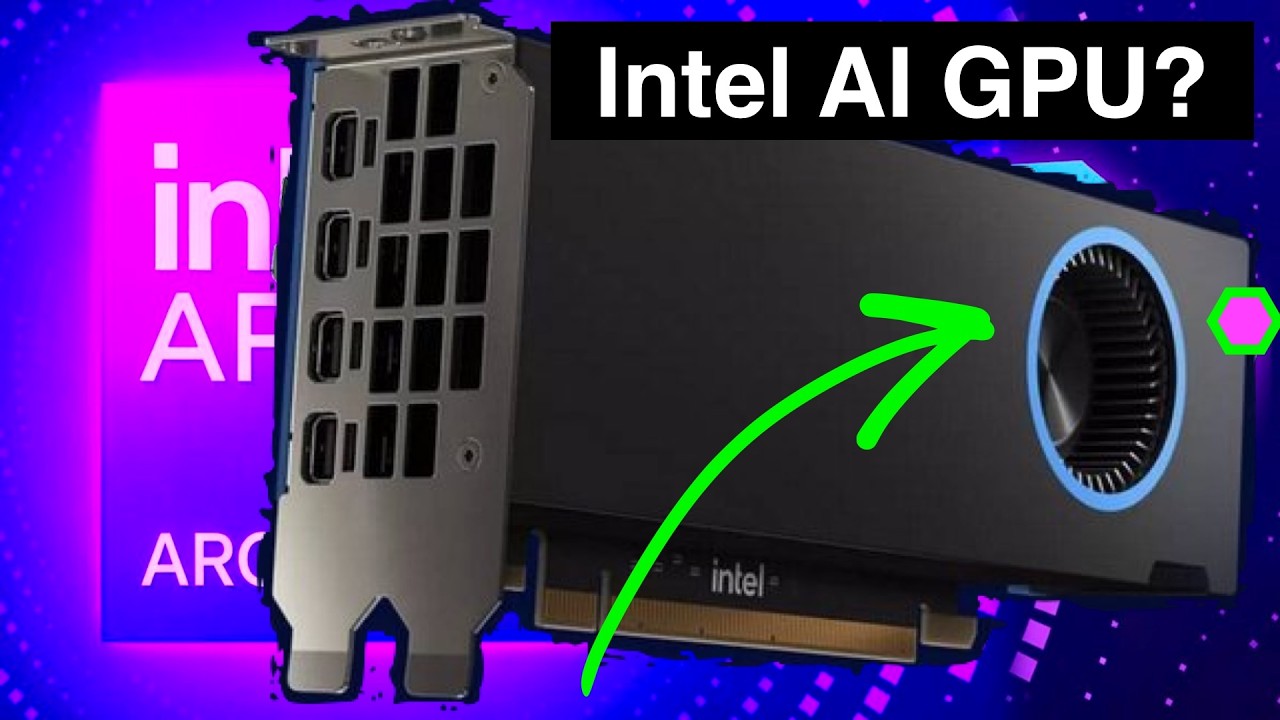
The video discusses Intel’s ARC PRO B50 GPU and its surprising success in the local AI market, where it has managed to carve out a niche against dominant players Nvidia and AMD. Despite Intel being previously written off in the GPU space, the ARC B50 showcases Intel’s willingness to take risks with innovative engineering choices, particularly focusing on features that matter for local AI workloads rather than raw speed. The B50 is a compact, power-efficient GPU with 16GB of fast VRAM, priced under $400, making it an attractive option for certain AI applications despite not being the fastest GPU available.
One of the key strengths of the ARC B50 lies in its support for SR-IOV (Single Root I/O Virtualization), a feature that enables efficient GPU virtualization and sandboxing, which is crucial for running multiple local AI agents securely and concurrently. This capability is especially important as local AI use cases shift towards agentic tasks that require multiple isolated environments rather than heavy image or video generation workloads. Intel’s first-party support for SR-IOV works well with popular virtualization platforms like Proxmox and OpenStack, offering a seamless experience that Nvidia struggles to match due to licensing and technical limitations.
The video also highlights that while the ARC B50 is not the fastest GPU in terms of raw throughput or time to first token, its average performance is competitive with Nvidia’s RTX 3060 Ti and RTX 3070, especially considering its 16GB VRAM capacity. This makes it a viable choice for users who need sufficient VRAM for AI models without breaking the bank. The tooling and software ecosystem around Intel GPUs have improved significantly, with Intel collaborating with platforms like Hugging Face to optimize AI model performance on their hardware, signaling a positive trajectory for future Intel GPU releases.
User experiences shared in the video reinforce the B50’s value proposition, particularly for those upgrading from older or less capable GPUs. The GPU’s VRAM capacity allows models to run without excessive reliance on slower system memory, and the overall performance gains over CPU-only setups are notable. However, some early manufacturing issues, such as thermal pad adhesive left on memory modules, have been reported but are relatively minor in the grand scheme. The B50 is positioned as a cost-effective solution for edge AI applications and home labs, especially for users who already have compatible Linux systems.
In conclusion, while the Intel ARC B50 is not recommended over high-end GPUs like the Nvidia RTX 3090 for raw performance, it represents a strategic and promising step for Intel in the local AI GPU market. Its unique features, competitive pricing, and improving software support make it an interesting option for specific AI workloads, particularly those involving multiple virtualized agents. The video suggests keeping an eye on Intel’s future GPU iterations, such as the B55 or B70, which may further enhance their position. Ultimately, the B50 is a noteworthy contender that challenges the status quo and signals Intel’s renewed commitment to the AI and GPU space.