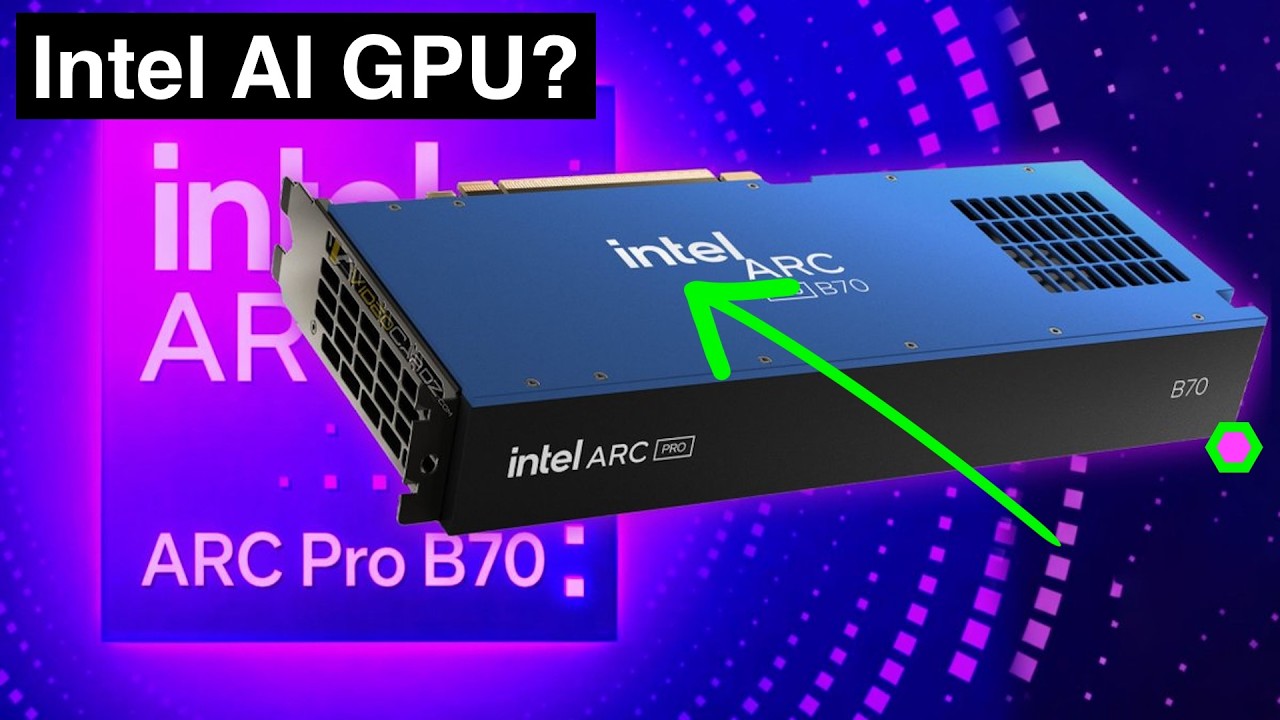
The video discusses the potential of the Intel Arc Pro B70 GPU as a compelling option for local AI workloads in 2026, especially in light of recent GPU market challenges such as skyrocketing prices and memory shortages. Despite Intel’s struggles in recent years, the company has made significant strides in GPU development, offering a blower-style card with reliable power delivery and promising performance that rivals Nvidia’s RTX 4000 series. Unlike AMD GPUs, which excel in training but lack robust tooling support for local AI projects, Intel has focused heavily on improving tooling, making the B70 a more practical choice for local AI enthusiasts and professionals.
The Intel Arc Pro B70 stands out primarily for its price-to-performance ratio, boasting 32GB of VRAM—more than Nvidia’s RTX 4000—and a competitive price point that is roughly 50% cheaper. The GPU features Intel’s BMG 31 architecture with 32 Xeon 2 HPG cores, 256 XMX engines, and 32 RT units, designed to balance everyday professional use with heavy-duty AI tasks. Intel’s approach also emphasizes scalability, allowing users to easily link multiple GPUs via PCIe Gen 5, which is a notable advantage over many Nvidia consumer GPUs that face limitations in multi-GPU setups.
Benchmarking from early adopters like David Hendrickson shows that the B70 competes well against Nvidia’s offerings, particularly in models like Gemma 4 31B and Llama 3, where the larger VRAM enables bigger context windows and better multi-user token throughput. Intel’s investments in inference-related startups have enhanced the GPU’s performance in agentic AI tasks, offering up to 85% higher throughput in parallelized token requests. While the B70 may not match Nvidia’s top-tier GPUs in raw speed, its memory capacity and architectural design provide unique advantages for local AI workloads.
However, the video also highlights some caveats, particularly around tooling and driver maturity. Nvidia’s dominance in AI tooling with CUDA and PyTorch remains a significant advantage, and Intel’s ecosystem is still in its early stages, with some users reporting less-than-ideal performance in certain applications. Despite this, the community and developer support around Intel’s GPUs are growing, and improvements are expected to come quickly. For users prioritizing cost and memory over peak performance, the B70 offers a compelling alternative, especially compared to older Nvidia GPUs like the 3090, which, while still competitive, are aging.
In conclusion, the Intel Arc Pro B70 is positioned as a strong contender for local AI users seeking a balance of price, memory, and performance in 2026. It is particularly attractive for those who want a blower-style card with good scalability and are willing to engage with a developing ecosystem. While Nvidia remains the leader in tooling and overall performance, Intel’s focused improvements and competitive pricing make the B70 a GPU worth considering for local AI workloads, especially for users who need larger VRAM and multi-GPU setups. The video invites viewers to share their experiences and plans regarding upgrading or purchasing GPUs in this evolving landscape.