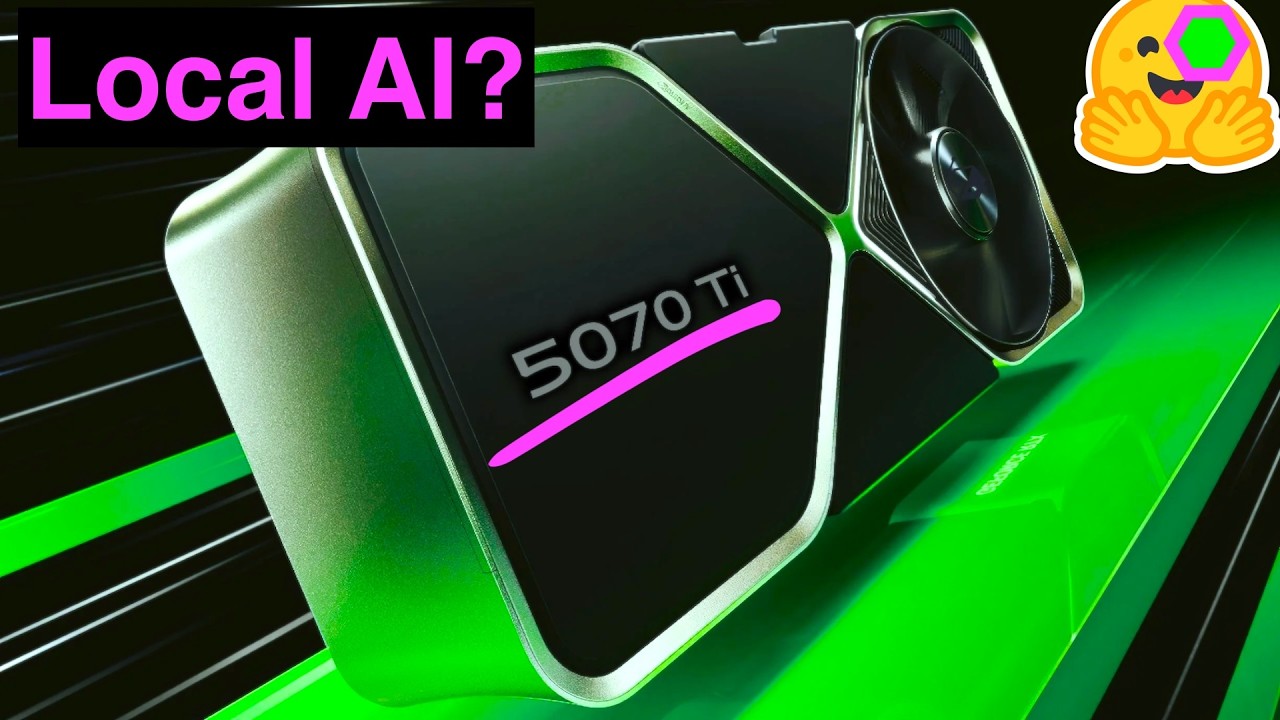
The Nvidia RTX 5070 Ti 16GB GPU is positioned between the 5060 Ti and 5080 in terms of performance and VRAM capacity, making it a compelling choice for local AI workloads in 2026. Initially released with 12GB VRAM, the 5070 Ti version upgraded to 16GB, enhancing its suitability for running advanced AI models like Qwen 3.6 and other powerful options that were previously challenging to handle locally. This GPU offers solid gaming performance alongside strong AI capabilities, benefiting from Nvidia’s latest driver and CUDA improvements, especially with emerging quantization techniques like FP4 and INV4 that optimize model size and performance for GPUs with limited VRAM.
Technically, the 5070 Ti is a Blackwell architecture GPU that delivers a 25-30% performance boost in AI tasks compared to the 5070, mainly due to increased tensor and CUDA cores, as well as improved memory bandwidth and a wider memory bus. Although its clock speed is slightly lower than the 5070, the overall enhancements make it a better GPU, especially compared to the 5060 Ti. Nvidia had plans for a 5070 Ti Super with 24GB of GDDR7 VRAM, but this model never materialized, partly due to VRAM supply constraints and market factors. Despite this, the 5070 Ti remains a strong contender for local AI workloads, especially given its first-party support and compatibility with Nvidia-focused tooling.
One of the standout features of the 5070 Ti is its support for INV FP4 quantization, which significantly improves performance and efficiency for AI models. This support is not available on older GPUs like the RTX 3090, making the 5070 Ti particularly attractive for running generative models and agentic AI tasks that involve multimodal processing. Benchmarks show substantial speedups—over 100% in some cases—when using FP4 quantization on this GPU, especially for image and video generation models. This makes the 5070 Ti a great option for users focused on generative AI workloads, as well as those combining image processing with reasoning tasks.
In practical use, the 5070 Ti can handle demanding models like the 3-bit or 4-bit quantized Qwen 3.6 27B, although with a single 16GB GPU, some offloading to system RAM is necessary. Users running multiple GPUs (two to four 5070 Ti or 5060 Ti units) have reported excellent results with frameworks like VLLM, making this GPU a versatile choice for researchers and developers working on local AI. Compared to older GPUs, the 5070 Ti offers a significant upgrade in both performance and compatibility with the latest quantization methods, which are becoming increasingly important for efficient local AI model deployment.
Regarding pricing, buying a new 5070 Ti at retail prices around $1,000 is not recommended, as it is relatively expensive. However, the used market, particularly on eBay, offers better deals often under $800, making it a more attractive option. While the RTX 3090 remains a competitor due to its raw power and price point, it lacks support for the latest quantization formats like INV FP4, which limits its efficiency for newer AI models. Overall, the 5070 Ti is a strong contender for local AI users willing to invest in a GPU that balances modern AI features, VRAM capacity, and price, especially if sourced from the secondhand market.