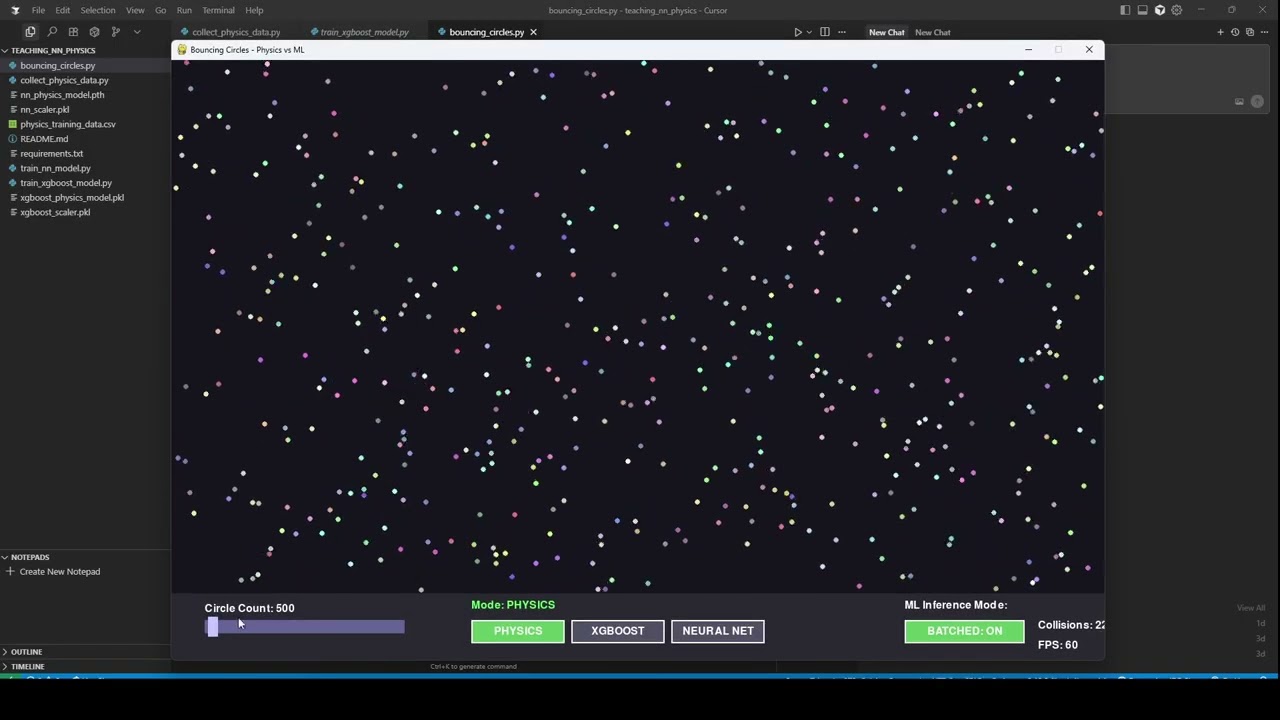
In this video, the creator shares an experiment where they trained a neural network to simulate physics, specifically focusing on bouncing circles in a Pygame environment. Initially, the simulation runs with regular physics calculations, but then the physics computations for collisions are replaced by predictions from machine learning models, including XGBoost and a neural network. The creator observes that while the neural network runs relatively fast, XGBoost tends to slow down the simulation. Despite this, both models manage to approximate the physics behavior reasonably well, with only minor differences compared to the original physics simulation.
The creator explains the data collection process used for training the models. They run a physics simulation to gather collision data over many frames, capturing details such as positions, velocities, masses, and radii of particles before and after collisions. This dataset is then used to train both the neural network and XGBoost models. Once trained, these models are saved and used to predict collision outcomes in the simulation, replacing the traditional physics calculations. The creator notes some biases in the training data, such as particles bunching up in certain areas, likely due to uneven distribution of collision directions in the dataset.
To explore the models’ behavior further, the creator experiments with training on smaller datasets, even down to a single frame with very few collisions. They observe that with limited data, both models perform poorly, with particles clustering unnaturally and the simulation becoming unstable. However, when trained on larger datasets, the models improve significantly, producing more realistic physics behavior. The creator also highlights that the neural network sometimes performs better than XGBoost, but both have their limitations and can exhibit biased behavior depending on the training data.
Throughout the video, the creator reflects on the performance trade-offs between traditional physics calculations and machine learning models. They hoped that the neural network would be faster than regular physics computations, but in this experiment, that was not the case. The neural network was faster than XGBoost but still not faster than the original physics engine. The creator suggests that more complex and computationally expensive physics simulations might be necessary for neural networks to offer a speed advantage over traditional methods.
Finally, the creator invites viewers to access the source code and additional projects through their Patreon page, offering exclusive content and weekly meetings. They express an intention to continue experimenting with this approach and to find ways to optimize neural network-based physics simulations. The video concludes with the creator encouraging viewers to follow along for future updates and improvements on this project.