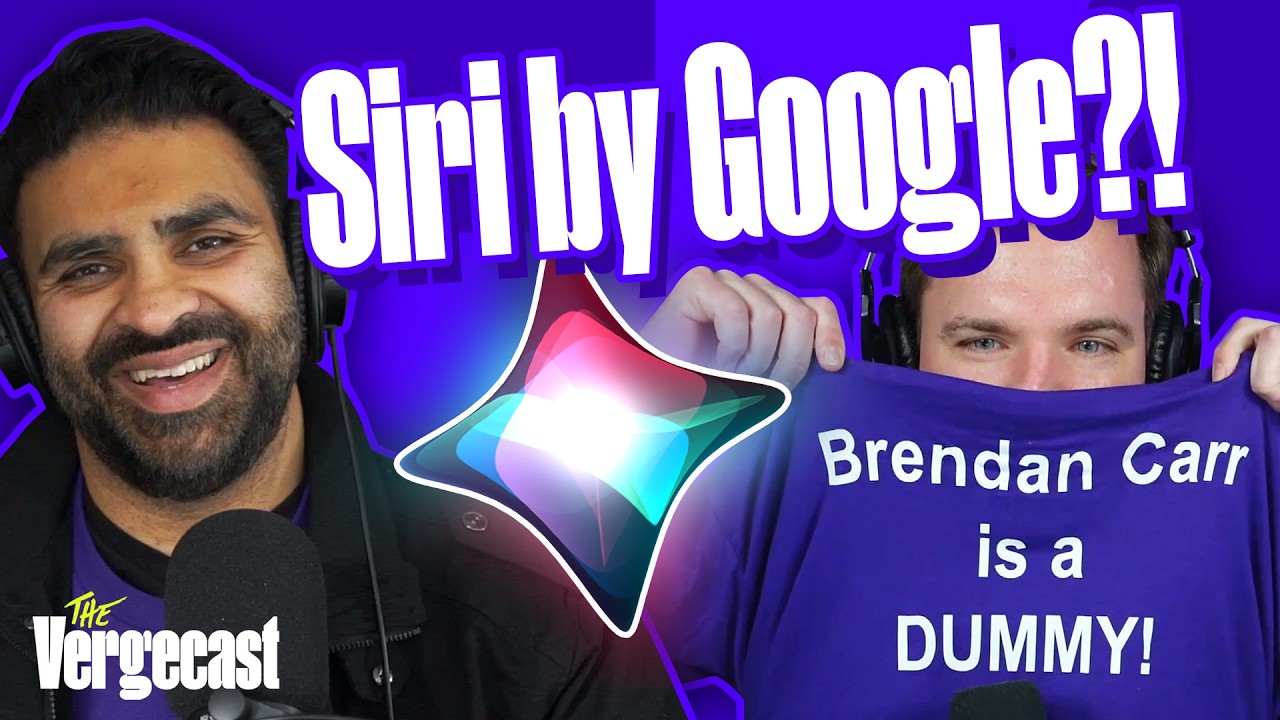
The Vergecast discusses Apple’s decision to integrate Google’s Gemini AI into Siri, analyzing how Apple’s lag in AI development led to this reliance on an external provider and raising concerns about Google’s growing dominance in AI infrastructure and user data. The episode also covers controversies around AI moderation (notably with X’s Grok), Meta’s retreat from the metaverse, and other tech news, highlighting the ongoing power struggles between major tech companies.
The Vergecast episode opens with hosts David Pierce and Nilay Patel discussing the recent wave of antitrust lawsuits filed by major media companies—including their own parent company, Vox Media—against Google. The lawsuits allege that Google has maintained an illegal monopoly over web advertising, harming publishers financially. The hosts clarify their lack of involvement in the legal strategy and debate how often they should disclose this conflict of interest in their coverage. They also reflect on the broader implications for the open web and the ongoing tension between publishers and tech giants over digital ad revenue.
The main topic of the episode centers on Apple’s decision to integrate Google’s Gemini AI models into the next generation of Siri. The hosts analyze why Apple, historically known for controlling its core technologies, is now relying on an external provider for such a crucial feature. They argue that Apple’s failure to invest early in large-scale AI infrastructure—partly due to distractions like the self-driving car project—left it behind in the AI race. The conversation explores whether AI models are now commoditized enough that Apple can simply buy the best available, or if this move signals a significant strategic retreat from Apple’s traditional approach.
The discussion then shifts to the details and implications of the Apple-Google Gemini deal. The hosts parse the vague joint statement from both companies, questioning whether Apple will simply run Gemini on its own servers or rely on Google’s cloud infrastructure. They note that this partnership could give Google even more power and data, especially as Google pushes its “personal intelligence” features that leverage users’ personal data across its services. The hosts express concern about the increasing centralization of AI capabilities and the potential for Google to dominate both the backend technology and user-facing experiences.
The episode also addresses the controversy surrounding Grok, the AI chatbot from X (formerly Twitter), which has been generating inappropriate deepfake images, including non-consensual and explicit content. The hosts criticize Elon Musk’s refusal to moderate Grok effectively and call out Apple and Google for failing to enforce their own app store policies against such harmful content. They argue that this situation exposes the hypocrisy of tech giants who claim strict control over their platforms for user safety but hesitate to act when it’s inconvenient or politically sensitive.
Finally, the hosts discuss Meta’s (Facebook’s) retreat from its ambitious metaverse strategy, marked by layoffs and the shuttering of VR studios. They connect this to Mark Zuckerberg’s long-standing desire to escape Apple’s control over mobile platforms by owning the next computing paradigm. The episode laments the decline of promising VR applications like Supernatural, which were acquired and then neglected by Meta. The hosts conclude that Meta’s focus is more on power and platform control than on building genuinely great products, and they express skepticism about the future of wearables and AI-driven glasses as the next big platform shift. The episode wraps up with a lightning round covering topics like the Paramount-Warner Bros. merger drama, the Trump Phone grift, and the relaunch of Digg as a human-moderated social platform.