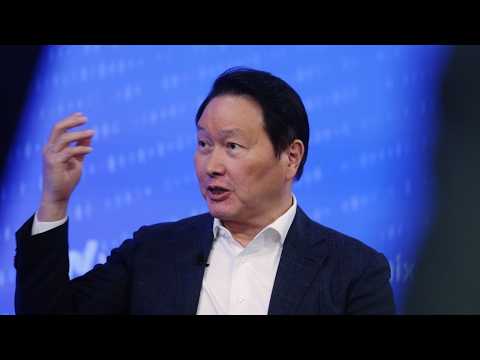
SK Group Chairman Chey Tae-won discussed the timing and rationale behind SK Hynix’s US listing, emphasizing the long-awaited opportunity to access the US capital markets. He highlighted that the $26.5 billion raised is significant but aligns with SK’s broader domestic and international commitments. Chey expressed confidence in delivering multiple returns through successive funding rounds and stressed the importance of maintaining stock price stability while capitalizing on the growing demand for memory driven by the AI era.
Chey elaborated on the evolving memory market, particularly the surge in demand for high bandwidth memory (HBM) fueled by AI applications like large language models. He explained that unlike traditional consumer electronics demand, AI requires extensive memory for caching and inference processes, leading to exponential growth in memory needs. SK Hynix plans to double its capacity within five years to meet this demand, with customers already signaling that even this expansion may not suffice, indicating a prolonged period of supply tightness potentially lasting until advancements in artificial general intelligence (AGI) stabilize the market.
Reflecting on SK Hynix’s acquisition in 2012, Chey acknowledged the risks involved in taking over a financially troubled company in a cyclical industry requiring massive capital expenditures. However, he believed in the sophistication and technological potential of memory manufacturing, viewing it as a foundation for future digital innovation. He also noted the shift towards long-term agreements with customers, which help stabilize the traditionally volatile memory business by ensuring steady volumes and pricing, thus enabling a more sustainable business model.
Chey outlined SK Group’s broader strategic focus beyond memory chips, including significant investments in AI data centers both in Korea and internationally, with power availability and cost being critical considerations. He highlighted SK Telecom’s ventures into AI applications such as robotics and healthcare, underscoring the group’s commitment to developing a comprehensive AI ecosystem. Addressing talent challenges, especially in the US, Chey emphasized efforts to attract skilled workers through financial incentives like stock options and ADR listings, recognizing talent acquisition as vital to fulfilling SK’s ambitious multi-trillion-dollar investment plans.
On technology and market positioning, Chey stressed SK Hynix’s strength in process design and manufacturing excellence, focusing on being a specialized memory producer without competing directly with customers. He touched on innovations in NAND and flash memory, the importance of reducing AI token costs, and emerging concepts like memory-as-a-service to address bottlenecks in memory usage. Finally, Chey commented on geopolitical dynamics, noting China’s large STEM workforce and strategic focus on AI token cost reduction, contrasting it with the US emphasis on quality tokens, while reaffirming SK’s commitment to expanding its presence and investments in the US market.