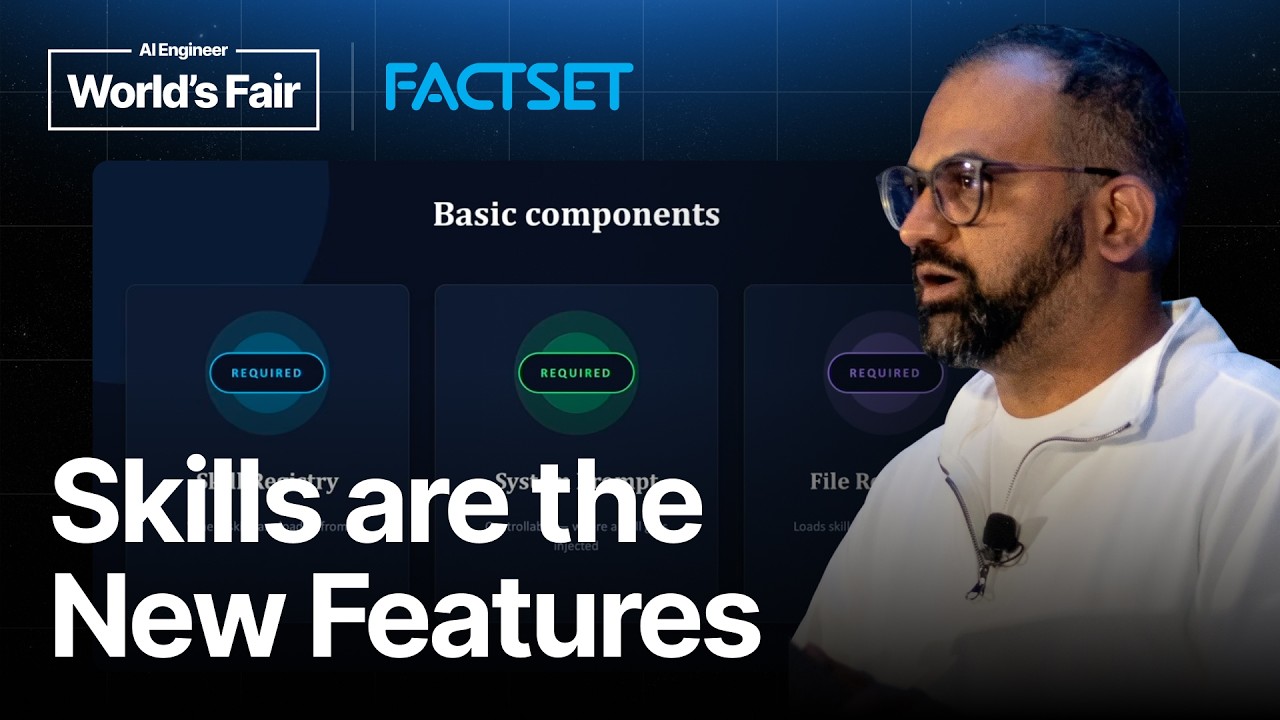
In this talk, Yogendra Miraje from FactSet discusses the concept of building skill-centric agentic products, emphasizing how skills have evolved to become the new features in AI-driven interfaces. Traditionally, products relied on screens, buttons, and dashboards for user interaction, but now agents often serve as the primary interface, either through direct conversation or by making decisions behind the scenes. In this context, skills define how specific tasks are accomplished, encapsulating business logic and shaping the agent’s behavior. This shift allows anyone with domain knowledge to create skills, changing the engineer’s role from feature development to building and maintaining the harnesses that enable these skills to function smoothly.
Miraje explains that a skill is essentially a standardized method to teach AI agents how to perform particular tasks effectively. Skills can range from simple markdown files to complex packages involving multiple scripts and references. The core of a skill is the skill.md file, which contains the name, description, and detailed instructions. To support skills in an agent harness, the minimum requirements include a skill registry, a system prompt, and basic file reading tools, with additional environments needed for running scripts. The skill registry acts as a catalog of available skills, which the agent references through the system prompt to decide which skills to activate based on user requests.
A key insight shared is the importance of skill descriptions as routing signals that guide the agent in selecting the appropriate skill. Descriptions should be aligned with user intent rather than just describing the skill itself, and they must be distinct to avoid confusion. Miraje also highlights that skills in agentic products are mostly model-driven to reduce cognitive load on non-technical users. He stresses the need to organize skills around real user intents rather than rigid data models, which often requires iterative refactoring as new use cases emerge. Additionally, skills must be regularly evaluated and tested, especially when upgrading AI models, to ensure they continue to function correctly.
As the number of skills grows, simply including all skills in the system prompt becomes impractical. Miraje suggests implementing mechanisms like embeddings and similarity searches to shortlist relevant skills dynamically. For very large skill libraries, hierarchical organization, metadata filtering, and governance become essential to maintain coherence and usability. Governance involves managing skill admission, ownership, boundaries, lifecycle, and coherence, borrowing best practices from software development such as versioning, deprecation, and human-in-the-loop reviews. This governance ensures that the skill library remains manageable, secure, and aligned with business needs.
In conclusion, Miraje emphasizes that skills are the fundamental features of agentic products, and the engineering focus is shifting towards building robust harnesses and routing mechanisms to support these skills at scale. As skill libraries expand, governance becomes critical to maintain quality and coherence. The talk underscores the transformative potential of skill-centric design in AI products and provides practical guidance on building, managing, and scaling skill libraries effectively in enterprise environments.