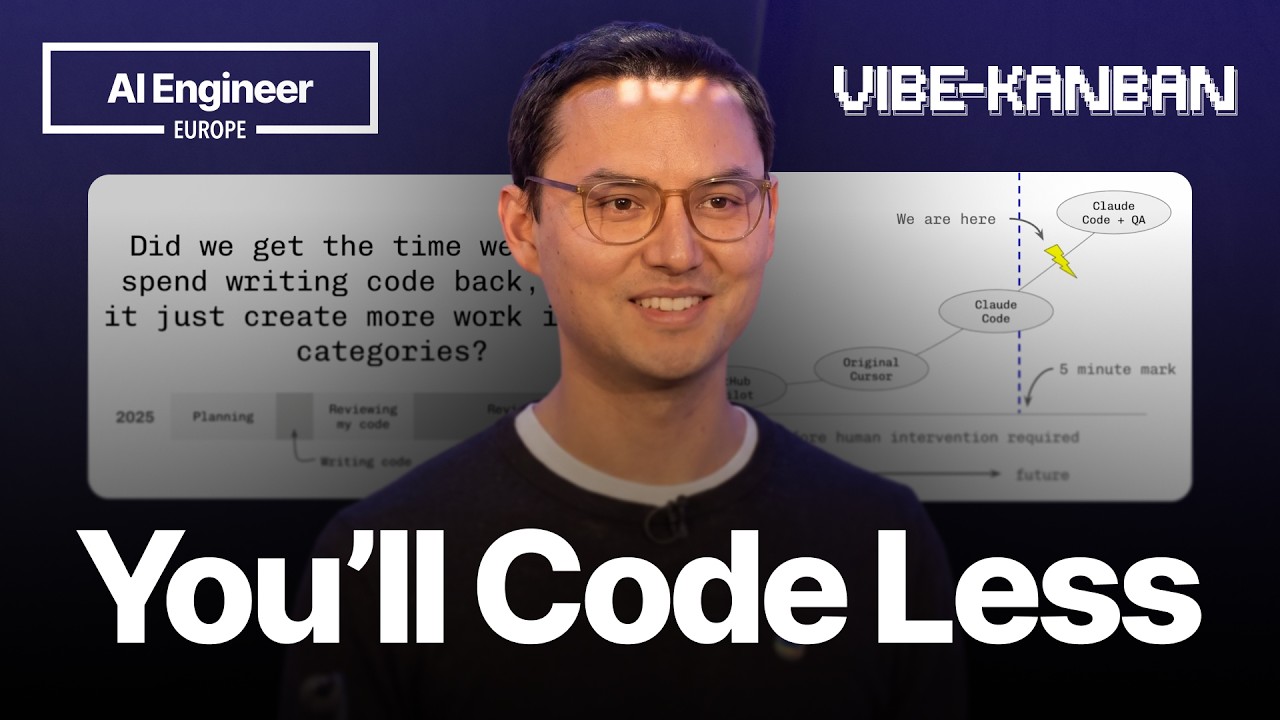
In this talk, Louis Knight-Webb, founder of Vibe Canvas and the London chapter of AI Tinkers, discusses the evolving role of software engineers in the age of advanced AI coding agents. He argues that as AI tools like GitHub Copilot, ChatGPT, and Claude Code improve, the traditional coding work of software engineers is shrinking, shifting their focus primarily to planning and reviewing AI-generated code. Rather than spending most of their time writing code, engineers will increasingly spend time crafting detailed plans for AI agents and reviewing their outputs to ensure quality and correctness.
Louis outlines two main approaches to working with AI coding agents: a plan-heavy approach and a review-heavy approach. The plan-heavy approach involves investing significant time upfront to create comprehensive specifications and plans, which reduces the need for extensive review later. Conversely, the review-heavy approach involves less upfront planning but requires more iterative back-and-forth to correct and refine the AI-generated code. He advocates for the plan-heavy method as it is more efficient and saves human time, especially when dealing with complex backend or migration tasks, whereas frontend feature development may require more iterative review due to its complexity and statefulness.
He also highlights how the increasing complexity and capability of AI agents lead to longer execution times for coding tasks, sometimes running for several minutes or more. This shift necessitates new workflows and tools that allow engineers to manage multiple AI-driven tasks in parallel rather than waiting idly for one task to complete. To address this, Louis and his team developed Vibe Kanban, a tool designed to help engineers manage multiple AI coding agents simultaneously, review code efficiently, and maintain productivity despite longer AI execution times.
Despite the innovative nature of Vibe Kanban and its adoption by thousands of users, Louis announces the difficult decision to shut down the company due to challenges in monetization and market maturity. He explains that the current market favors enterprise sales and token reselling, areas where Vibe Kanban did not compete effectively. Nonetheless, the project will continue as a non-commercial open-source effort, and Louis reflects positively on the experience, emphasizing the value of working with great people and the learning gained from running a startup at the cutting edge of AI and software development.
In closing, Louis shares insights from his entrepreneurial journey, including the importance of hard work, team motivation, and the need for strong enterprise sales skills. He expresses relief and optimism about the future, planning to take time off before starting a new venture. The talk ends with a live demonstration of shutting down Vibe Kanban using the tool itself, symbolizing both the end of the project and the ongoing evolution of software engineering in an AI-driven world.