The video explains how AI is revolutionizing software development by rapidly decompiling and recreating complex programs and video games, effectively rendering traditional software creation obsolete and shifting competitive focus to services and unique features. It also highlights AI’s transformative potential in scientific discovery and mathematics, while underscoring the continued importance of human creativity and emotional depth in crafting meaningful experiences amid widespread AI-generated content.
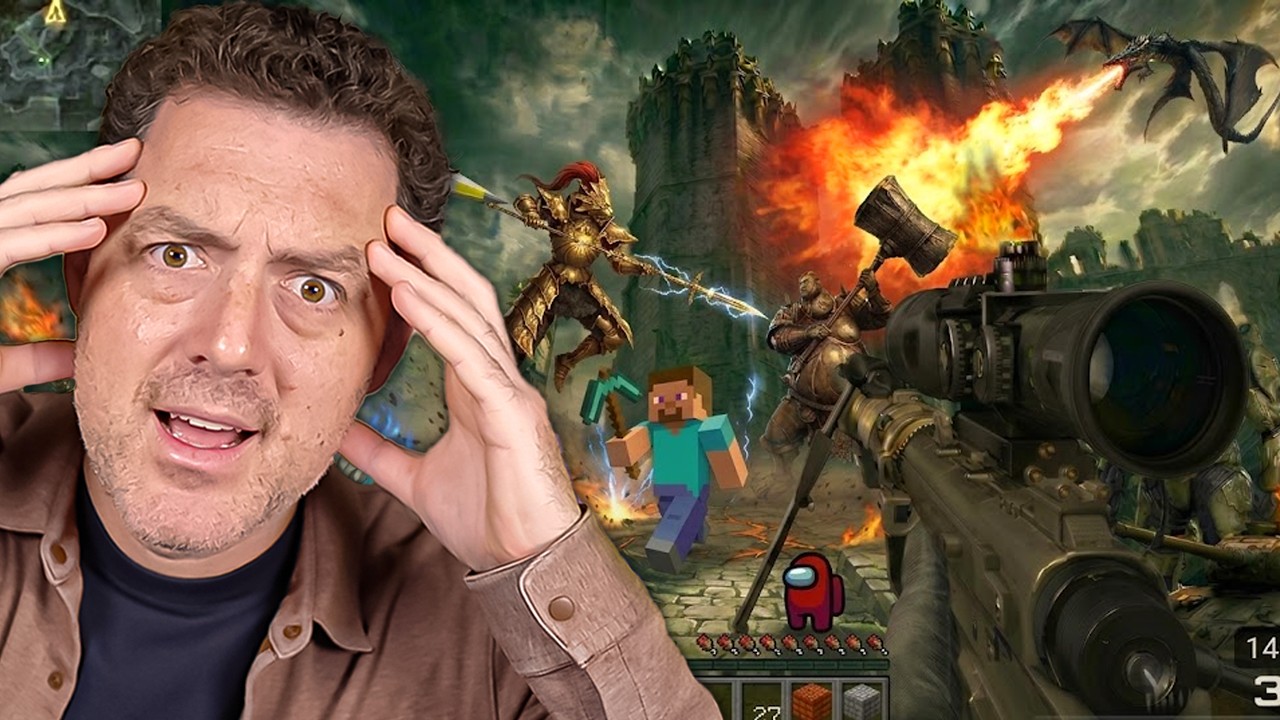
The video discusses the revolutionary impact of AI on software development, particularly in the realm of video games. AI has drastically accelerated the process of decompiling games—transforming machine code back into human-readable source code—from years to mere weeks or days. This is achieved through AI’s ability to iteratively guess and verify code functionality, a task that humans previously found painstakingly slow. The presenter illustrates this with examples like Super Mario in Elden Ring and mashups of different game mechanics, highlighting how AI enables the recreation and modification of games with unprecedented speed and accuracy.
Different methods of game mashups are explored, ranging from simple asset swaps (like changing character skins) to more complex integrations such as pass-through mods that allow two games to run simultaneously and interact, and even recreating game mechanics from one title in another. The most intensive approach involves rebuilding a game’s rules and software from scratch using AI, which offers greater control and realism but requires significant computational effort. These advancements showcase AI’s growing capability to not only replicate but also innovate within software environments.
The implications extend beyond gaming to all software, exemplified by AI recreating complex programs like Photoshop and Excel without access to their original source code. This signals a fundamental shift where software itself becomes less of a competitive advantage, pushing companies to focus on additional services like customer support, maintenance, and unique features. The presenter argues that software is effectively “solved” by AI, as it can replicate any program with verifiable outcomes, making traditional software development paradigms obsolete.
The video also touches on AI’s transformative potential in mathematics and scientific discovery. AI’s ability to work tirelessly through complex problems and explore all possible solutions has led to breakthroughs in math that humans alone could not achieve. This recursive self-improvement—where AI enhances its own capabilities continuously—could lead to exponential advances in intelligence and problem-solving, raising both excitement and concerns about managing AI’s rapid progress and alignment with human values.
Finally, the presenter emphasizes the enduring importance of human creativity and emotional resonance in a world where AI can generate countless variations of content. While AI can replicate and remix existing ideas endlessly, the human role in crafting meaningful, engaging stories and experiences remains crucial. The challenge moving forward will be to discern and nurture genuine creativity amid the flood of AI-generated derivatives, ensuring that innovation continues to resonate on a deeply human level.
Useful Links