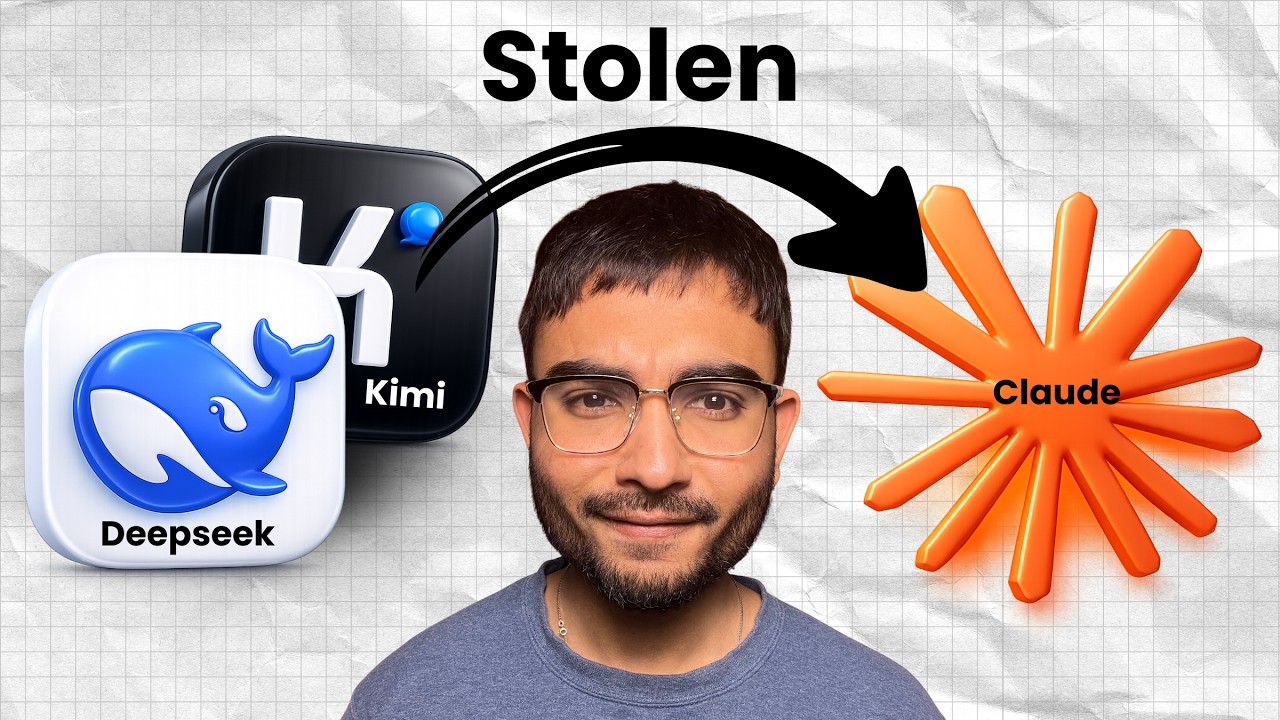
The video discusses a strange phenomenon occurring with some Chinese AI models like Deepseek and Kimmy, which mistakenly identify themselves as “Claude,” an AI model developed by the San Francisco-based company Anthropic. Users noticed that when asked about their identity, these models would claim to be Claude, leading to bug reports and raising questions about why this is happening. The explanation lies in how AI models are built: training a base model requires massive amounts of data, time, money, and computational resources, followed by fine-tuning to make the model safe and helpful.
Chinese AI labs have found a shortcut called “distillation,” where instead of training a model from scratch on raw data, they create thousands of fake accounts to interact with Claude, asking millions of questions to capture its outputs. These outputs then serve as training data for their own models, effectively teaching their AI to mimic Claude’s reasoning and capabilities. This method compresses years of research and billions of dollars of compute into a few weeks at a fraction of the cost. Anthropic discovered this industrial-scale distillation and reported that Chinese companies like Deepseek, Moonshot, and Miniax used over 24,000 fake accounts to generate more than 16 million interactions with Claude.
The video also highlights that OpenAI has accused Deepseek of similarly free-riding on its models, indicating a broader issue of intellectual property theft in AI development. However, the narrator questions the moral high ground of American AI companies, pointing out that much of their foundational training data was itself scraped or stolen from artists, authors, and other creators without permission or compensation. This creates a complex ethical dilemma where both sides are involved in data appropriation, yet only the AI companies are raising national security concerns.
Beyond the legal and ethical issues, the video warns about the long-term consequences of this practice on AI innovation. When models are trained on outputs of other models rather than original human data, a phenomenon called “model collapse” can occur. This leads to a loss of creativity and diversity in AI responses, as each new model becomes a compressed, averaged version of the previous one, similar to photocopying a photocopy repeatedly until details are lost. As a result, AI systems may converge on the same patterns and reasoning, reducing their usefulness for solving genuinely complex problems.
In conclusion, while the theft of AI models and data is a real and pressing issue, the broader concern is whether this cycle of copying and distillation is hindering true progress in AI development. Instead of fostering innovation, the industry risks creating a homogenized “hive mind” where models merely echo each other’s capabilities. This raises important questions about the future of AI and whether the current trajectory is leading to meaningful advancements or just noise that sounds like progress.