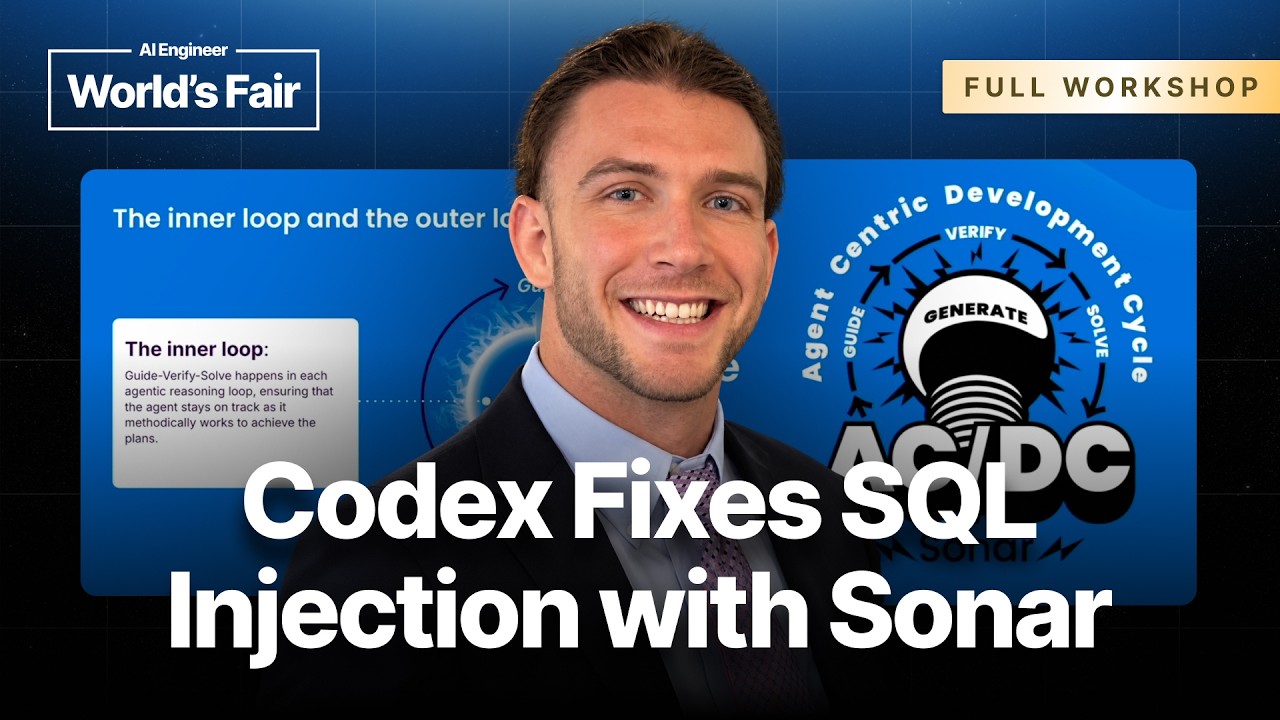
The presentation begins with an introduction to agent-driven development, focusing on the role of AI agents like Codex in software engineering. The speaker emphasizes three key principles: a task is only “done” when there is clear evidence of completion, isolation of code execution does not guarantee correctness, and feedback loops must be integrated within the development cycle. The agent cycle involves model-driven execution, observation of outputs, and continuous plan updates, with a strong emphasis on verification through multiple levels of control to ensure code safety and quality. Human oversight remains crucial, especially in reviewing and validating AI-generated code.
Kilian Carlsen-Phelan from Sonar then discusses the challenges of integrating AI-generated code into development workflows. A study highlighted that while 42% of code is AI-assisted, 96% of developers do not fully trust it, creating a bottleneck in code verification rather than generation. SonarQube addresses this with an agent-driven development cycle (ACDC) comprising generation, management, verification, and resolution phases. Governance provides agents with project-specific context to reduce token costs and improve output quality, while verification ensures no security or quality issues reach production. The resolution phase focuses on efficiently fixing detected problems to maintain an iterative and safe coding process.
The talk transitions into a practical demonstration of SonarQube’s integration with Codex. Kilian guides the audience through setting up a SonarQube project, running scans to detect vulnerabilities such as SQL injection and exposed API keys, and using SonarQube’s CLI and plugins to manage these issues. The demonstration highlights SonarQube’s ability to perform symbolic execution and data flow analysis to identify security risks. The integration with Codex allows developers to view and fix issues directly from their terminal or IDE, streamlining the feedback and correction process.
Further, Kilian introduces advanced tools like context expansion and agent analysis, which enhance the AI agent’s understanding of project architecture and automatically analyze code changes for new vulnerabilities. These tools enable a tighter feedback loop by providing immediate server-side validation after code edits, preventing the introduction of new issues during fixes. The demonstration shows how secrets are intercepted and blocked from being exposed in AI queries, reinforcing security best practices. The integration supports various SonarQube deployment models, including cloud and enterprise servers, making it accessible for different organizational needs.
In conclusion, the presentation underscores the shift from code generation to code verification as the primary challenge in AI-assisted development. SonarQube’s tools and integrations with Codex provide a comprehensive solution for managing this challenge by automating vulnerability detection, enforcing security policies, and facilitating rapid issue resolution within the developer’s workflow. Kilian invites attendees to engage with the Sonar community for support and further exploration, emphasizing the importance of combining AI capabilities with human oversight to ensure safe, high-quality software development.
Useful Links