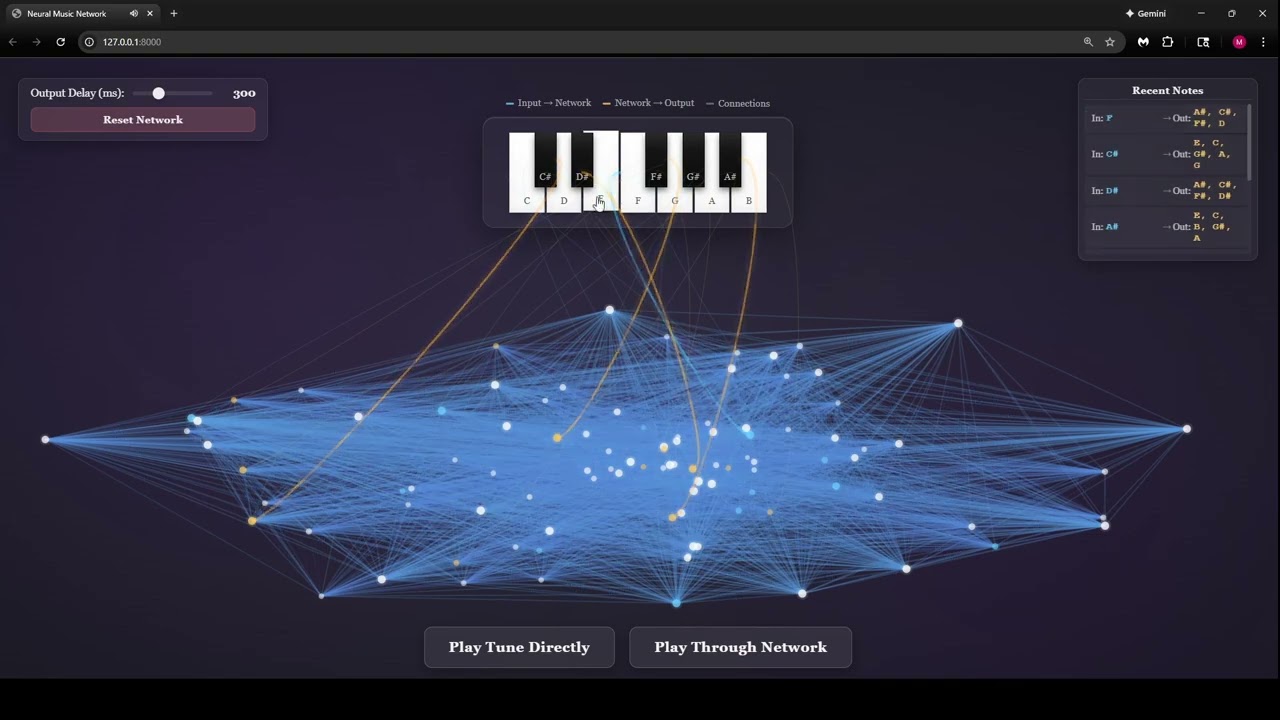
In this video, the creator demonstrates a spiking neural network that learns to play the piano using the Hebbian learning rule, without relying on backpropagation. When a piano note is pressed, the network produces output notes, shown as brown notes, which represent what the network plays in response. Although the performance is rudimentary and not very accurate yet, the network learns from scratch by strengthening connections based on the principle of “fire together, wire together.” The output is delayed, and the network updates its activations and weights each time a note is played.
The network operates by processing input notes as a one-hot vector of 12 possible notes. When a key is pressed, all activations are calculated and strengthened according to the Hebbian rule. The output can sometimes be a single note or multiple notes, depending on the network’s current state. The more the network is played with, the more its weights and thresholds adjust, allowing it to gradually improve its responses. The creator also demonstrates the network playing a tune automatically, showing that it can replay learned sequences even without new input.
An interesting aspect of the network is the implementation of inhibition mechanisms. When many connections activate simultaneously, the network calculates the average activation and subtracts it from each individual activation. This helps regulate firing and prevents overactivation. Additionally, the network dynamically adjusts firing thresholds: if a neuron or connection fires too often, its threshold increases to reduce firing frequency; if it fires too rarely, the threshold decreases to encourage more activity. This feedback loop helps maintain balanced activity within the network.
The creator emphasizes that this project is still in its early stages and quite basic, but it contains many intriguing ideas such as inhibition and adaptive thresholds. The simplicity of the design makes it accessible for others to build upon and experiment with. The network’s ability to learn piano notes through a biologically inspired Hebbian learning rule, without backpropagation, presents an exciting avenue for further exploration in spiking neural networks and music generation.
Finally, the creator plans to make the project open source on Patreon, inviting viewers to explore the code and ideas in detail. They encourage those interested in their work to consider becoming patrons, as they offer over 500 projects, exclusive videos, and weekly meetings. The video concludes with an invitation for feedback and thoughts on the project, highlighting the creator’s enthusiasm for continuing development and experimentation in this area.