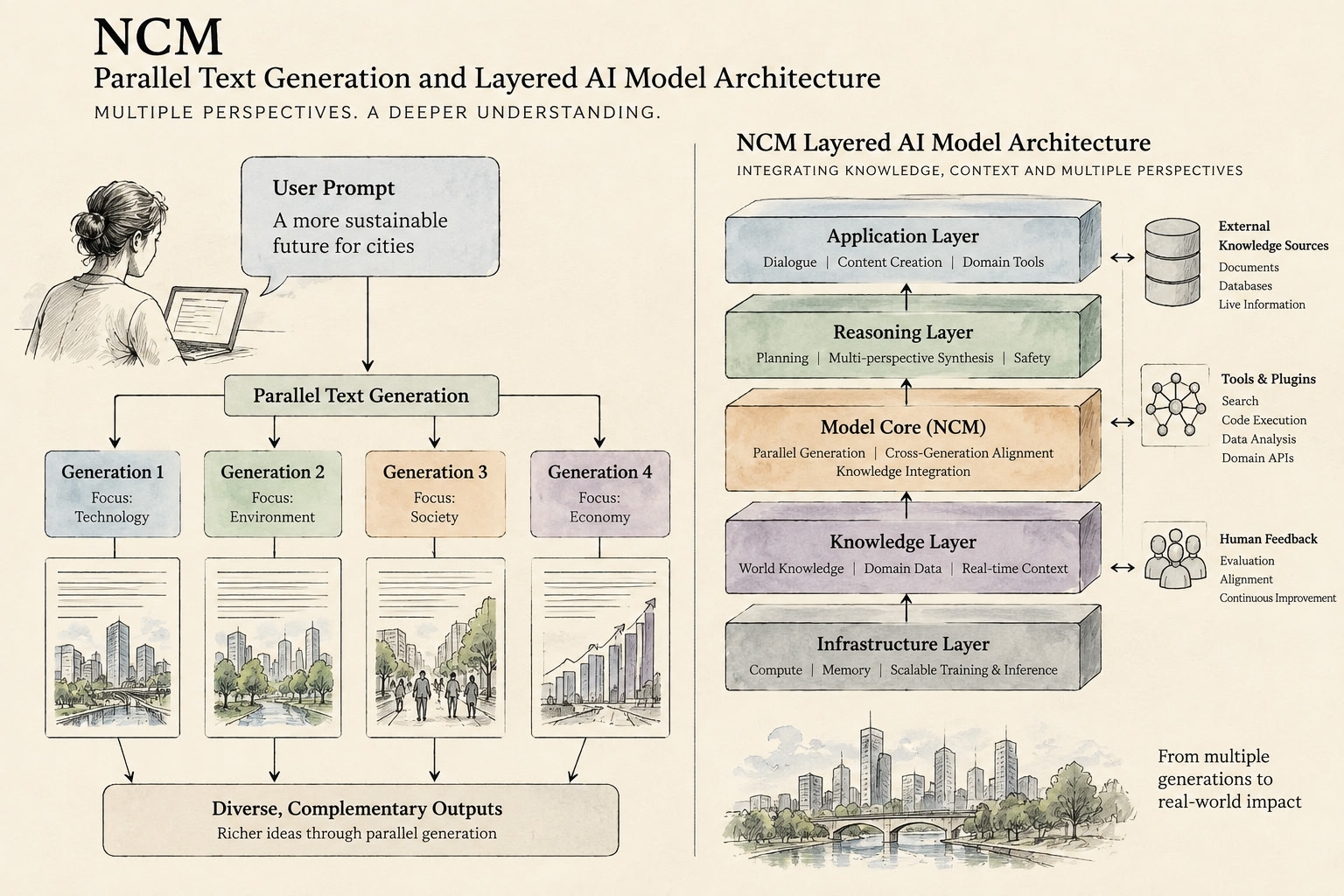
Stanford University researchers, in collaboration with Together AI, have unveiled Next Concept Modeling (NCM), a novel artificial intelligence architecture designed to dramatically accelerate and optimize text generation. Unlike traditional large language models (LLMs) that generate text one token at a time in a sequential manner, NCM produces entire outputs in parallel by building up layered internal representations from coarse to fine detail.
How NCM Works
NCM employs a two-stage process: first, it encodes text into a hierarchy of discrete codes using a multiscale residual VQ-VAE (Vector Quantized Variational Autoencoder). Then, a transformer model generates each level of this hierarchy in parallel, predicting all codes within a level simultaneously. This approach allows NCM to reduce the number of sequential steps required for text generation, resulting in significant speed improvements.
Performance and Benchmarks
According to published research and independent experiments, NCM achieves:
- Up to 31× faster text generation compared to leading diffusion language models (DLMs) on certain benchmarks (e.g., XSum summarization dataset).
- Comparable or better generative quality on tasks such as LM1B and OpenWebText, with 21× and 10× speedups, respectively.
- Superior performance on reasoning tasks like Sudoku, where a 25-million-parameter NCM model solved 86.1% of hard puzzles, vastly outperforming traditional autoregressive models.
- Substantial reductions in memory bandwidth requirements—by over 30 times in some cases—potentially enabling advanced language models to run on consumer-grade hardware.
Limitations and Industry Impact
While NCM optimizes memory bandwidth and offers faster inference, it does not reduce the large memory capacity needed to store long conversation histories (the so-called KV cache) in AI systems. Experts caution that, despite its efficiency gains, NCM is unlikely to immediately disrupt the demand for high-bandwidth memory chips, such as those produced by NVIDIA, especially in large-scale AI deployments where memory capacity remains a bottleneck.
Additionally, NCM’s layered, lossy compression approach may face challenges with structured data formats and has not yet demonstrated clear superiority over standard LLMs on general text tasks at the largest scales.
Conclusion
Next Concept Modeling represents a promising step toward more efficient and scalable AI text generation. Its parallel, coarse-to-fine architecture could enable faster and more accessible AI applications, particularly for reasoning tasks and local inference. However, further research and development are needed before NCM can challenge the dominance of current LLMs and the hardware that supports them.
Sources
Internal sources
- Is This the End of LLMs? This Stanford Paper Could Make Nvidia’s Memory Chips Unnecessary
- Is This the End of NVIDIA’s Memory Chip (NCM)
- Reproducing Next-Concept Modeling (NCM): Same Quality, 31x Faster?!