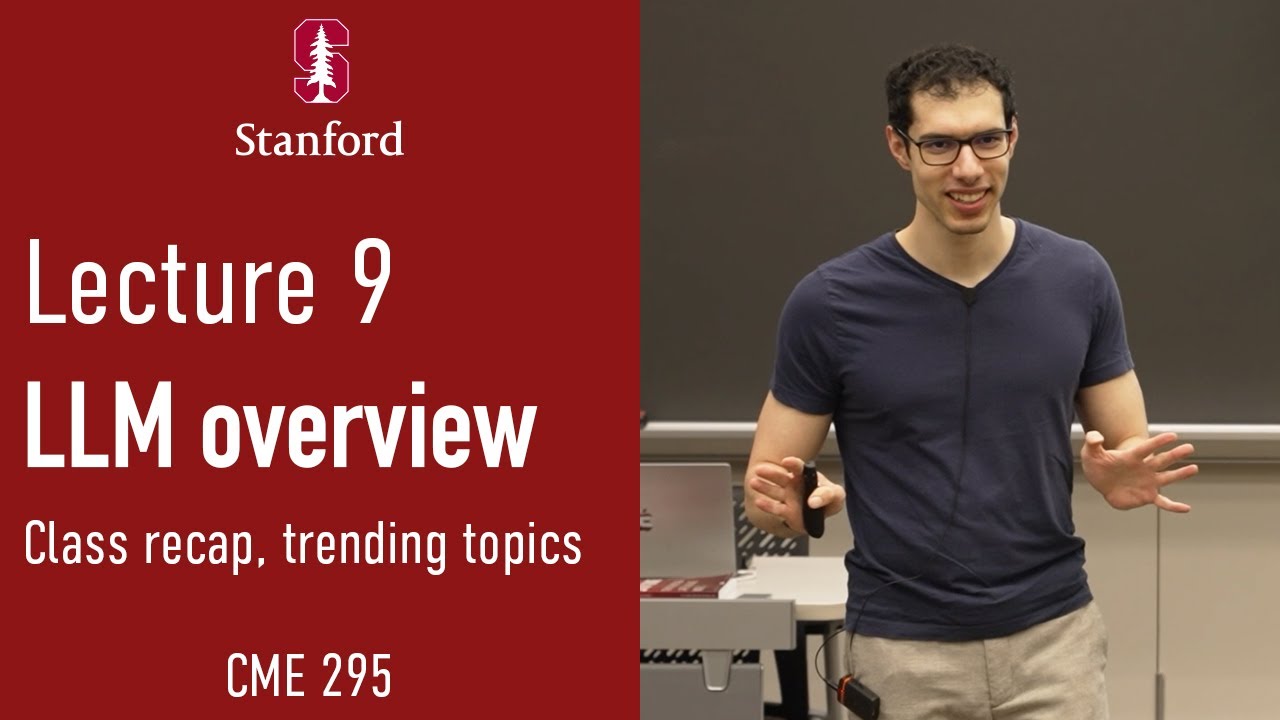
The final lecture of Stanford’s CM295 course provided a comprehensive recap of the entire quarter, tracing the evolution of transformers and large language models (LLMs) from their foundational concepts to current trends in 2025. The course began with an introduction to tokenization and embedding techniques, highlighting the limitations of early methods like Word2Vec and RNNs, and culminating in the introduction of the self-attention mechanism central to transformers. The architecture of transformers, including encoder-only models like BERT, decoder-only models like GPT, and encoder-decoder models like T5, was thoroughly discussed. The lecture also covered training strategies for LLMs, including pre-training, supervised fine-tuning, and preference tuning using reinforcement learning techniques to align models with human preferences.
The lecture then shifted focus to recent advancements and trends, emphasizing the adaptability of transformers beyond text. A notable example was the Vision Transformer (ViT), which applies transformer architecture to image classification by dividing images into patches and processing them similarly to tokens in text. This approach challenged traditional convolutional neural networks by relying less on inductive biases and more on large-scale data to learn image representations. The integration of multimodal inputs, such as combining image and text tokens for tasks like visual question answering, was also explored, showcasing the versatility of transformer-based models across different data types.
Another significant trend discussed was the emergence of diffusion-based models for text generation, inspired by their success in image generation. Unlike traditional auto-regressive LLMs that generate text token-by-token sequentially, diffusion models start with a fully masked sequence and iteratively refine it, allowing for faster and potentially more flexible generation. The lecture explained the challenges of adapting diffusion techniques to discrete text data, where masking tokens serve as the equivalent of noise in images. Although diffusion-based LLMs are still catching up to the performance of auto-regressive models, they offer promising advantages in speed and the ability to handle tasks like “fill-in-the-middle” more naturally.
The final part of the lecture addressed ongoing research and future directions in the field. It highlighted continuous innovations in transformer architecture, optimization methods, normalization techniques, and activation functions. The importance of high-quality data was underscored, especially as the prevalence of AI-generated content grows, posing challenges for training diversity and model robustness. Hardware advancements were also discussed, including novel architectures designed to optimize transformer computations beyond traditional GPUs. The lecture concluded with reflections on practical applications of LLMs today, such as coding assistants, AI-powered browsing, and creative tools, while acknowledging challenges like hallucinations, personalization, and continuous learning.
In closing, the instructors encouraged students to stay engaged with the rapidly evolving field through resources like arXiv, conference proceedings, open-source codebases, and community discussions on platforms like Twitter and YouTube. They emphasized the importance of understanding foundational concepts while remaining open to new developments across modalities and architectures. The course wrapped up with gratitude for the students’ participation and enthusiasm, wishing them success in their final exams and future endeavors in AI and machine learning.