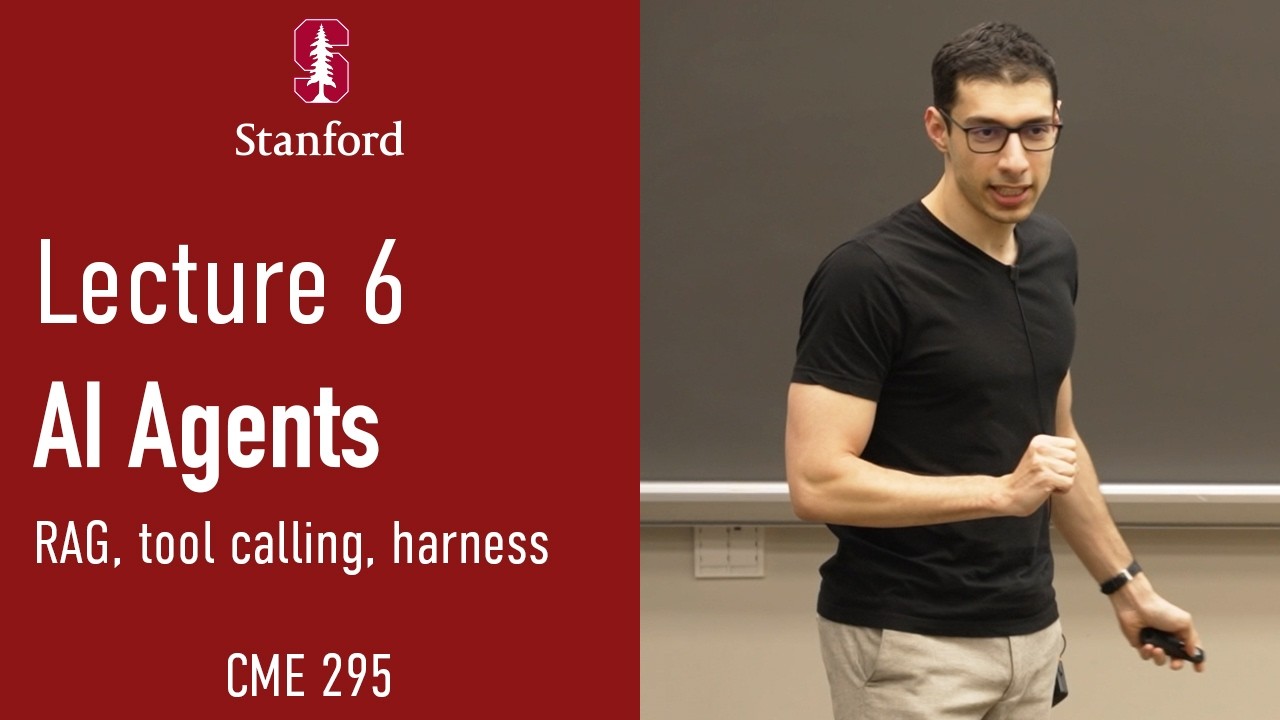
In Lecture 6 of Stanford’s CME 295 course, the focus is on AI agents, particularly their integration with large language models (LLMs) and how they overcome inherent limitations of LLMs. Initially, LLMs like ChatGPT were used primarily for generating code snippets based on prompts, but over time, coding agents evolved to handle end-to-end tasks such as writing, testing, and deploying code. A key limitation of LLMs is their static knowledge base, constrained by their training data cutoff date, and their inability to perform actions beyond generating text. To address these, Retrieval Augmented Generation (RAG) techniques are introduced, which involve retrieving relevant external documents to augment prompts, thereby enabling LLMs to access up-to-date and context-specific information efficiently.
The lecture delves into the mechanics of RAG, emphasizing the importance of an effective retrieval system. Documents are chunked into manageable pieces, each represented by embedding vectors, with hyperparameters like embedding size, chunk size, and overlap carefully chosen to optimize retrieval quality. Retrieval operates in two stages: candidate retrieval using bi-encoder models to quickly find potentially relevant chunks based on semantic similarity or keyword matching, and a more nuanced re-ranking stage using cross-encoder models that jointly encode queries and documents to capture detailed relationships. Hybrid approaches combining semantic and keyword-based retrieval are often employed to improve accuracy, especially in natural language tasks.
Moving beyond retrieval, the lecture introduces the concept of tools that enable LLMs to perform real-world actions, such as querying GPS data or executing code. Tools are implemented as functions with well-documented APIs, allowing LLMs to predict and invoke them dynamically during interactions. This three-step process—predicting the tool call, executing the action, and interpreting the output—extends LLM capabilities from passive text generation to active problem-solving. Tool selection mechanisms help manage conflicts and optimize which tools are available based on context, user profiles, and conversation history, ensuring relevant and safe tool usage while minimizing context window bloat.
The discussion then broadens to the architecture surrounding LLMs, termed the “harness,” which includes tools, memory management, compaction strategies, and prompting techniques. The REACT paradigm (Reason + Act) is highlighted as a framework where agents iteratively observe, plan, and act to achieve goals, integrating reasoning with tool usage. Memory is categorized into short-term (context window) and long-term (persistent storage), with strategies like summarization and retrieval used to manage information over time. Compaction techniques help maintain performance by summarizing or pruning conversation history, crucial for sustaining effective interactions within limited context sizes.
Finally, the lecture focuses on coding agents as a prime example of AI agents in practice. Coding agents leverage exact match retrieval methods like grep for efficient codebase searches and incorporate safety mechanisms such as auto-approval for executing actions. They utilize standardized rule sets (e.g., agents.md) to maintain consistent behavior and support reusable workflows called skills. The ecosystem includes various agents with differing harness complexities, and emerging trends involve multi-agent systems or agent swarms collaborating on complex tasks. The lecture concludes by acknowledging challenges such as tool conflicts, cost management through prompt caching, and security considerations, emphasizing the complementary roles of models and their harnesses in building robust AI agents.
Useful Links