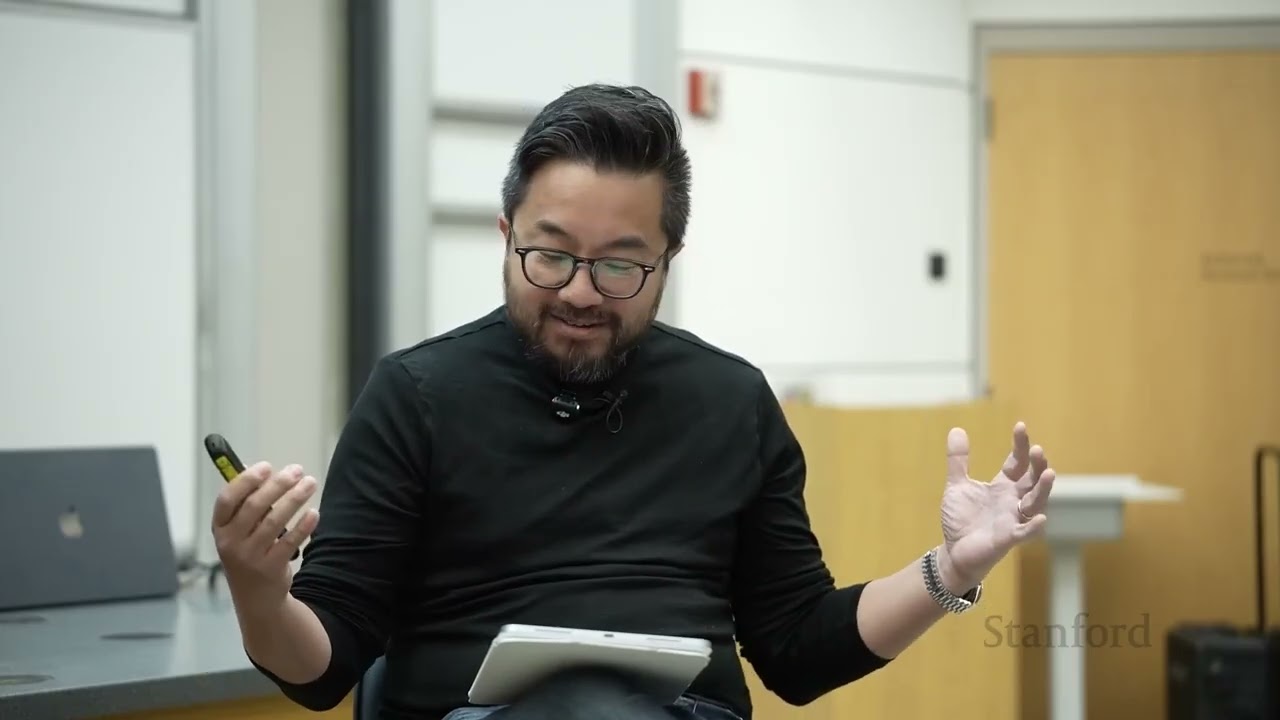
The lecture begins with an introduction to Garry Tan and Diana Hu from Y Combinator (YC), highlighting the historical context of Stanford’s CS153 class and its connection to Silicon Valley’s startup ecosystem. The speaker draws parallels between the evolution of compute infrastructure and venture capital, emphasizing how YC’s introduction of the SAFE (Simple Agreement for Future Equity) standardized early-stage startup funding, much like how electricity standards enabled widespread industrial progress. This sets the stage for understanding how systems design principles apply beyond engineering to accelerate innovation and unblock bottlenecks in capital deployment and technology.
Garry Tan shares his personal journey from a Stanford student to a YC founder and now a pioneer in AI-native software development. He discusses the transformative impact of AI coding agents, such as Claude code and Gstack, which have exponentially increased engineering productivity—sometimes by factors of 10x to 1000x. Garry explains how these tools enable rapid software creation with high test coverage, reducing errors and improving reliability. He introduces concepts like “skills,” “resolvers,” and “skillify,” which are methods to modularize and automate complex workflows using AI agents, blending deterministic code with latent space reasoning to build scalable, agentic systems.
The discussion then shifts to the architecture of AI-native companies, where Diana Hu explains the transition from traditional open-loop organizational structures to closed-loop systems powered by AI agents. These agents integrate deeply with company data and workflows, enabling real-time feedback and decision-making that dramatically increase efficiency and reduce the need for middle management. Roles in such companies evolve into builders (individual contributors), DRIs (Directly Responsible Individuals), and AI founders who continuously adopt cutting-edge AI tools to maintain competitive advantage. The emphasis is on embedding AI agents into every aspect of operations to create self-healing, adaptive organizations.
A critical theme is the importance of human judgment or “taste” in AI-native companies. While AI can automate coding and many processes at near-zero marginal cost, discerning quality, user trust, and domain-specific nuances remains a uniquely human responsibility. Founders and teams must develop custom evaluation systems (“evals”) to monitor AI outputs, detect failures, and iteratively improve their agents. This human-in-the-loop approach ensures that AI systems align with business goals, comply with regulations, and deliver real value to customers, highlighting that successful AI integration requires both technological and human expertise.
The lecture concludes with an optimistic outlook on the unprecedented opportunities for founders today. The rapid growth of AI capabilities enables small teams or even individuals to build companies that scale to millions in revenue within months, disrupting traditional industries by automating complex, previously manual workflows. Examples from YC portfolio companies illustrate this trend across sectors like finance, logistics, and document processing. The speakers encourage students to engage hands-on with AI tools, experiment with building agentic systems, and embrace the frontier of AI-native entrepreneurship, positioning them as the next generation of innovators shaping the cognitive layer of society.