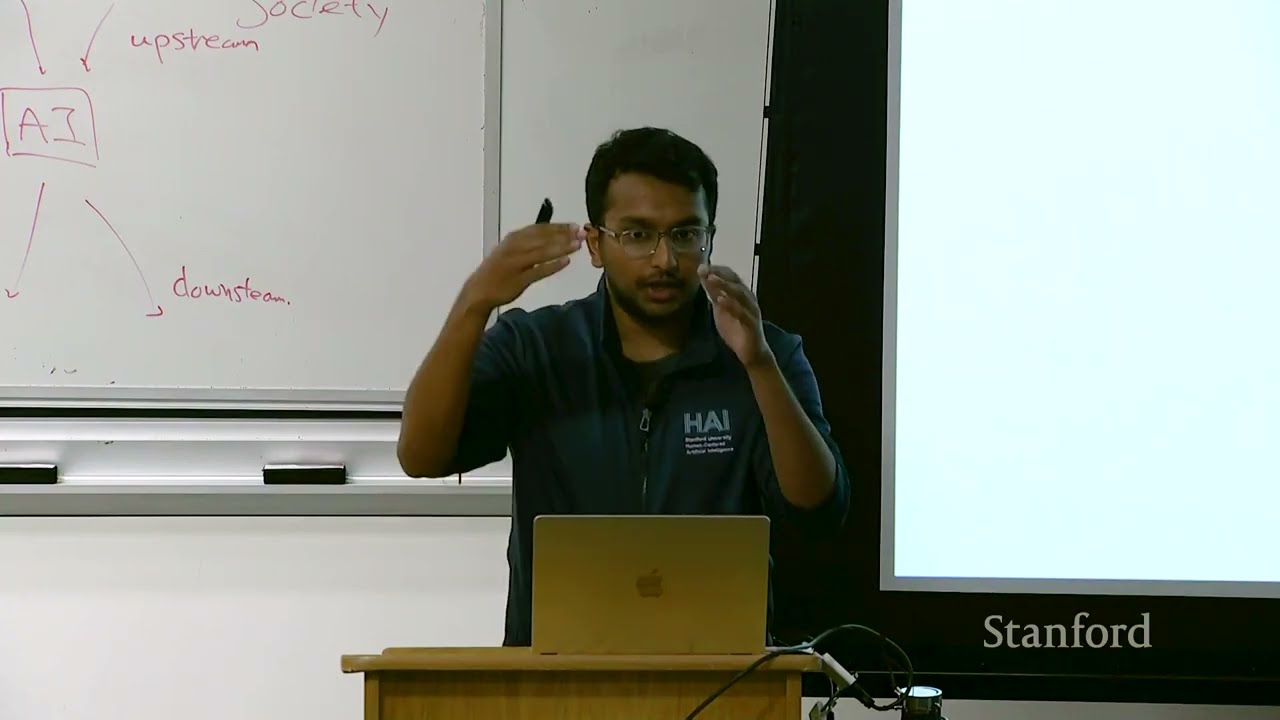
This lecture from Stanford’s CS221 course focuses on the societal and economic impacts of AI, moving beyond the technical aspects to consider the broader ecosystem in which AI operates. The instructor, joined by guest speaker Rishi Bommasani, emphasizes the importance for technologists to understand not just how AI systems are built, but also how they interact with society and the economy. The discussion begins by highlighting the significant role AI companies now play in the global economy, with the top AI firms making up a substantial portion of the S&P 500. The lecture also introduces key questions about how AI affects both the macroeconomic landscape and individual workers, such as changes in hiring patterns and the impact of AI tools on different demographic groups within the workforce.
A central theme is the concept of AI supply chains, which are described as complex networks involving both technological resources (like data and compute) and organizational actors (companies and institutions). The lecture breaks down the supply chain into three main regions: compute, data, and distribution. On the compute side, the supply chain is dominated by a few critical companies—ASML (lithography), TSMC (chip manufacturing), and Nvidia (chip design)—each holding near-monopolistic positions in their respective domains. This concentration creates bottlenecks and geopolitical implications, especially given the strategic importance of semiconductors in global technology competition.
The data supply chain is characterized as more heterogeneous and less concentrated than compute. Data used for training AI models comes from various sources: internally generated synthetic data, user data from existing products, publicly available datasets, and data acquired through licensing or annotation services. The lecture discusses the evolving landscape of data acquisition, including increasing restrictions on web crawling and the legal complexities around copyright and privacy. The cost and accessibility of different types of data, as well as legal compliance, are highlighted as key factors shaping the future of AI development and competition.
Distribution of AI models is presented as a spectrum ranging from fully closed (models not released externally) to fully open (model weights and code released). The choice of distribution strategy affects downstream innovation, pricing, privacy, and the range of possible applications. Closed models allow for greater vertical integration and control, while open models foster competition and broader adoption. The lecture notes that these strategic choices by AI companies have significant implications for how AI technologies diffuse through the economy and who benefits from them.
In the latter part of the lecture, the focus shifts to the long-term economic impact of AI, particularly through the lens of general purpose technologies (GPTs). AI is argued to meet the criteria for a GPT: it is pervasive across sectors, improves rapidly, and enables complementary innovations. The discussion covers different economic forecasts, from modest to transformative, and explores how AI might affect GDP growth. Three scenarios are considered: AI primarily boosting productivity in specific sectors, AI acting as a new form of labor, and AI accelerating the generation of new ideas. The lecture concludes by noting the limitations of traditional economic metrics like GDP in capturing the true value of AI, suggesting the need for new measurement tools, and acknowledging the uncertainties and open questions about AI’s ultimate impact on society and the economy.