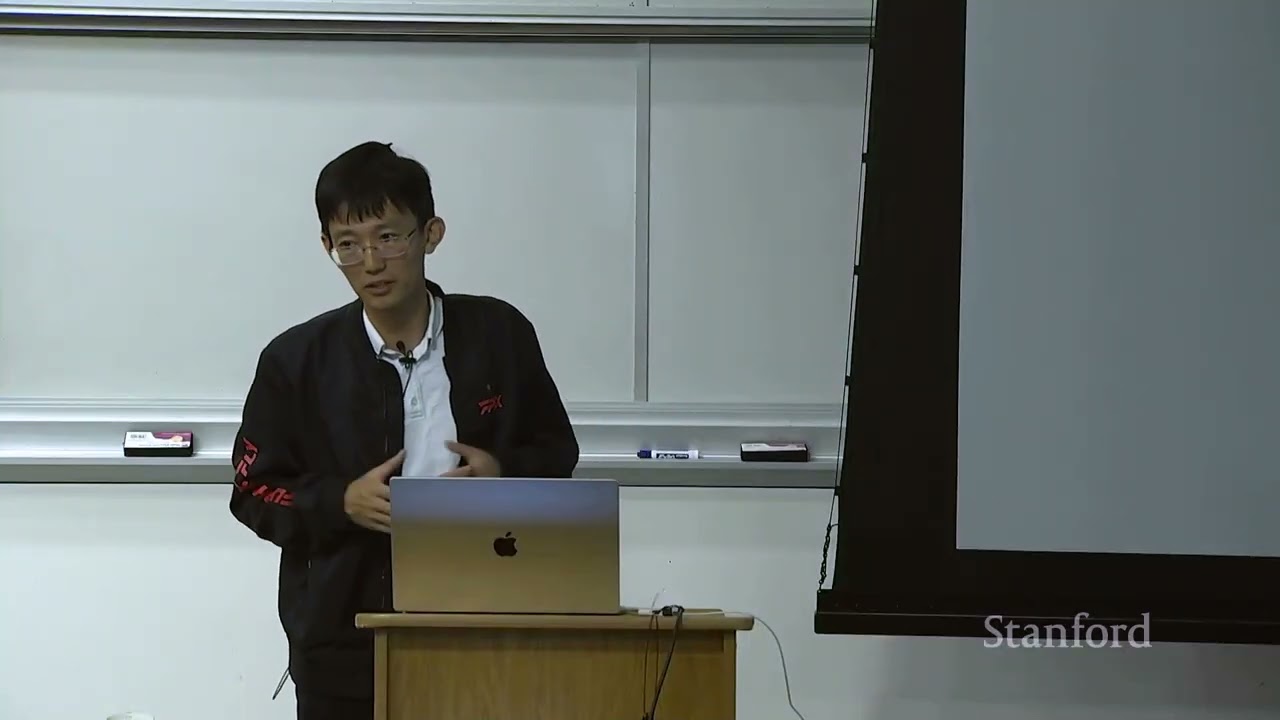
The first lecture of Stanford’s CS229 Machine Learning course offers a relaxed introduction to the course structure, teaching staff, and foundational concepts in machine learning. The instructor emphasizes the mathematical intensity of the course, focusing on understanding the underlying algorithms and models rather than programming. Prerequisites include knowledge of probability and linear algebra, with supplementary Friday TA lectures available for students needing background reinforcement. The course maintains a traditional approach to machine learning, concentrating on core methodologies that remain relevant despite rapid advancements in AI.
The lecture covers the broad definitions and taxonomy of machine learning, referencing classic definitions from 1959 and 1998 that highlight key components: experience (data), tasks, and performance measures. It categorizes machine learning into supervised learning, unsupervised learning, and reinforcement learning, noting the intersections and evolving nature of these paradigms. Supervised learning is illustrated through examples like house price prediction and image classification, explaining concepts such as inputs (features), outputs (labels), regression, and classification. The importance of high-dimensional data and the role of deep learning in enabling complex models are also introduced.
Unsupervised learning is described as learning from data without explicit labels, aiming to discover patterns or structures such as clusters within the data. Examples include gene expression analysis and document clustering, with techniques like Latent Semantic Analysis (LSA) used to find relationships between words and documents. The lecture also touches on word embeddings, which represent words as high-dimensional vectors capturing semantic relationships. These foundational unsupervised methods set the stage for understanding more advanced models like large language models, which are trained on massive unlabeled datasets to perform a wide range of tasks.
Reinforcement learning (RL) is presented as a framework for sequential decision-making, where an agent learns by interacting with an environment and receiving feedback. Traditional RL applications include robotics and game playing, while modern uses involve training large language models through techniques like policy gradients and reinforcement learning with human feedback (RLHF). The instructor explains how RL differs from supervised and unsupervised learning by allowing models to collect and learn from new data interactively, enabling continuous improvement through trial and error.
Finally, the lecture outlines the course syllabus and additional topics such as machine learning systems, which focus on optimizing software and hardware for efficiency—a critical factor given the high computational costs of training large models. The course also plans to address the social impact and fairness of AI, recognizing the importance of ethical considerations as AI technologies increasingly influence society and the job market. Overall, the lecture sets a comprehensive foundation for exploring both theoretical and practical aspects of machine learning throughout the course.