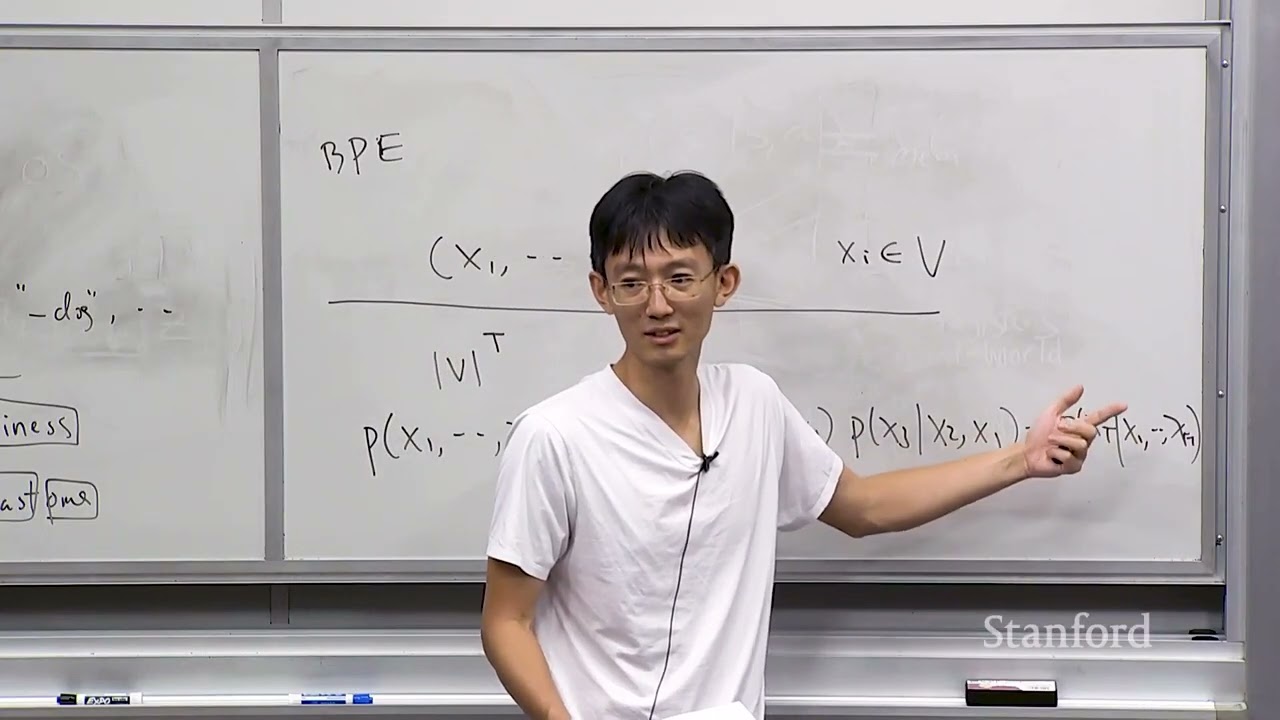
The lecture begins with an introduction to large language models (LLMs), focusing primarily on autoregressive models like GPT-3. Autoregressive models generate tokens sequentially, where each token depends on the previous ones, modeling the probability distribution of language in a chain-like manner. The first key concept discussed is tokenization, which converts text into numerical tokens that the model can process. Instead of using characters or whole words, subword tokenization is preferred because it balances granularity and efficiency, allowing the model to understand rare or complex words by breaking them into meaningful sub-components. The vocabulary size typically ranges in the hundreds of thousands, and tokenization algorithms like Byte Pair Encoding (BPE) are used to build this vocabulary based on frequent subword patterns.
Next, the lecture explains how the probabilistic model of language sequences is constructed. Since the number of possible token sequences is astronomically large, the joint probability distribution is decomposed into a product of conditional probabilities using the chain rule. Each conditional probability models the likelihood of a token given all previous tokens, which is parameterized by a neural network—in this case, a transformer. Tokens are first converted into embeddings, which are trainable vector representations, and then passed through the transformer to produce logits. These logits are converted into probabilities via a softmax function, enabling the model to predict the next token in the sequence. The lecture also covers generation techniques, including the use of temperature to control randomness and top-k sampling to limit token choices for efficiency and diversity.
The core of the lecture focuses on the transformer architecture, particularly the attention mechanism. Attention allows the model to weigh the importance of different tokens in the input sequence when generating each output token. This is done by computing queries, keys, and values from the input embeddings through learned linear projections. The attention scores are calculated as scaled dot products between queries and keys, followed by a softmax to produce a probability distribution over tokens to attend to. The output for each position is a weighted sum of the value vectors, where weights correspond to attention scores. To maintain the autoregressive property, masking is applied to prevent tokens from attending to future tokens, ensuring that predictions depend only on past and present context.
The lecture further elaborates on multi-head attention, where multiple attention mechanisms run in parallel with different learned parameters. Their outputs are concatenated and linearly transformed to enrich the model’s capacity to capture diverse relationships in the data. This is combined with feed-forward neural networks (MLPs) and residual connections, along with normalization layers, to form the transformer layers. The design balances flexibility and structure, enabling the model to learn complex dependencies efficiently. The importance of this architecture is highlighted by contrasting it with simpler models like standalone MLPs, which lack the ability to model interactions across sequence positions effectively.
Finally, the lecture touches on computational considerations, emphasizing that the attention mechanism’s complexity scales quadratically with the sequence length, which can be prohibitive for very long sequences. Techniques like masking and flash attention help manage memory and computation, but there is an inherent trade-off between efficiency and model expressiveness. The lecture hints at ongoing research and upcoming discussions on methods to reduce this quadratic dependency, such as alternative transformer variants, which aim to maintain performance while improving scalability. Overall, the lecture provides a comprehensive overview of how transformers model language sequences, the role of attention, and practical aspects of training and generation.