The lecture concludes with an in-depth exploration of policy gradient methods and introduces Proximal Policy Optimization (PPO) as a stable and efficient algorithm widely used in training large language models. It emphasizes the application of reinforcement learning techniques, including PPO, to enhance models’ long chain-of-thought reasoning abilities through strategies like “thinking tokens” for maintaining coherence in multi-step inference tasks.
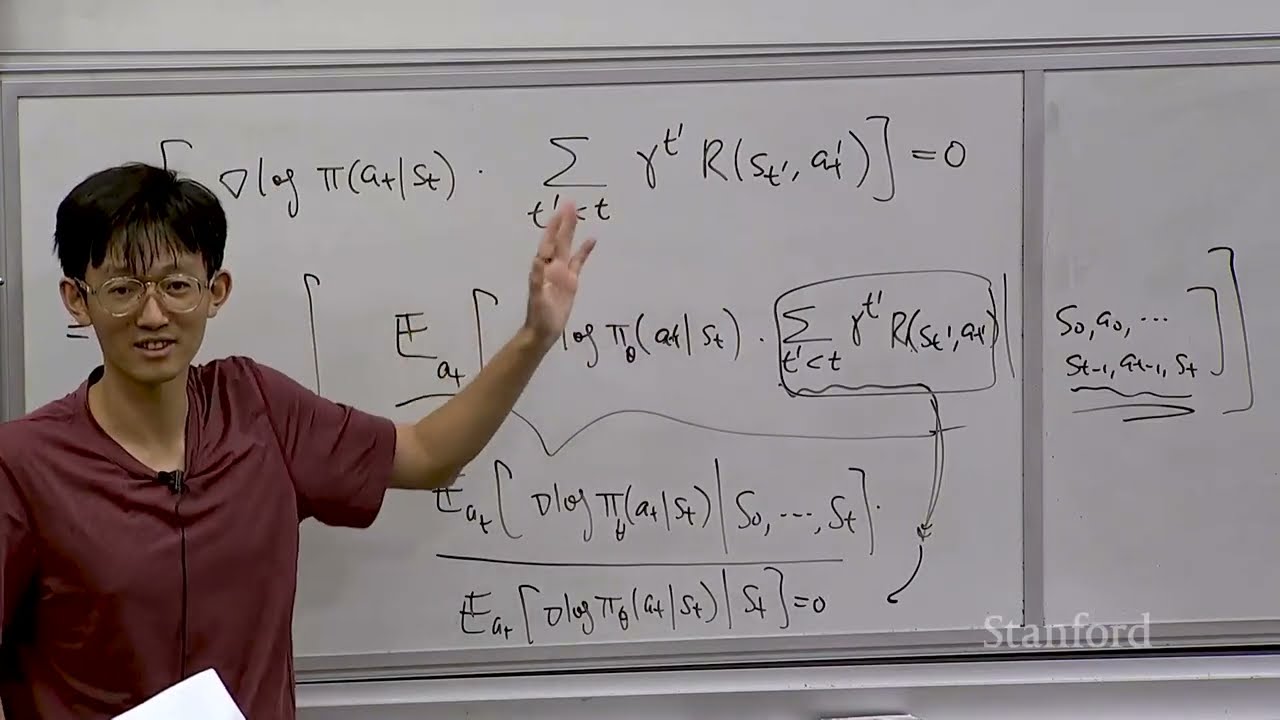
In the final lecture of the quarter, the focus is on reinforcement learning, specifically continuing the discussion on policy gradient methods. The lecture aims to wrap up the foundational concepts behind policy gradients, which are essential for optimizing policies in reinforcement learning tasks. This sets the stage for introducing more advanced algorithms that build upon these principles.
Following this, the lecture introduces Proximal Policy Optimization (PPO), an extension of the policy gradient method. PPO is highlighted as one of the most popular and effective algorithms currently used, particularly in training large language models. Its significance lies in its ability to provide stable and efficient policy updates, making it a preferred choice in practical applications involving complex models.
The discussion then shifts towards the application of reinforcement learning techniques, including PPO, in training large language models. The focus is on how these methods can be leveraged to enhance the models’ reasoning capabilities, especially for tasks that require long chain-of-thought processing. This involves training models to handle extended sequences of reasoning steps, which is crucial for tasks demanding deep understanding and multi-step inference.
An important aspect covered is the challenge of training models to perform long reasoning chains with “thinking tokens,” which represent intermediate steps in the reasoning process. The lecture explores strategies to ensure that models can maintain coherence and accuracy over these extended reasoning trajectories, which is vital for verifiable and reliable AI outputs.
Overall, the lecture provides a comprehensive overview of advanced reinforcement learning methods, emphasizing their role in improving large language models’ reasoning abilities. By connecting theoretical foundations with practical algorithms like PPO, the session offers valuable insights into the future directions of AI training methodologies, particularly in the context of complex, multi-step reasoning tasks.