In this lecture, the focus is on backpropagation, the fundamental algorithm used to compute gradients of loss functions with respect to parameters in neural networks. The instructor begins by reviewing the concept of loss functions and stochastic gradient descent (SGD), emphasizing the importance of efficiently computing gradients in complex multi-layer networks. Backpropagation, also known as automatic differentiation, is introduced as a key technique that automates gradient computation, making it essential for training deep learning models. Understanding backpropagation is crucial because it underpins many decisions in model design and optimization, even though modern frameworks handle the computations automatically.
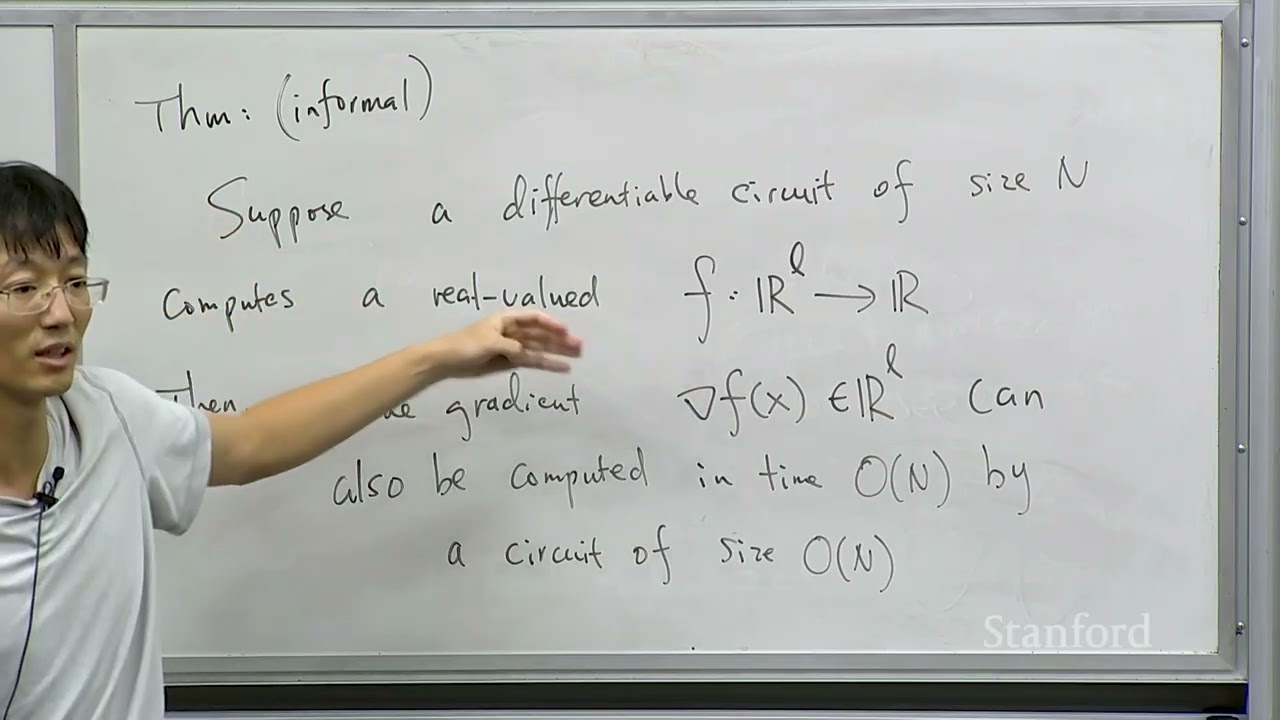
The lecture then presents a general theoretical framework for gradient computation using differentiable circuits or computational graphs. These circuits represent functions as compositions of elementary operations like addition, multiplication, and activation functions. A key theorem states that if a function can be computed by a circuit of size n, then its gradient can also be computed in O(n) time, meaning the backward pass (gradient computation) is roughly as efficient as the forward pass (function evaluation). This result applies broadly to neural networks, where the number of operations is typically proportional to the number of parameters, ensuring efficient gradient computation.
Next, the instructor discusses advanced applications of this framework, including second-order methods and meta-learning. For example, gradients can be computed through multiple steps of gradient descent or through entire optimization algorithms, enabling techniques like learning rate tuning via backpropagation through the training process. The lecture also explains how Hessian-vector products, important in second-order optimization, can be computed efficiently without explicitly forming the Hessian matrix, leveraging the differentiable circuit structure.
The core mechanism of backpropagation is then explained through the chain rule of calculus. The instructor illustrates how gradients propagate backward through a sequence of functions by iteratively applying the chain rule, using intermediate variables and Jacobian matrices. This backward computation depends only on local information from each function and the gradient from the subsequent layer, allowing efficient and modular implementation. The concept of forward and backward functions is introduced, where each module in a network implements a forward computation and a corresponding backward function to propagate gradients.
Finally, the lecture delves into concrete examples of backward functions for common neural network operations such as matrix multiplication and activation functions. For matrix multiplication, the gradient with respect to inputs and parameters is derived using the chain rule, showing that the backward pass involves multiplying by the transpose of the weight matrix and computing outer products for parameter gradients. For activation functions, the backward pass involves element-wise multiplication with the derivative of the activation function. The instructor confirms that these backward computations are efficient and comparable in complexity to the forward pass, reinforcing the practicality of backpropagation in training deep networks.