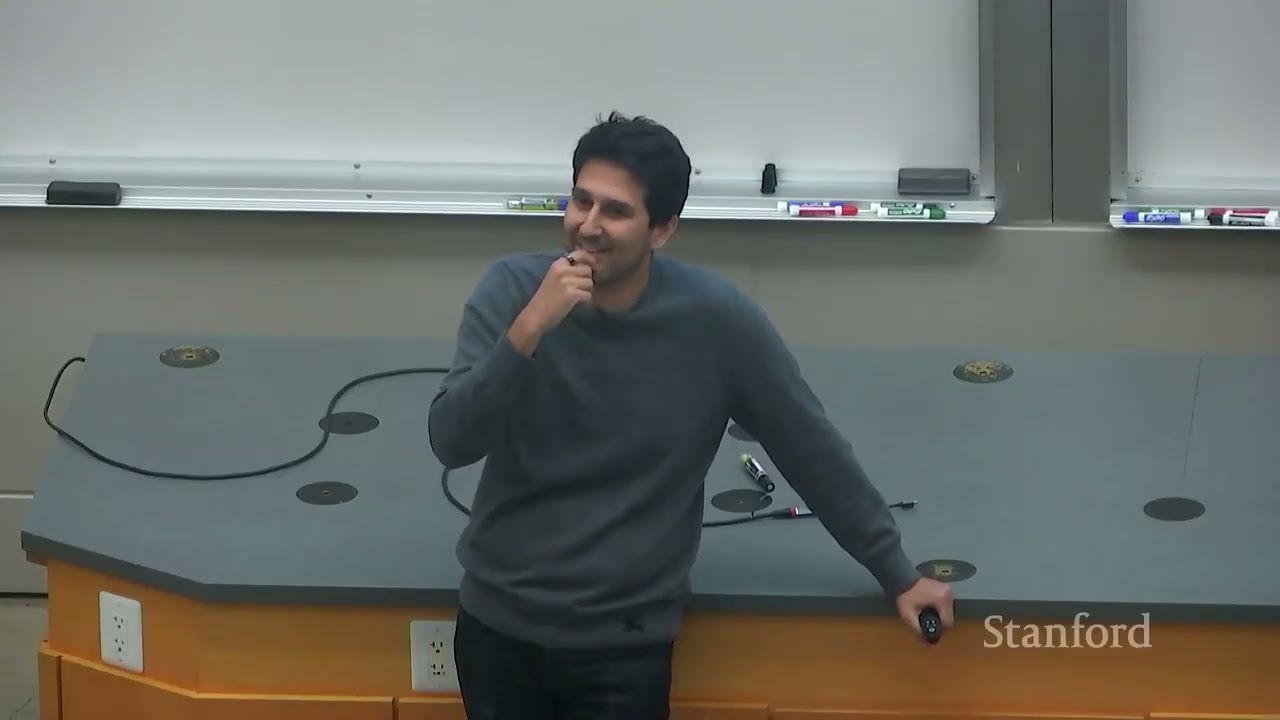
In this lecture from Stanford’s CS230 course on deep learning, the focus is on advancing large language model (LLM) applications beyond basic usage, exploring practical techniques to enhance their performance in real-world settings. The instructor begins by discussing the limitations of vanilla pre-trained LLMs, such as lack of domain-specific knowledge, outdated information, difficulty controlling outputs, limited context windows, and challenges with sourcing and hallucinations. These issues highlight the need for augmenting LLMs through methods like prompt engineering, fine-tuning, retrieval-augmented generation (RAG), and agentic AI workflows to build more specialized, accurate, and controllable AI systems.
Prompt engineering is emphasized as a critical first step in optimizing LLM performance without modifying the underlying model. Techniques such as zero-shot and few-shot prompting, chain-of-thought reasoning, and prompt chaining are explored to improve task decomposition, control, and debugging. The lecture also covers the importance of prompt templates for personalization and scalability, and the use of LLM-based evaluation methods (LLM judges) to automate quality assessment. While fine-tuning can be useful for domain-specific tasks requiring high precision, it is generally discouraged due to its cost, complexity, and risk of overfitting.
Retrieval-augmented generation (RAG) is introduced as a powerful approach to overcome LLM limitations by integrating external knowledge sources through embeddings and vector databases. This method enables LLMs to access up-to-date, grounded information and provide sourced answers, which is crucial in fields like medicine and law. The lecture discusses various RAG enhancements, such as chunking large documents and hypothetical document embeddings, and debates the long-term viability of RAG given evolving compute capabilities. RAG represents a key technique for building more reliable and context-aware AI applications.
The concept of agentic AI workflows is presented as a way to extend LLM capabilities from single-step tasks to multi-step autonomous processes involving memory, tools, APIs, and dynamic user interaction. The instructor contrasts traditional deterministic software engineering with the fuzzy, probabilistic nature of AI-driven workflows, emphasizing the need for specialized engineering approaches and human-in-the-loop systems to manage uncertainty and maintain control. Examples include enterprise credit memo generation and travel booking agents, illustrating how agents can plan, execute, and learn from interactions while balancing autonomy and control.
Finally, the lecture explores multi-agent systems, where multiple specialized agents operate in parallel or hierarchically to handle complex tasks more efficiently and enable reuse across domains. A smart home automation example demonstrates how agents for security, climate control, energy management, and more can be orchestrated to provide seamless user experiences. The instructor concludes by discussing future AI trends, including potential plateaus in LLM scaling, the promise of multimodal models, the integration of diverse learning methods, and ongoing research into human-centric and non-human-centric AI architectures. The rapid pace of AI development underscores the importance of a broad foundational understanding combined with the agility to learn new techniques as they emerge.