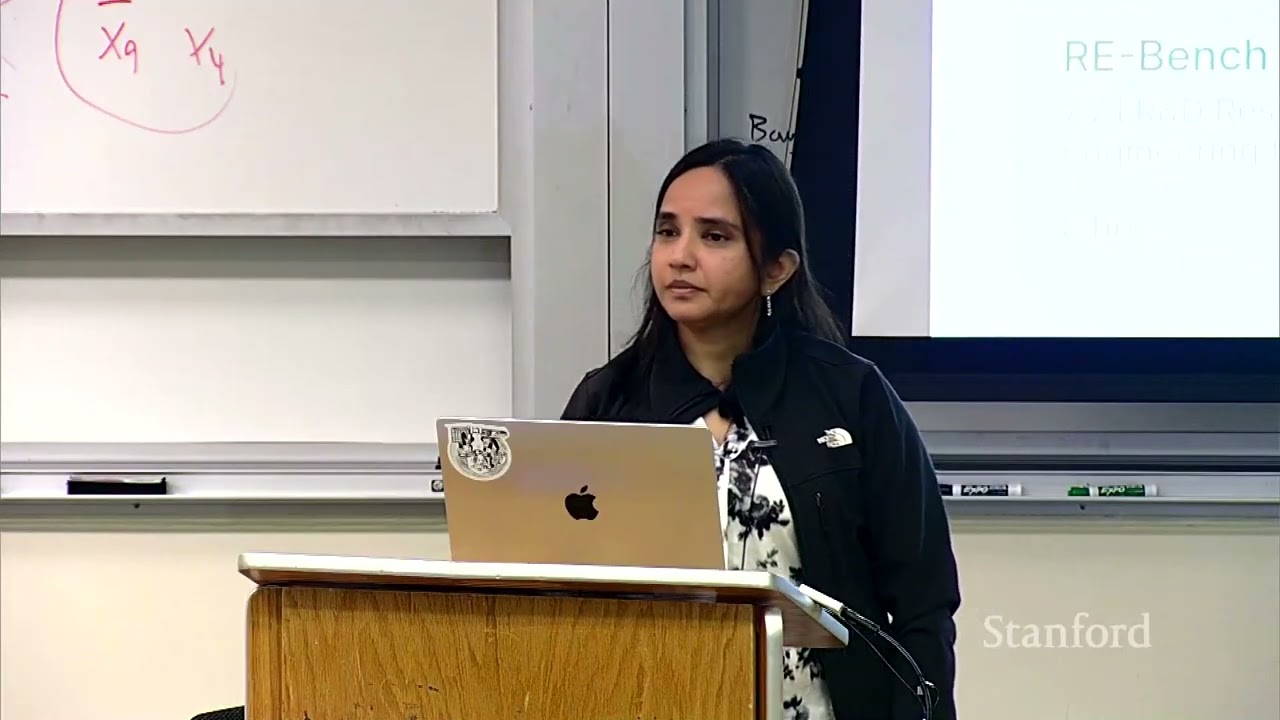
The lecture focuses on agentic evaluations and long horizon tasks in AI, exploring how models are assessed based on their ability to complete complex, extended tasks and their economic value in real-world applications. The discussion begins with the METR benchmark, which measures the duration and reliability of tasks that AI models can complete, calibrated against human professional performance. Tasks range from atomic actions taking seconds to research engineering tasks lasting hours. The findings show a significant improvement over time, with models like GPT-2 handling very short tasks, while newer models such as Claude 3.7 can tackle tasks lasting nearly an hour, albeit with only about 50% success reliability. Key drivers of this progress include enhanced reasoning, code generation, tool usage, and error recovery capabilities.
The lecture then transitions to GDPVal, a benchmark evaluating AI performance on economically valuable, real-world tasks across diverse professions such as healthcare, finance, manufacturing, and customer service. This benchmark compares AI outputs directly against industry experts with over a decade of experience, focusing on the win rate of AI models. Results indicate that while AI models are improving, their progress is more linear compared to the exponential gains seen in METR. Models perform well on shorter, well-specified tasks like document formatting and customer service but struggle with longer, more complex tasks requiring deep contextual understanding. Failure modes often involve instruction-following errors, hallucinations, and inadequate use of reference data.
A significant challenge highlighted is the AI’s ability to handle tasks requiring extensive context and reference to external knowledge bases. The DeepScholar-Bench benchmark addresses this by evaluating AI’s capacity for deep research synthesis, specifically generating related work sections for academic papers using recent, domain-specific literature. Despite advances, current models achieve low scores in knowledge synthesis, retrieval quality, and verifiability, often missing key facts or foundational papers and struggling to back claims with accurate citations. This underscores the difficulty AI faces in comprehensive information gathering and maintaining high-quality, verifiable outputs in complex research tasks.
Across these benchmarks, the lecture emphasizes that while AI models have made substantial strides in isolated, well-defined tasks—particularly in software engineering and machine learning research—they still face significant limitations. These include low performance on tasks requiring broad context, ambiguity resolution, and high reliability (e.g., 95% success rates). Moreover, real-world tasks often demand human-like contextual understanding and decision-making about priorities, which current models lack. The benchmarks also reveal that AI’s economic impact varies by profession and task type, with some sectors nearing parity with human experts and others lagging considerably.
In conclusion, the lecture synthesizes insights from the three benchmarks to highlight the current state and future challenges of agentic AI evaluations. METR shows rapid, exponential improvements in task duration capabilities but with moderate reliability. GDPVal presents a more conservative, linear improvement in AI’s ability to match expert-level economic tasks. DeepScholar-Bench reveals critical gaps in knowledge retrieval and synthesis for research-intensive tasks. Overall, the progress in AI is promising but uneven, with substantial headroom for enhancing reliability, context handling, and verifiability, especially for long-horizon, economically valuable, and knowledge-intensive tasks.