The lecture explores the emerging field of physical AI, focusing on world models—generative AI systems that simulate realistic video environments conditioned on actions. Unlike traditional simulators that rely on explicit 3D state representations and physics engines, world models learn from vast amounts of data to generate photorealistic visuals and plausible dynamics in real time. Examples include Google DeepMind’s Genie3 and applications in automotive companies like Tesla, which use these models for data augmentation by generating rare events to improve policy robustness. The talk emphasizes the transition from traditional simulators to learned models, highlighting their complementary strengths and limitations, such as the sim-to-real gap and challenges in interpretability and real-time performance.
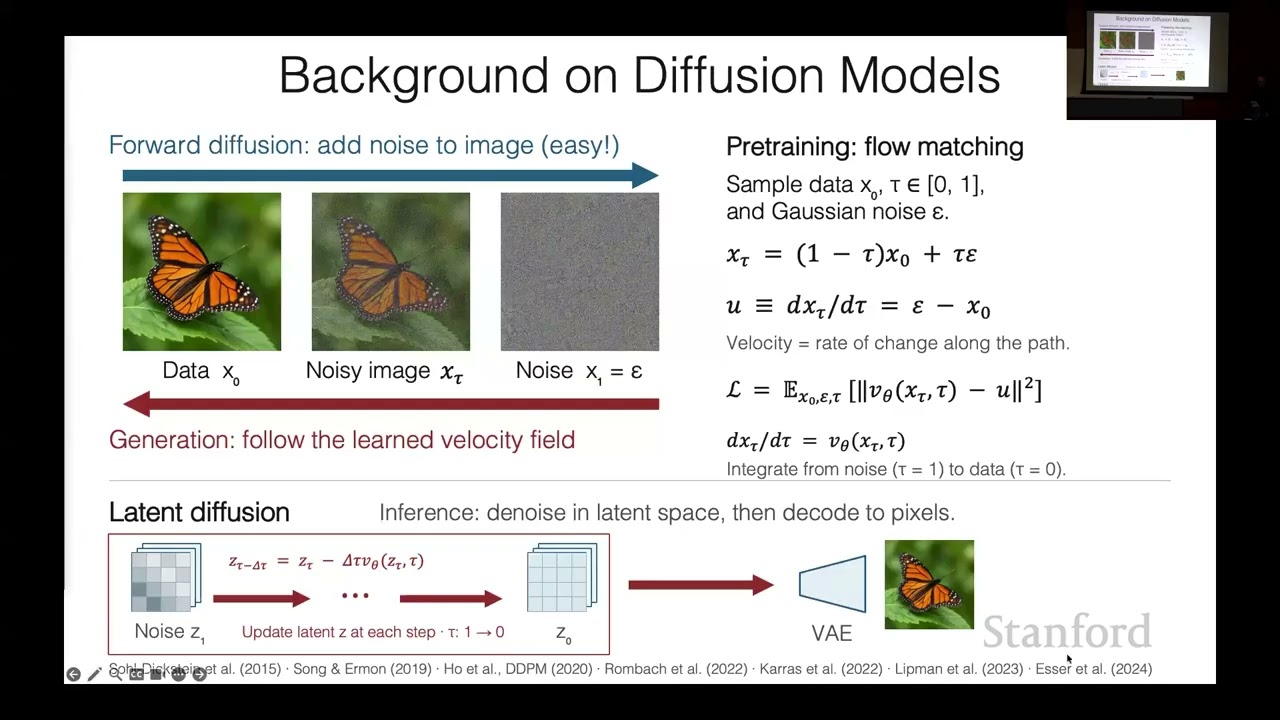
A significant portion of the discussion centers on diffusion models, the generative backbone of many world models. These models generate new images or videos by learning to reverse a noise process, transforming random Gaussian noise into coherent data samples through iterative denoising steps. Training such models requires massive datasets—billions of images or videos—and sophisticated architectures like transformers, which enable conditional generation based on text prompts or previous frames for video consistency. The speaker also explains the challenges of scaling these models to handle long temporal contexts, which is crucial for maintaining coherence over extended sequences but computationally expensive due to the quadratic complexity of transformers.
To address the long context problem, the lecture presents innovative approaches inspired by human memory systems, such as frame packing, which compresses past frames spatially and temporally to extend context length efficiently. Another approach involves building explicit spatial memory through 3D point clouds that capture the environment’s geometry, enabling consistent scene representation over time. These methods help mitigate issues like drift and exposure bias, where errors accumulate during autoregressive generation. The talk also covers multi-agent scenarios, demonstrating how shared maps can maintain global consistency in multiplayer video world models, allowing multiple players or agents to interact within a coherent generated environment.
Controllability is another key theme, with the speaker highlighting techniques for conditioning world models on various control signals, including camera pose, hand tracking for VR interactions, and independent control over space and time (e.g., bullet time effects). These control mechanisms enhance the usability of generated worlds for applications ranging from gaming to virtual reality. The lecture also addresses the problem of drift in autoregressive video generation and introduces a novel training method called backwards aggregation (BAGGER), which helps models self-correct by training on degraded versions of their own outputs played in reverse, improving both visual fidelity and motion realism.
Finally, the talk connects world models to robotics, discussing how video-based world models can serve as simulators for training robot policies, potentially overcoming the sim-to-real gap by leveraging large-scale unlabeled video data. Instead of relying solely on limited labeled datasets, the approach involves learning to generate future observations and then inferring actions through inverse dynamics models, enabling data-efficient policy training. The speaker showcases industrial applications such as robotic manipulation tasks in logistics and agriculture, emphasizing ongoing challenges like scaling context length, integrating vision-language models, improving efficiency, and ensuring safety. The lecture concludes with reflections on open problems and the importance of grounding generative models in real-world observations to mitigate hallucination and maintain reliability in physical AI systems.
Useful Links