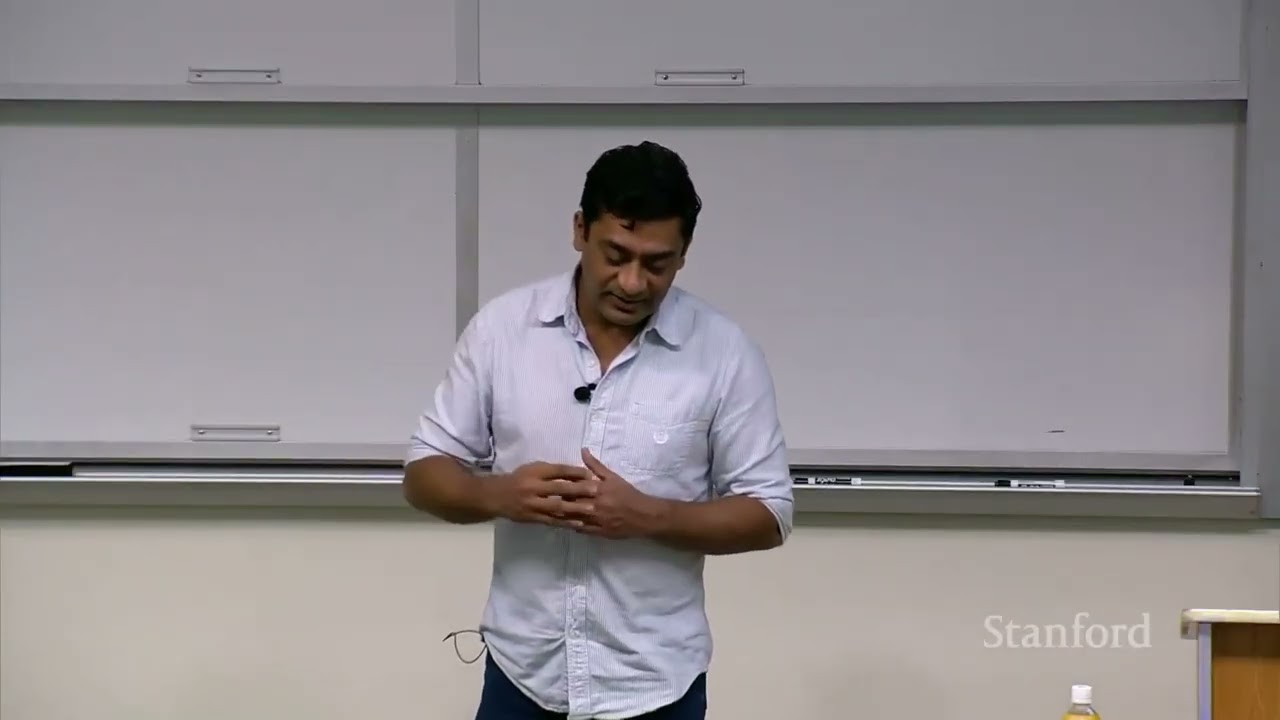
The speaker begins by introducing their background, highlighting a career that spans both academic research and entrepreneurship, including founding companies like Catapult, which went public. The focus of the talk is on integrating AI with robotics to create practical, real-world applications, particularly in enterprise settings such as agriculture, construction, and distribution. The speaker emphasizes the importance of physical intelligence—understanding and incorporating physics—into AI models for robotics, contrasting this with traditional digital AI that relies heavily on vast amounts of human data. They argue that while digital AI has benefited from decades of accumulated data, physical AI requires a fundamentally different approach due to the complexities of the physical world.
The talk then delves into the evolution of AI in robotics, starting from early models like Markov random fields and conditional random fields used to interpret images, to the rise of convolutional neural networks (CNNs) that revolutionized perception tasks. The speaker shares examples from their own work, such as using radar sensors to monitor respiration and pulse rates, demonstrating how AI can be applied in healthcare. However, a significant challenge remains: the scarcity of data in physical environments compared to digital domains. Collecting sufficient data for training physical AI models is costly and often impractical, especially for diverse and unpredictable real-world scenarios like agriculture or underwater robotics.
To address these challenges, the speaker introduces the concept of embedding physics directly into AI models through graph-based representations of kinematics and dynamics. By structuring models around the physical relationships and constraints of robots and their environments, they can achieve better generalization and cross-embodiment transfer—allowing a model trained on one robot or task to adapt to others with fewer examples. This approach integrates hard physics, such as kinematics, with learned soft physics like contact dynamics, all within a large model architecture optimized for real-time performance on GPUs. The speaker illustrates this with examples of robots manipulating boxes, cutting food items, and performing complex tasks like ice cream making, highlighting the efficiency gains from combining physics with data-driven learning.
The speaker also discusses the practical deployment of these models in various industries, including warehouse logistics, construction, agriculture, and airport operations. They emphasize the importance of modular, agent-based architectures that allow different components of a robotic system to communicate and operate efficiently. This modularity supports rapid development and deployment across multiple customers and use cases without extensive reprogramming. The speaker notes that regulatory considerations shape how and where robots can operate, advocating for solutions that work within existing frameworks to ensure safety and compliance. They also highlight the potential for AI to augment human capabilities rather than merely replace them, especially in complex, variable environments.
In closing, the speaker reflects on the future of robotics, predicting a shift from vertically integrated stacks to stratified ecosystems where specialized companies provide components like AI models, testing frameworks, and deployment services. They stress that the integration of physics into AI models is crucial for advancing physical intelligence and enabling robots to handle the complexities of the real world. For students and researchers, the speaker recommends focusing on marrying large AI models with robotics knowledge, particularly in areas like memory and context management. Overall, the talk presents a compelling vision of how combining physics with advanced AI can unlock transformative applications in robotics across diverse industries.