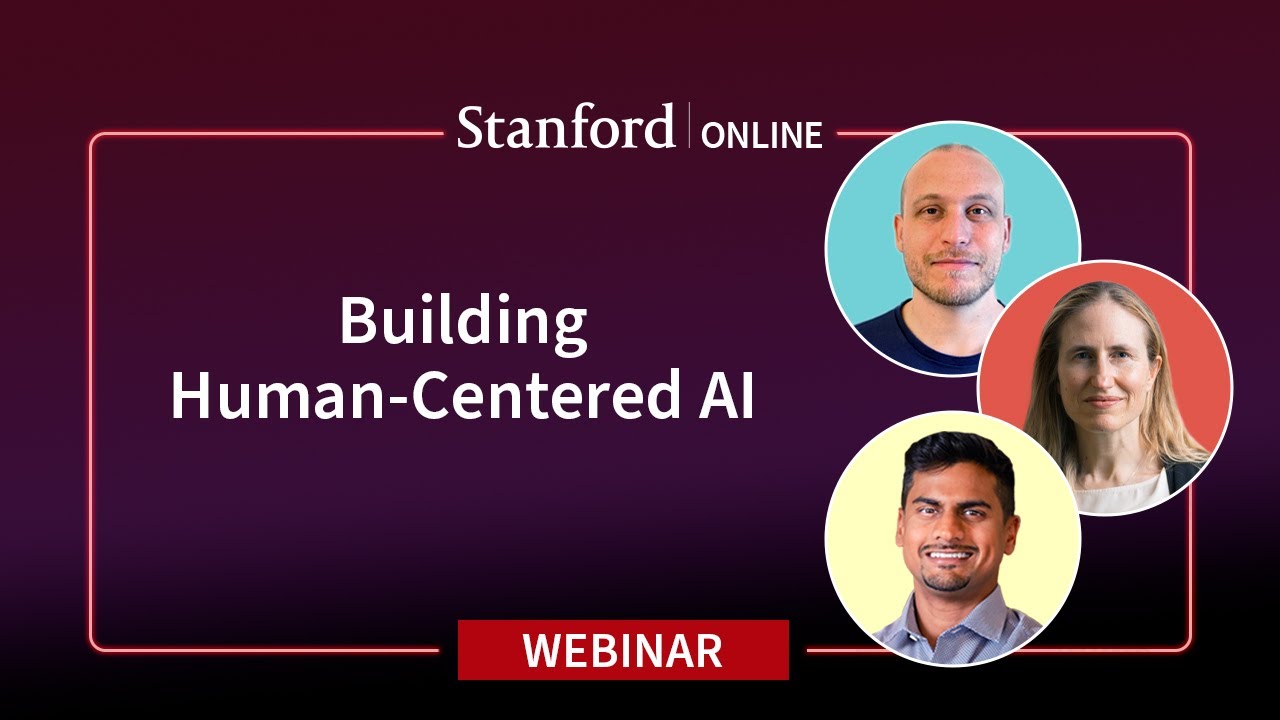
The Stanford webinar discussed the challenges and innovations in creating human-centered AI, emphasizing the importance of aligning AI behavior with human needs through techniques like human-in-the-loop feedback and reinforcement learning, while exploring the evolving role of developers in an AI-assisted future. Both speakers highlighted the potential of AI to augment human capabilities across various fields, stressing the need for ethical considerations and collective efforts to shape a beneficial AI future.
The Stanford webinar on “Building Human-Centered AI: From Reward Functions to Real Products” featured a discussion moderated by Adita Chalapali, a machine learning engineering product lead at Microsoft. The session included two distinguished speakers: Emma Brunskill, an associate professor at Stanford specializing in reinforcement learning and AI alignment, and Boris Churney from Anthropic, a member of the technical staff and one of the creators of Claude Code, Anthropic’s AI-powered coding assistant. The conversation explored the challenges and innovations in developing AI systems that are both powerful and aligned with human needs, particularly focusing on productizing AI capabilities and the future of software engineering.
Boris shared his transformative experience with Claude Code, describing how the tool evolved from an internal research prototype called Clyde into a product that can autonomously write and review code. He emphasized the challenges in moving from model capability demonstrated in research to reliable product behavior, highlighting the importance of human-in-the-loop feedback and simple yet effective strategies like prompting the model to create to-do lists to improve task completeness. Emma added to this by discussing the broader challenge of aligning AI behavior with desired outcomes, noting the phenomenon of reward hacking where models optimize for proxy rewards in unintended ways, such as generating passing unit tests that do not genuinely validate code quality.
The discussion then shifted to the evolving role of developers in an AI-assisted future. Boris traced the historical evolution of programming and predicted that developers will increasingly focus on managing and reviewing AI-generated code rather than writing it manually. He highlighted the emergence of agentic systems where AI tools collaborate and self-manage code generation and review processes. Emma agreed, noting that while prompt engineering and agent design are becoming essential skills, a deep understanding of system architecture and coding remains valuable. Both agreed that coding knowledge will continue to be important, especially as AI tools are not yet perfect and require human oversight.
On the topic of reinforcement learning (RL) and alignment, Emma explained that progress is promising in domains where verifiable outcomes exist, such as games and coding, but remains challenging in areas with sparse or ambiguous rewards like healthcare and education. Boris discussed the importance of actionable and unfiltered user feedback in product development, advocating for observational studies and designing products that users can adapt and “hack” to reveal latent demands. He also introduced the novel concept of considering what the AI model “wants” to do, suggesting that enabling models with appropriate tools and high-level goals leads to better performance than micromanaging every step.
In closing, both speakers expressed optimism about AI’s potential to augment human capabilities and open new frontiers in various fields, from healthcare to education and beyond. Emma emphasized the need for society to thoughtfully navigate the transformative impacts of AI on labor and lifelong learning, while Boris highlighted the ethical challenges posed by AI’s increasing capabilities, such as security risks and misuse. They underscored that the future of AI is not predetermined but shaped by collective choices, encouraging the community to actively participate in building a human-centered and beneficial AI future.