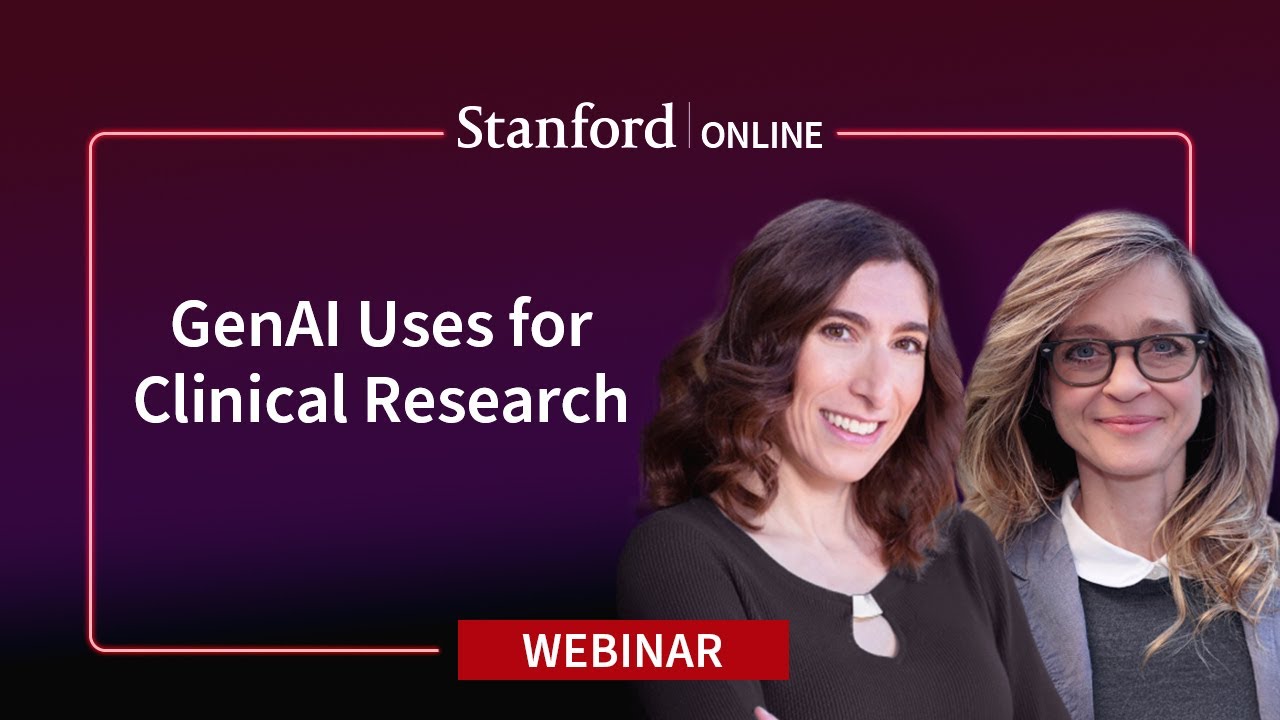
Certainly! Here’s a five-paragraph summary of the Stanford Webinar “Ten Game-Changing Generative AI Uses for Clinical Research” featuring Dr. Kristen Akobs Sanani and Dr. Regina Nuzzo:
1. Introduction and Context
The webinar, hosted by Stanford professors and science journalists Dr. Kristen Akobs Sanani and Dr. Regina Nuzzo, explores the transformative potential of generative AI—particularly large language models (LLMs) like ChatGPT—in clinical research and scientific writing. The speakers emphasize that, contrary to fears that AI will erode critical thinking, these tools actually elevate the importance of higher-level reasoning by automating routine, algorithmic tasks. This shift allows researchers to focus more on data interpretation, bias detection, and creative problem-solving.
2. Practical AI Applications in Research
Sanani and Nuzzo share ten impactful ways they use AI in their work, ranging from direct data analysis to creative brainstorming. Notably, ChatGPT can now analyze datasets directly, bypassing the need for manual coding, which accelerates exploratory analysis and data visualization. They caution, however, that while AI can quickly process and visualize data, researchers must still double-check results and ensure reproducibility by generating and reviewing code. AI also excels at translating complex statistical methods into plain language, making research more accessible to non-experts.
3. Enhancing Critical Review and Writing
A standout use case is employing AI as an adversarial collaborator or “red team,” where ChatGPT is prompted to critique manuscripts, grant proposals, or scripts from specific perspectives (e.g., as a skeptical reviewer or regulatory official). This helps researchers anticipate and address potential criticisms before peer review. In writing, the speakers highlight that while ChatGPT is not a strong original writer, it is invaluable for dictation, transcription, editing, and breaking writer’s block. It can clean up spoken drafts, suggest organizational frameworks, and provide targeted editorial feedback.
4. Everyday and Personal Uses
Beyond professional tasks, the presenters discuss how AI can support everyday life. Examples include generating practice tests for students, helping with homework, and even providing emotional support or venting outlets. Dr. Nuzzo shares a personal story of using ChatGPT to translate her experiences as a cochlear implant user into actionable feedback for her audiologist, demonstrating AI’s ability to bridge communication gaps between patients and clinicians. The speakers also use AI for creative motivation, such as generating cartoons or visualizations for teaching and personal projects.
5. Ethical Considerations and Future Directions
The webinar concludes with a discussion on ethical and practical considerations. The presenters stress the importance of not uploading sensitive or non-anonymized data to AI platforms, recommend using private modes, and suggest using AI to help anonymize datasets before analysis. They acknowledge the evolving landscape of AI ethics in academia and publishing, advocating for responsible use that augments rather than replaces human judgment. Looking ahead, they anticipate deeper integration of AI into peer review, education, and research workflows, with a continued emphasis on critical thinking and iterative collaboration between humans and AI.