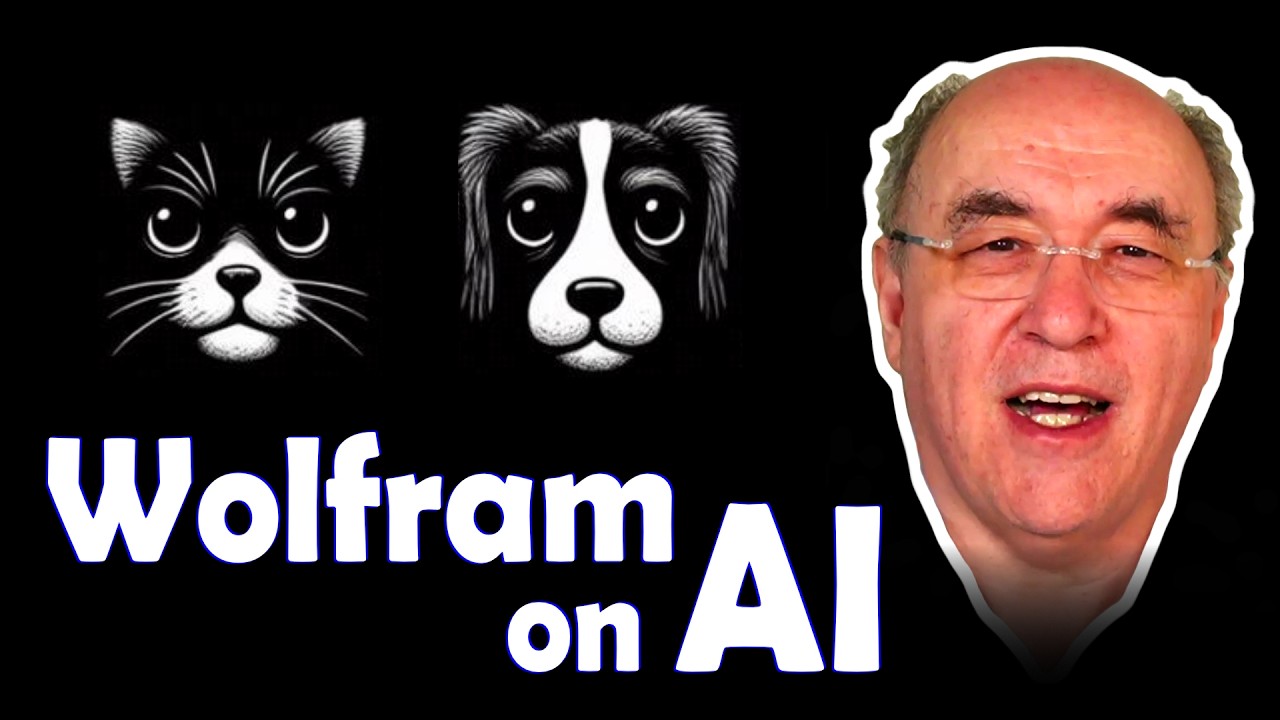
In the discussion, Stephen Wolfram explores the distinction between human-like thinking and formal, computational thinking. He explains that while human brains and large language models (LLMs) excel at broad but shallow thinking—quickly connecting concepts and recognizing patterns—they do not perform deep formal computations like running code or proving complex theorems. Formal knowledge, such as mathematics and computational models, builds tall, precise towers of understanding that are computationally irreducible and often beyond direct human comprehension. Wolfram emphasizes the complementary nature of these two modes: human-like linguistic interfaces provided by LLMs and the rigorous, formal computational structures that underpin scientific knowledge.
Wolfram highlights the role of LLMs as effective linguistic user interfaces that can interact with humans in natural language, facilitating the integration and application of existing knowledge. These models are adept at tasks like image generation or pattern recognition by connecting known elements in novel ways. However, they do not generate fundamentally new knowledge through formal computational processes, which remain the domain of specialized algorithms and automated theorem proving. He notes that some formal proofs, such as his own 104-step proof of a minimal axiom for Boolean algebra, are incomprehensible to humans, illustrating the limits of human understanding in formal domains.
A significant part of the conversation focuses on the nature of machine learning and why it works. Wolfram compares traditional engineering, which builds systems from uniform, explainable components, to machine learning, which assembles “lumps of irreducible computation” like irregular stones to form functional but opaque structures. This analogy explains why neural networks, despite varying architectures, can learn similar tasks effectively. However, these learned structures lack the transparency and modularity of engineered systems, making it difficult to build indefinitely tall towers of knowledge or fully understand the internal workings of AI models.
Wolfram also delves into the concept of knowledge hypergraphs and the structure of meaning in AI-generated spaces. Using generative AI image models as an example, he describes how concepts like “cat” occupy tiny, distinct regions in a vast “meaning space” or “interconcept space” filled with countless possible but unnamed variations. Human language and cognition have only colonized an infinitesimal fraction of this space, representing a tiny corner of the broader computational universe he terms the “rulial space.” This perspective offers a way to visualize how human knowledge fits within the immense landscape of all possible computational concepts.
Finally, Wolfram reflects on the implications of AI exploring regions of meaning beyond human concepts. While AI can navigate and generate content in these interconcept spaces, humans may struggle to understand or align with such alien forms of intelligence. This gap poses challenges for communication and comprehension but also opens opportunities for expanding our grasp of the computational universe. Overall, Wolfram envisions a future where the integration of formal computational knowledge and human-like AI interfaces advances our collective understanding, even as much of the computational realm remains mysterious and unexplored.