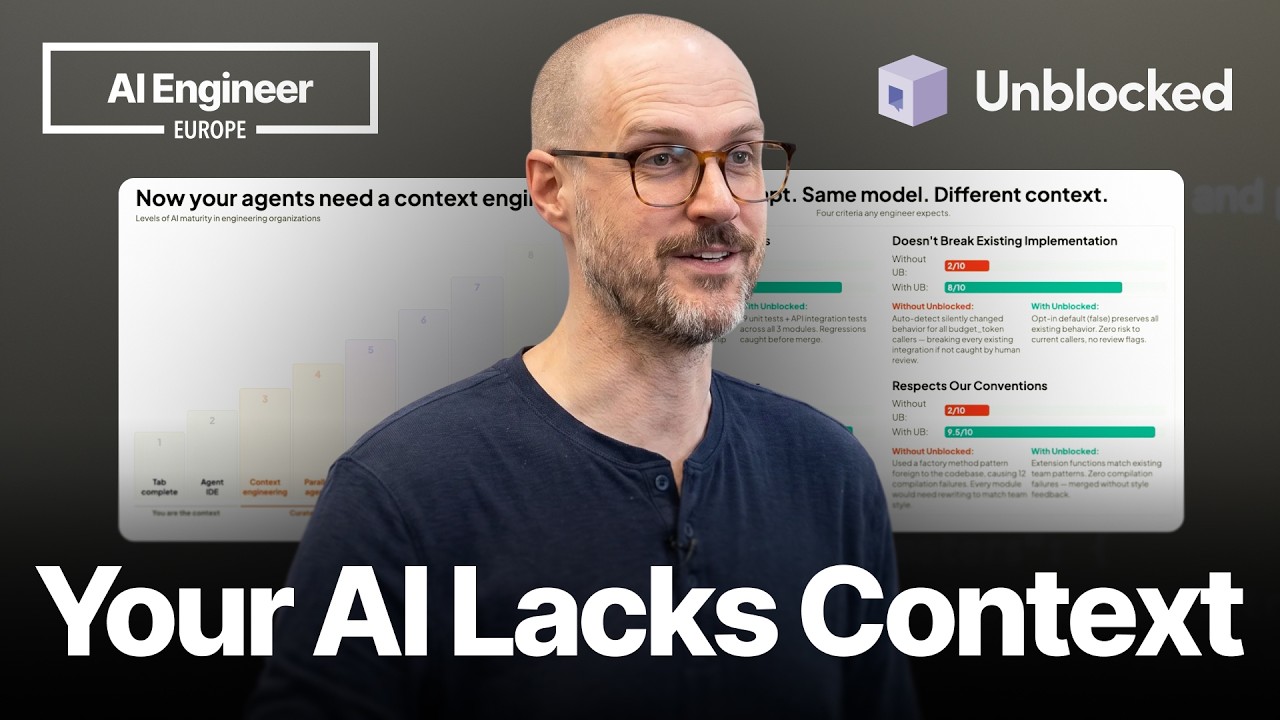
Brandon Walsenuk from Unblocked discusses the challenge of “babysitting” AI agents in software engineering, emphasizing that these agents start with zero context about an organization and require substantial input to function effectively. He explains that traditionally, engineers themselves act as the “context engine,” accumulating knowledge over time through experience, collaboration, and learning. However, as AI agents become more prevalent, there is a pressing need to build dedicated context engines that provide agents with the relevant organizational knowledge they need to operate autonomously and accurately.
Walsenuk debunks three common myths about providing context to AI agents. First, simply using naive retrieval-augmented generation (RAG) over static documents does not suffice because agents may prematurely stop searching once they find a seemingly relevant piece of information, missing critical details. Second, merely connecting multiple data access points (MCPs) does not guarantee understanding or reasoning across disparate data sources. Third, increasing the context window size alone is ineffective since agents struggle to reason over vast amounts of unstructured data without structured relationships and entity recognition.
The core solution presented is the development of a sophisticated context engine that integrates static corporate knowledge with dynamic, runtime data from various systems, SaaS applications, and communication platforms. This engine uses a social graph to map relationships between people, codebases, and projects, enabling it to resolve conflicts in information and prioritize authoritative sources, such as CTO directives over outdated code. It also respects data governance and permissions, ensuring sensitive information is only accessible to authorized users. The context engine optimizes token usage by delivering concise, relevant information tailored to the agent’s needs.
Walsenuk shares lessons learned from building Unblocked’s context engine, highlighting the importance of understanding over mere access, the necessity of conflict resolution rather than ignoring discrepancies, and the pitfalls of caching answers that can quickly become outdated. He illustrates the practical benefits of such an engine through a demo of a social graph tool that visualizes collaboration and expertise within an engineering team, and an agent that successfully plans a complex integration task by leveraging the context engine’s capabilities.
In conclusion, Walsenuk advocates for AI agents that produce work indistinguishable from experienced team members by leveraging robust context engines. These engines empower agents to plan, execute, and review code with high accuracy and efficiency, reducing the need for constant human oversight. He encourages teams to adopt context engines to unlock the full potential of AI in software development and invites attendees to explore Unblocked’s open-source tools and engage further at their booth.