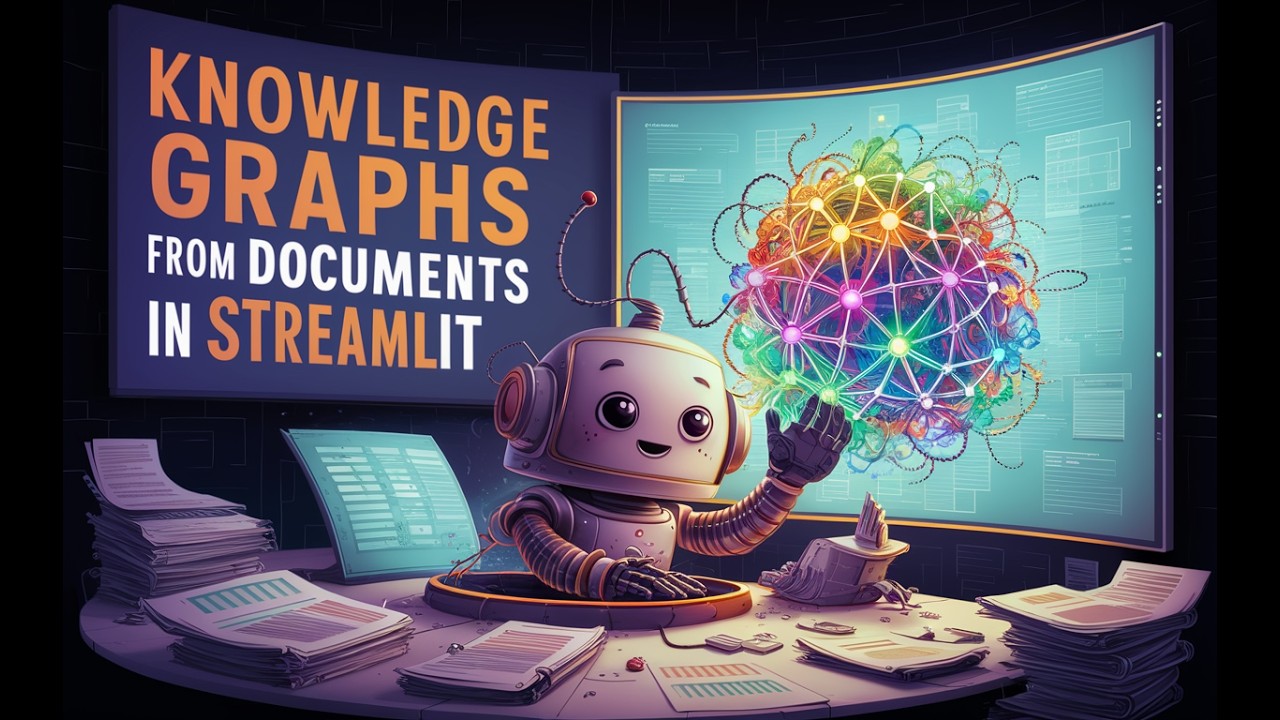
The video demonstrates how to create knowledge graphs from text and PDF documents using a Streamlit application, allowing users to extract entities and relationships, generate summaries, and download the results. The presenter emphasizes the importance of choosing the right model for extraction and walks through the app’s structure, encouraging experimentation with different models to optimize performance.
In the video, the presenter demonstrates how to create knowledge graphs from text and PDF documents using a Streamlit application. The app allows users to extract entities and relationships from the provided content, generate a summary, and download the resulting knowledge graph, summary, and JSON data separately. Users can either paste their text or upload files, such as transcripts from YouTube videos or PDF reports, and the app supports multiple models, including OpenAI’s GPT-3.5 and GPT-4, as well as Anthropic’s Claude and Gemini.
The process begins with the user inputting content or uploading a document. The app then extracts entities and relationships, while providing real-time feedback in the terminal. As the extraction is ongoing, users can see the identified entities and their relationships displayed in the app. The presenter also emphasizes the importance of the model used for entity extraction, noting that different models may yield varying results in terms of entity complexity and detail.
The video showcases the functionality of the app by testing it with different types of documents, including lengthy files like an MBD 10-Q report. The presenter explains that while larger documents may increase costs and lead to potential failures in generating full knowledge graphs, the app is designed to extract essential information efficiently. Users are encouraged to experiment with different models to find the best fit for their needs, with a particular mention of GPT-4’s superior performance over others in managing extensive texts.
In terms of coding, the presenter walks through the app’s structure and primary functions, highlighting how the core logic is built using libraries like NetworkX for graph manipulation and pandas for file reading. The video details how to interact with unified APIs to streamline the extraction process and manage message history efficiently. The importance of setting appropriate system messages is discussed, as these messages guide the model in accurately parsing and summarizing the provided text.
Finally, the presenter invites viewers to access the code files on their Patreon, where they can also find numerous other projects and courses. The video concludes with an invitation to follow the presenter on social media for updates and additional content. Overall, the tutorial aims to empower users to harness the potential of knowledge graphs in analyzing and visualizing data from various text sources effectively.