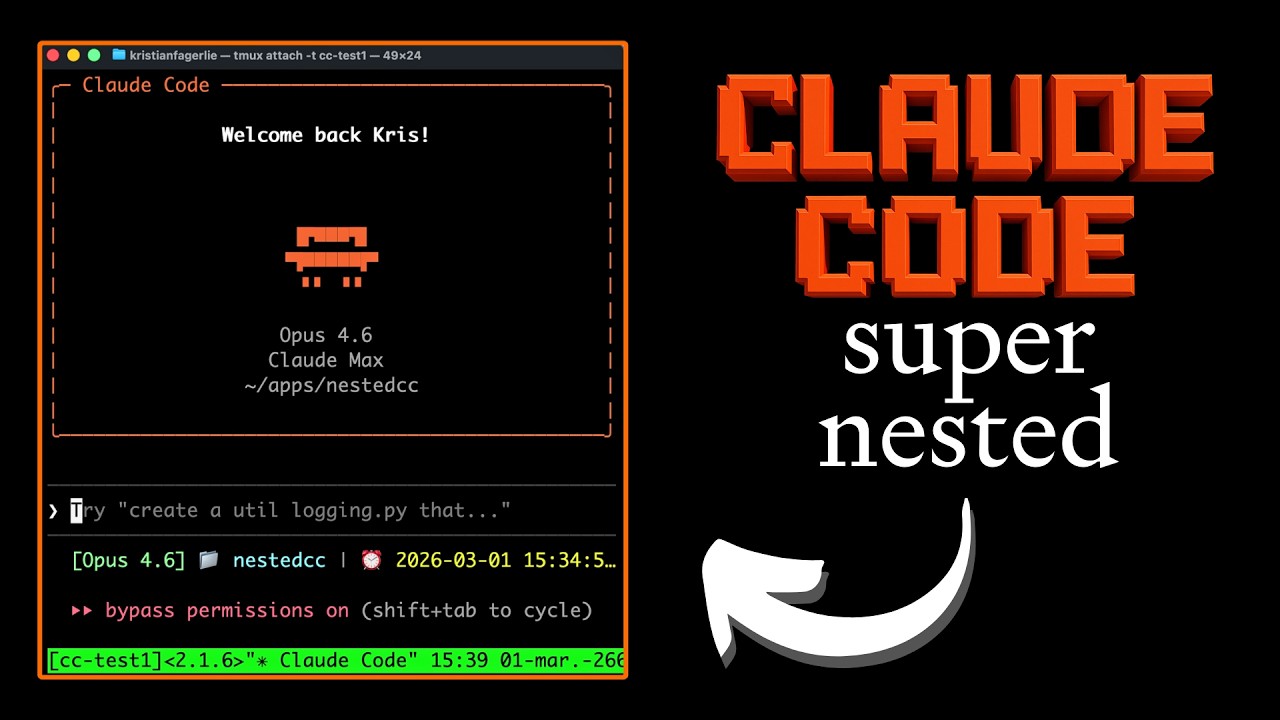
The video demonstrates an advanced coding workflow using a system called “Super Nested Claude Code,” which leverages multiple parallel terminals in Tmux to run several instances of Claude code simultaneously. The presenter explains that the system is designed to take a high-level goal—such as building a game in 3JS—and then autonomously plan, distribute, and execute tasks across multiple terminals. Each terminal can be assigned a specific role, like UI, API, database, or testing, and the controller (the main Claude code instance) manages all prompts, outputs, and terminal states without requiring manual intervention beyond the initial goal.
A significant portion of the video is dedicated to showing how easy it is to set up this environment using Hostinger, the video’s sponsor. The presenter walks through the process of deploying OpenClaw (the open-source Claude code controller) on a cloud VPS, highlighting the simplicity and speed of the setup. Viewers are encouraged to use a discount code and are reminded of the benefits of running such systems in the cloud, such as scalability and uptime, compared to local hardware like a Mac Mini.
The presenter then demonstrates the system in action by setting a complex goal: building a never-ending, procedurally generated space galaxy game in 3JS, controlled by an AI spacecraft. The controller agent decides to spin up six parallel terminals, each handling a different aspect of the project (galaxy, index, objects, render, spacecraft, and UI). The controller distributes detailed prompts to each terminal, and all work is done in parallel. Once the code is generated, the system automatically tests the integration, launches the server, and even takes a screenshot to verify the output before shutting down the terminals.
To showcase the system’s versatility, the presenter tries a different project: visualizing the training process of a minimal GPT language model in real time. This time, the controller spins up four terminals for backend, charts, dashboard, and samples. The system generates a UI that displays live training metrics, such as loss curves, learning rate, and generated names, providing a clear visualization of the model’s learning process. The presenter notes that the controller’s detailed instructions allow even less powerful models to perform well, as long as the main controller uses a strong model like Opus.
The video concludes with a summary of the system’s capabilities and its open-source availability. The presenter encourages viewers to try out the setup, contribute to the project, and provide feedback. It’s noted that the system currently only works on macOS due to Tmux dependencies. The video wraps up with a reminder to check out Hostinger for easy deployment and an invitation to explore the possibilities enabled by this parallel, autonomous coding workflow.