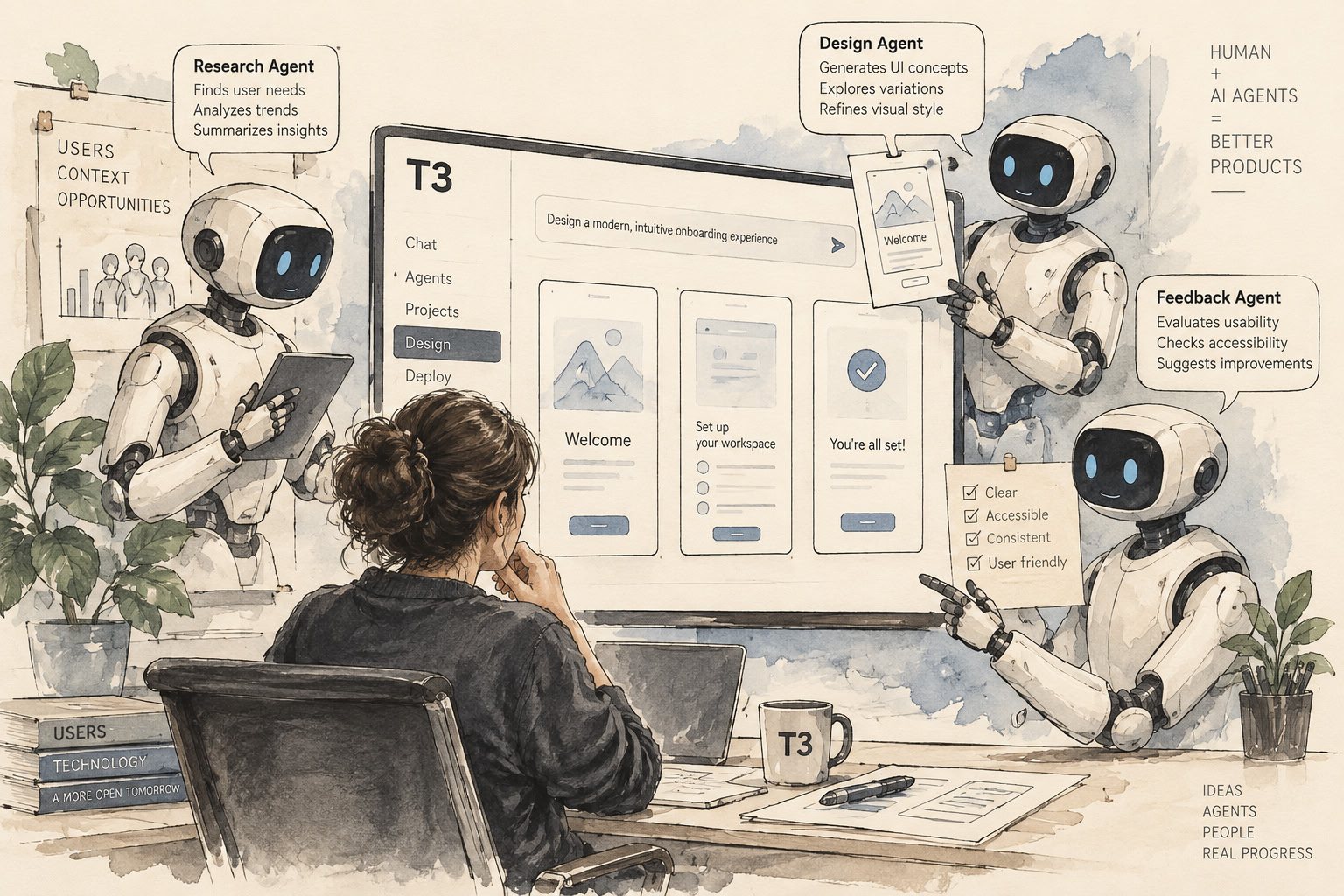
Recent developments in the open-source agentic development environment (ADE) T3 Code have highlighted significant advances in AI harness integration and autonomous user interface (UI) improvement. T3 Code, designed to manage multiple AI harnesses and sub-agents, is at the forefront of a shift toward self-improving, AI-assisted development workflows.
A key innovation showcased by T3 Code is the use of AI agents to autonomously and iteratively enhance the project’s UI. The process, described by the project’s creator, involves a hill climbing technique where multiple AI models act as a “council” to review, score, and refine UI changes. Each iteration aims to achieve consensus on high design quality, with the system continuing to improve the UI until it meets or exceeds the standards of competing products. This approach resulted in a more readable, consistent, and aesthetically pleasing interface, with the AI reviewers eventually rating the design as excellent across all categories. The experiment, while resource-intensive (costing approximately $250-$400 in API usage), demonstrated that AI agents can autonomously produce high-quality UI improvements without the need for a dedicated human designer.
T3 Code also addresses the evolving debate over the relevance of AI harnesses. Traditionally, harnesses have enabled language models (LLMs) to interact with tools and perform actions beyond text generation. However, as AI abstractions mature, the distinction between harnesses and interfaces is becoming less critical. T3 Code serves as an interface that connects humans to various harnesses, allowing for flexible management and interoperability without locking users into a single harness. This design philosophy encourages developers to focus on productivity and adaptability rather than specific tool preferences, reflecting broader trends in the AI development community.
Beyond UI improvements, similar AI-driven evaluation and refinement techniques have been applied to optimize how models interact with T3 Code’s tool descriptions and multi-agent coordination. These optimizations have led to significant reductions in token usage and improved model performance, further enhancing the system’s efficiency and reliability.
The T3 Code project exemplifies the growing potential of AI-assisted, self-improving development environments, signaling a move toward more automated and efficient software workflows.
