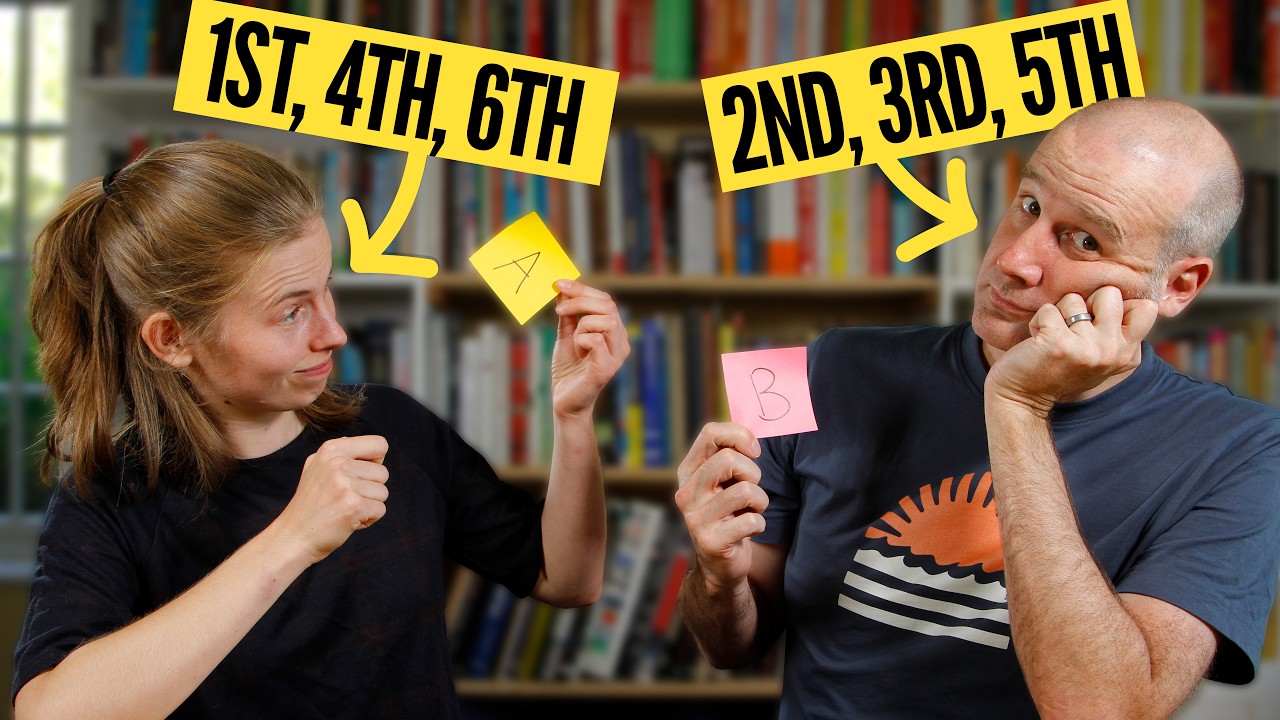
The video revisits the concept of the Thue-Morse sequence, previously introduced as the fairest way to share items between two people, and explores recent developments in fair sharing methods. Matt and his friend Sophie discuss the shortcomings of simple alternating turns (ABAB) in fairness, especially when items are ranked or of equal value, and introduce the Thue-Morse sequence as a superior alternative. They explain how the sequence balances advantages by using patterns like ABBA and BAAB, which when combined and iterated, create a non-repeating, fair distribution that ensures neither person consistently has the upper hand.
Sophie shares several fascinating mathematical properties and applications of the Thue-Morse sequence, including its generation through binary digit sums modulo 2, its use in optimal configurations such as rowing teams, and its connections to transcendental numbers and the Riemann zeta function. She also highlights a geometric interpretation where following the sequence’s instructions leads to the Koch snowflake fractal. The sequence’s pronunciation is briefly debated, but its mathematical elegance and utility remain undisputed.
The video then tackles the challenge of generalizing the Thue-Morse sequence for more than two people, inspired by a question about fair draft orders in a 14-person fantasy sports league. Matt introduces a “duel” method where players take turns based on who has the lowest probability of having already won, which surprisingly generates the Thue-Morse sequence for two players and can be extended to any number of participants. Using code from a Math Stack Exchange user, Matt demonstrates sequences for various numbers of players, including 14, and discusses visualizations that help make these complex patterns more understandable.
To provide a practical and memorable approach to fair drafting for multiple players, Matt proposes the “hydra draft,” a compromise between the simple snake draft (back-and-forth order) and the full Thue-Morse sequence. The hydra draft involves multiple “snakes” or waves of picking orders—forward, backward, middle-out, and outside-in—that collectively approximate the fairness of the Thue-Morse sequence while being easier to follow. Comparative analyses show that hydra draft performs nearly as well as the ideal Thue-Morse sequence in minimizing advantage disparities among players, especially when item values decrease quadratically.
Finally, Matt delves into the computational aspects of generating these sequences, explaining that the code uses binomial coefficients and polynomial calculations rather than directly simulating duel probabilities. He notes an intriguing and unresolved phenomenon: while the two-player Thue-Morse sequence never repeats, sequences for three or more players eventually fall into repeating patterns, a mystery that remains unsolved. The video concludes with links to further resources, including Sophie’s Numberphile videos, the podcast “A Problem Squared,” and interactive visualizers, inviting viewers to explore and contribute to this fascinating area of fair division mathematics.
Useful Links