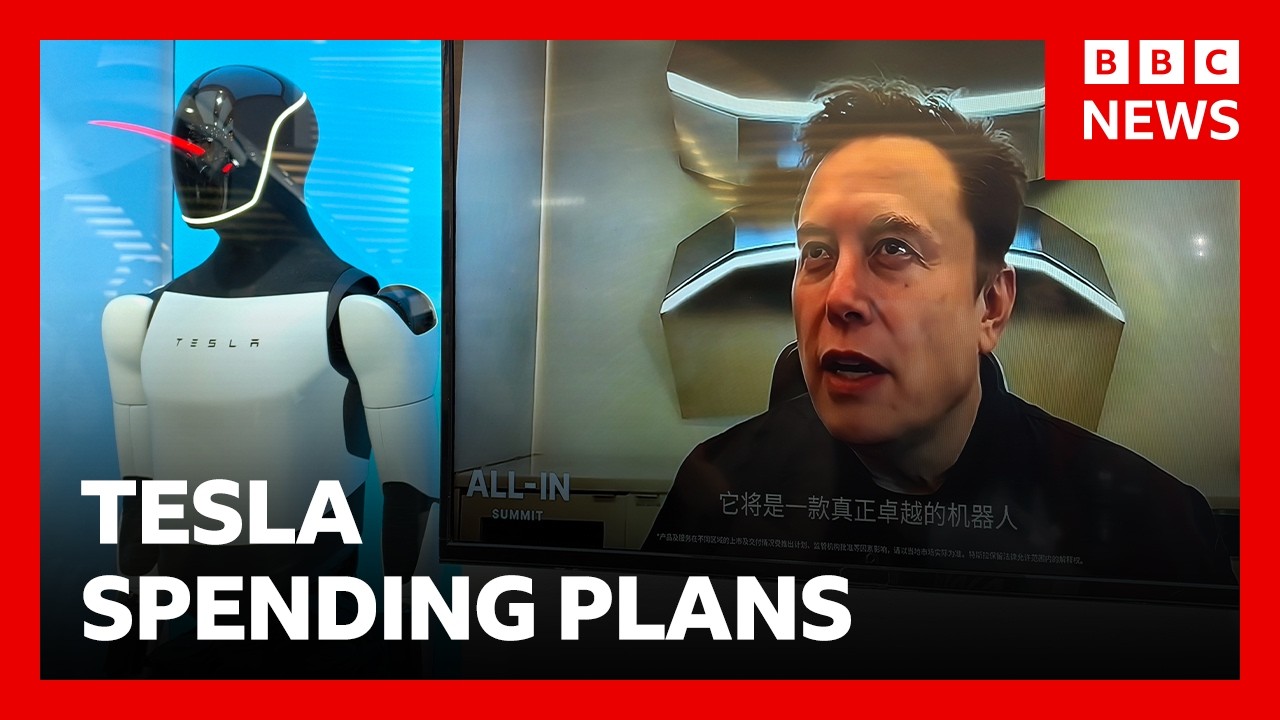
Tesla has announced plans to increase its spending to over $25 billion, focusing heavily on artificial intelligence, robotics, and chip development. CEO Elon Musk emphasized that these investments are aimed at creating significant future revenue streams and described the expenditure as well-justified. Despite this ambitious plan, Tesla’s stock showed mixed reactions, initially rising but then falling in after-hours trading. The company, primarily known for its electric vehicles, currently holds a market valuation close to $1.5 trillion.
During Tesla’s recent earnings call, Musk revealed that a substantial portion of the $25 billion investment would be directed towards AI software and chip technology. This move aligns Tesla with other major American tech firms that are ramping up their AI investments. Musk expressed confidence that these investments would yield substantial returns in the long term. However, Tesla faces challenges in monetizing emerging areas such as robo-taxis and robotics, with products like the Optimus robot not yet available to consumers.
Tesla’s core electric vehicle business is also encountering difficulties, particularly in competing with companies like China’s BYD. Sales have been impacted by Musk’s political involvement in the US and abroad, which has caused some uncertainty among consumers. Although shareholders approved a record $1 trillion compensation package for Musk last November, the full payout is contingent on meeting specific performance benchmarks, adding pressure on the company to deliver results.
Industry expert Joe McCabe highlighted concerns about Tesla’s revenue streams, noting that income from carbon credits has diminished due to the removal of penalties in the US, reducing the demand for such credits. Tesla currently relies heavily on three vehicle models: the Model 3, Model Y, and Cybertruck. However, the Cybertruck has been polarizing and is losing favor among consumers. While Tesla has plans for new products like the Cybercab, Cybertruck SUV, and Roadster 2.0, the company faces stiff competition, especially in European and Asian markets.
McCabe also pointed out that Tesla’s recent quarter was its second worst in the past two years in terms of production, despite showing some profit growth compared to the same period last year. The previous year’s poor performance was partly attributed to Musk’s political activities, which temporarily affected demand. Although Tesla maintains a strong position in North America due to restrictions on Chinese competitors, the company is beginning to show signs of strain as it navigates increasing competition and market challenges globally.