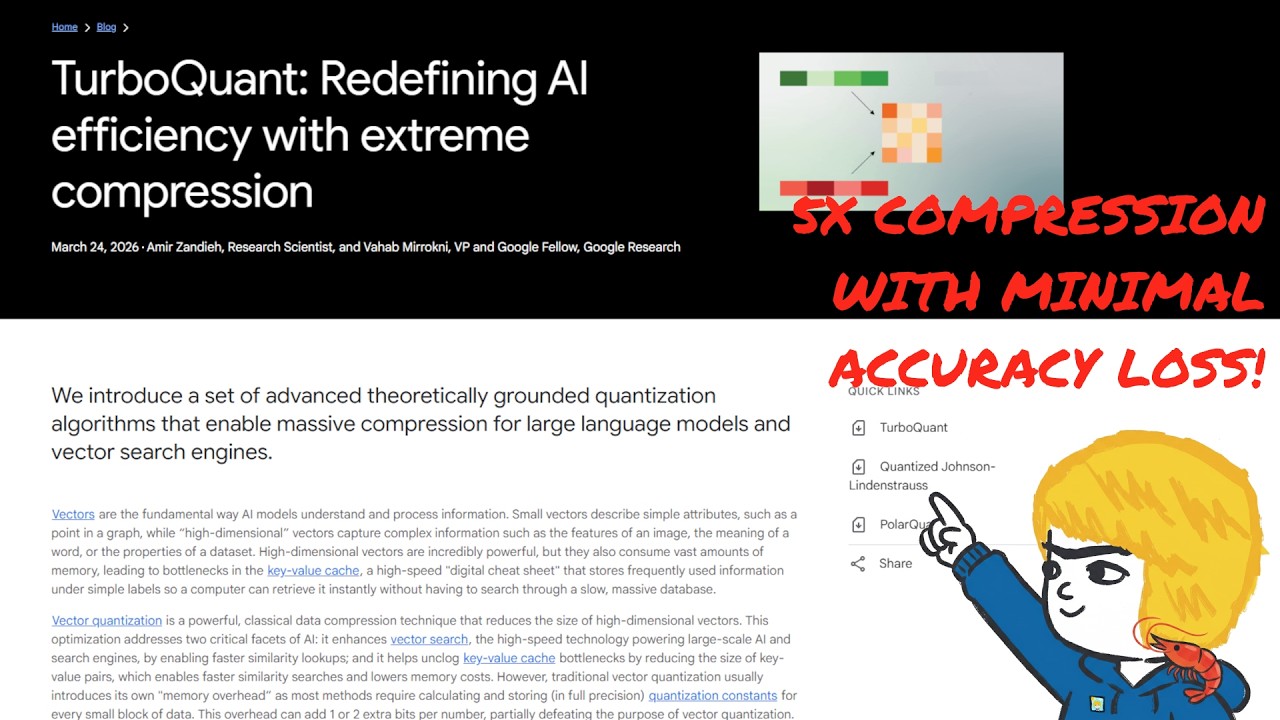
In this video, the creator explores Google’s newly introduced Turbo Quant compression algorithm, which promises to reduce the memory footprint of large language models’ (LLMs) key value (KV) cache by up to six times without sacrificing accuracy. The video begins by explaining the problem Turbo Quant addresses: LLMs like ChatGPT and Llama are powerful but require massive amounts of memory and specialized hardware, making them slow and expensive to run. Turbo Quant tackles this by compressing the KV cache, which acts like the AI’s “cheat sheet” during conversations, allowing for longer context windows and more efficient memory use.
The presenter breaks down the concept of quantization, likening it to compressing a photo from a large raw file to a smaller JPEG with minimal quality loss. Turbo Quant uses a two-stage process: first, polar quantization reorganizes the data into a simpler form, and second, a QJL correction step removes bias introduced in the first stage. This approach reduces the data from 32 bits to roughly 3 bits per number, achieving about a 10x compression rate while maintaining zero accuracy loss and requiring no retraining of models.
To validate Turbo Quant, the creator implemented the algorithm independently in Python using the Opus 4.6 framework, replicating the math and testing it on a real LLM, the Quen 2.53B model, running on a mid-range RTX 3060 GPU. The tests confirmed that the compression maintained unbiased inner products, preserved attention patterns with 99.5% similarity at 3-bit compression, and achieved practical compression rates of around 5x. The “needle in a haystack” test also showed perfect retrieval accuracy, proving that important information is not lost during compression.
The results demonstrate that Turbo Quant can significantly reduce the memory needed for KV caches, enabling longer context windows and the ability to run larger models on consumer-grade hardware. While the official Google implementation is not yet available, the creator’s independent tests align closely with reported benchmarks, suggesting that Turbo Quant is a promising breakthrough for making AI models more accessible and efficient. The 3-bit compression level emerged as the sweet spot, balancing compression and accuracy effectively.
In conclusion, Turbo Quant represents a major advancement in AI model compression, offering a plug-and-play solution that dramatically reduces memory usage and speeds up processing without retraining or accuracy loss. This could lead to cheaper, greener, and more widely available AI, including on mobile and lower-end devices. The creator plans to share their code and invites viewers to follow along for further experiments, highlighting the exciting potential for running powerful local AI models on everyday hardware.