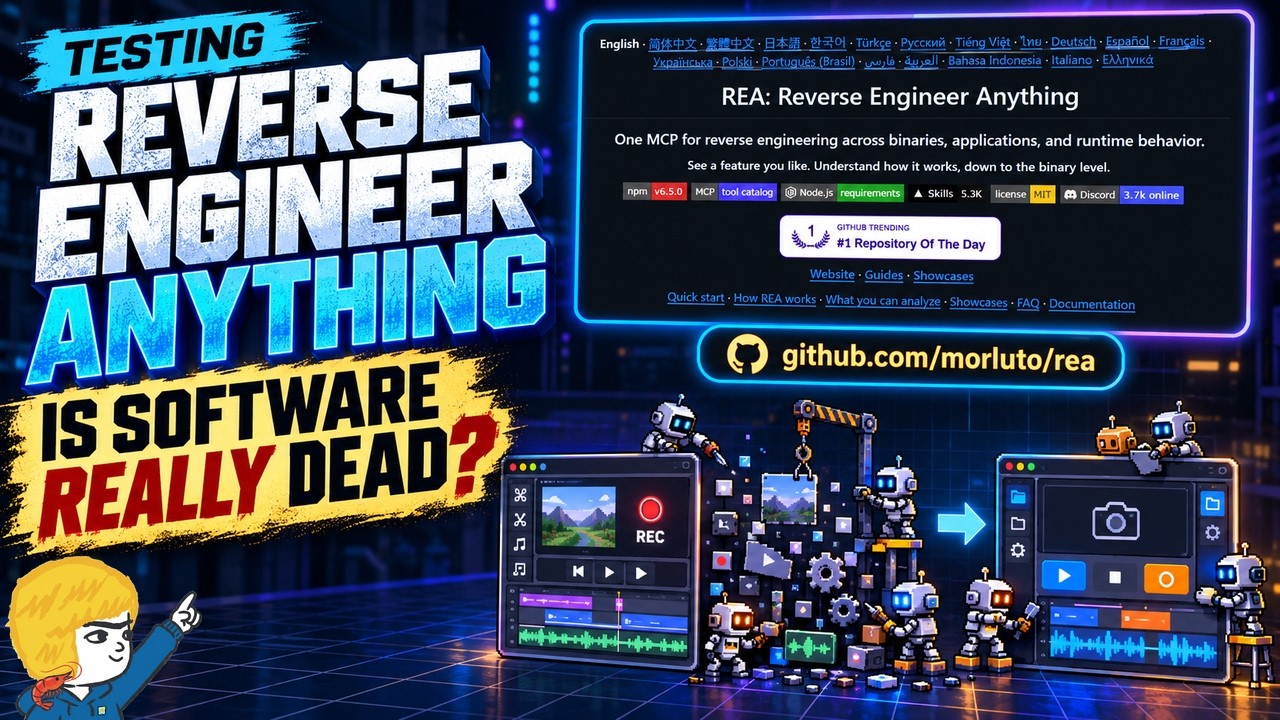
The creator uses the open-source tool “Reverse Engineer Anything” (REA) to analyze the popular video recording app Loom, uncovering its internal workings to fix bugs and improve their own Recordly-based video software. This process demonstrates how REA enables developers to reverse engineer and enhance applications, highlighting the evolving potential of AI-assisted software development.
In this video, the creator explores the use of the open-source GitHub project “Reverse Engineer Anything” (REA) to improve a custom-built video recording and editing software based on the open-source project Recordly. The current version of their software suffers from issues such as poor scrolling and frequent freezing, making it difficult to use. The goal is to leverage REA to reverse engineer a popular video recording app, Loom, to gain insights and fix these bugs in their own application.
REA is a toolset that combines multiple command-line interface (CLI) and model communication protocol (MCP) tools to analyze software, including desktop apps and websites. It integrates well-known decompiling tools like Hopper and Ghidra, allowing an AI agent to inspect, trace, and analyze software components. The agent uses this information to answer follow-up questions and suggest improvements, creating a feedback loop that aids in understanding and rebuilding software features.
The creator demonstrates installing and using REA with Hermes Agent and the Claude Opus 5.5 model to analyze Loom, an Electron-based video recorder. Although REA has limitations on app size, it successfully analyzes Loom’s core app code, revealing details about its recording process, UI windows, and HUD design. By pushing REA further, they uncover how Loom manages its HUD with multiple window pages and trace JavaScript semantics to understand unnamed communication channels within the app.
Using Ghidra through REA, the creator decompiles Loom’s pause and resume handlers, gaining a deeper understanding of its native recording functionality. With this knowledge, they incorporate improvements into their own Recordly-based software, addressing the HUD dragging and freezing issues that plagued their earlier builds. The result is a more stable and user-friendly video recorder that can be dragged smoothly and closed without freezing, demonstrating the practical benefits of reverse engineering with REA.
The video concludes with reflections on the potential of REA and similar tools to empower developers to build custom software tailored to their needs. While reverse engineering requires legal caution and is best suited for personal experimentation, it offers a powerful way to learn from existing applications. The creator plans to continue exploring REA in future projects and integrate AI agents more deeply into their video recording and editing software, highlighting that software development remains very much alive and evolving with these new capabilities.