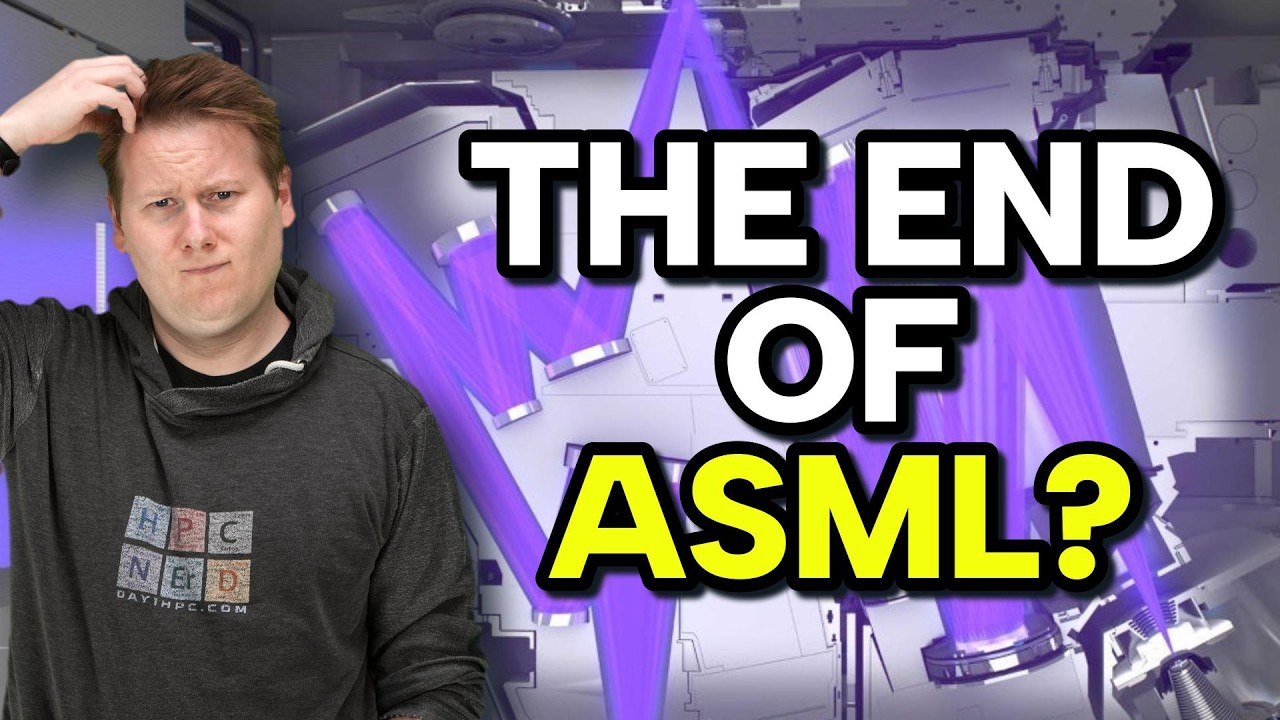
In November 2025, a startup named Substrate emerged prominently in semiconductor news, claiming to revolutionize chip manufacturing with practical X-ray lithography, promising sub-2 nanometer chips at half the cost of current fabs. This bold claim challenges the dominance of ASML, the industry leader in extreme ultraviolet (EUV) lithography, which has been the backbone of modern chip production. The video explores the physics and economics behind lithography, explaining how light at different wavelengths is used to pattern silicon wafers, with EUV currently operating at 13.5 nanometers and Substrate proposing to use even shorter wavelength soft X-rays around 1 nanometer. While shorter wavelengths theoretically allow finer patterns, they introduce significant technical challenges, including mirror reflectivity loss, resist chemistry issues, and massive increases in power requirements.
The lithography process is central to chip manufacturing, involving multiple steps of depositing layers, patterning with light through masks, etching, doping, and polishing to build transistors and interconnects. EUV lithography tools are extraordinarily complex and expensive, costing hundreds of millions of dollars each, with intricate optics and plasma light sources developed over decades. Substrate’s approach involves using particle accelerator-based X-ray sources, akin to synchrotrons or free electron lasers, which are large, power-hungry national research facilities rather than compact industrial tools. This raises questions about the feasibility of scaling such technology for high-throughput semiconductor production, given the enormous infrastructure, energy consumption, and cost involved.
A critical challenge with X-ray lithography lies in the interaction of high-energy photons with photoresists and wafers. Unlike EUV photons, X-rays penetrate deeper, causing broader electron scattering and damaging the resist chemistry, leading to blurred patterns and defects. The stochastic nature of photon arrival (shot noise) worsens as fewer photons are needed due to higher energy per photon, increasing variability and reducing pattern fidelity. Historical attempts by IBM and others in the 1970s and 1980s demonstrated the scientific potential of X-ray lithography but failed to overcome throughput, mask durability, and resist damage issues, leading the industry to favor EUV as a practical compromise between resolution and engineering feasibility.
Substrate’s recent claims lack publicly available data, detailed technical disclosures, or a team with known lithography expertise, raising skepticism among industry veterans. The company’s CEO, James Proud, has a background outside semiconductor lithography, and the startup’s cleanroom facilities appear small and insufficient for large-scale production. Despite raising significant venture capital and garnering media attention, Substrate has not demonstrated a working tool or provided evidence addressing fundamental physical and economic barriers. The video emphasizes that while the promise of X-ray lithography is enticing, extraordinary claims require extraordinary proof, especially when they challenge decades of established research and the massive ecosystem supporting EUV technology.
Ultimately, the video cautions viewers to distinguish between hopeful narratives and credible engineering breakthroughs. The semiconductor industry’s progress depends on rigorous physics, data, and incremental innovation rather than hype. Substrate’s vision, if realized, could transform chip manufacturing and restore American leadership, but the current lack of transparency and technical validation suggests the company faces monumental challenges. The presenter plans to follow up after engaging directly with Substrate’s leadership, underscoring the need for evidence-based assessment in evaluating such disruptive technological claims.