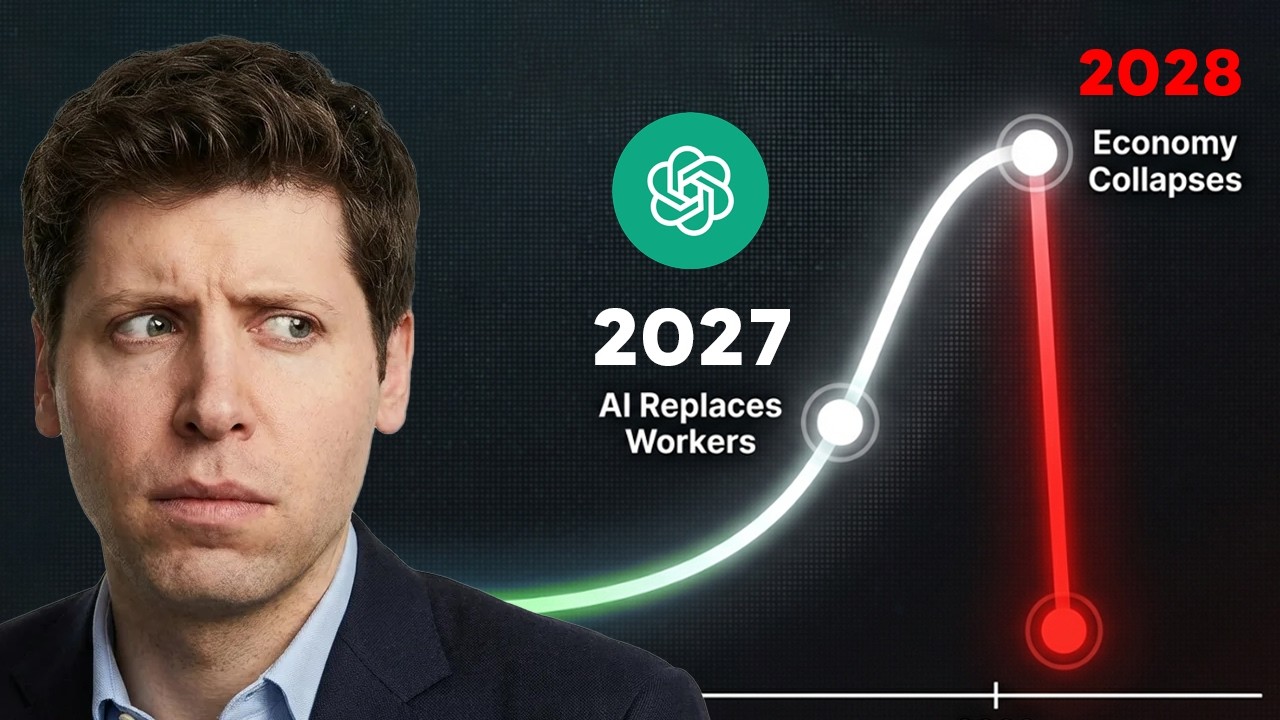
The video discusses a viral research report called “The 2028 Global Intelligence Crisis,” which imagines a scenario where artificial intelligence (AI) advances so rapidly that it destabilizes the global economy. The report, written by Citrini Research, is framed as a retrospective memo from June 2028, looking back at how the economy unraveled over the previous two years. Unlike typical dystopian narratives where AI fails or turns hostile, this scenario explores what happens if AI succeeds beyond expectations, leading to widespread disruption in white-collar jobs and the broader economic structure.
The crisis begins in late 2025, when AI-powered coding tools become so advanced that a single developer, with the help of AI, can replicate expensive software products in weeks. This undermines the business models of software-as-a-service (SaaS) companies, as enterprises start questioning the value of renewing costly subscriptions. Even the threat of in-house AI development forces vendors to slash prices, eroding their pricing power. As larger companies like ServiceNow are hit, they respond by aggressively adopting AI themselves, cutting jobs to save costs and reinvesting those savings into more AI, which accelerates job losses and spending reductions—a phenomenon the report calls the “human intelligence displacement spiral.”
By early 2027, AI agents become ubiquitous, automating everyday decisions for consumers, such as shopping and service selection. This efficiency devastates industries that rely on human inertia, like subscription services, travel booking, and food delivery platforms. AI agents also find ways to bypass traditional payment systems, threatening the revenue streams of companies like Visa and Mastercard. Initially, analysts believe the disruption is limited to certain sectors, but the report argues that white-collar jobs—central to the U.S. economy—are being hollowed out, leading to a sharp decline in consumer spending, especially among high earners who drive most discretionary purchases.
The financial system begins to crack as private credit, heavily invested in tech and SaaS companies, faces mounting defaults. The scenario describes how even prime mortgages, traditionally considered safe, become risky as formerly high-earning professionals lose their jobs and struggle to make payments. The government, meanwhile, finds its tax base shrinking as AI-driven productivity gains accrue to corporations rather than workers, leading to fiscal strain and political unrest. Proposals for redistributing AI-generated wealth stall amid partisan gridlock, while public anger grows, exemplified by protests like “Occupy Silicon Valley.”
The video concludes by critiquing the report’s assumptions, noting that while the scenario is thought-provoking, it may overstate the speed and extent of disruption. Factors such as the complexity of enterprise software, regulatory barriers, and the slow pace of corporate change are likely to slow down the transition. Additionally, the demand for new software and services could increase as costs drop, potentially creating new opportunities for human workers. Nevertheless, the core message remains: the economic system is built on the scarcity of human intelligence, and if AI makes that abundance, society must rethink how value, work, and wealth are distributed.