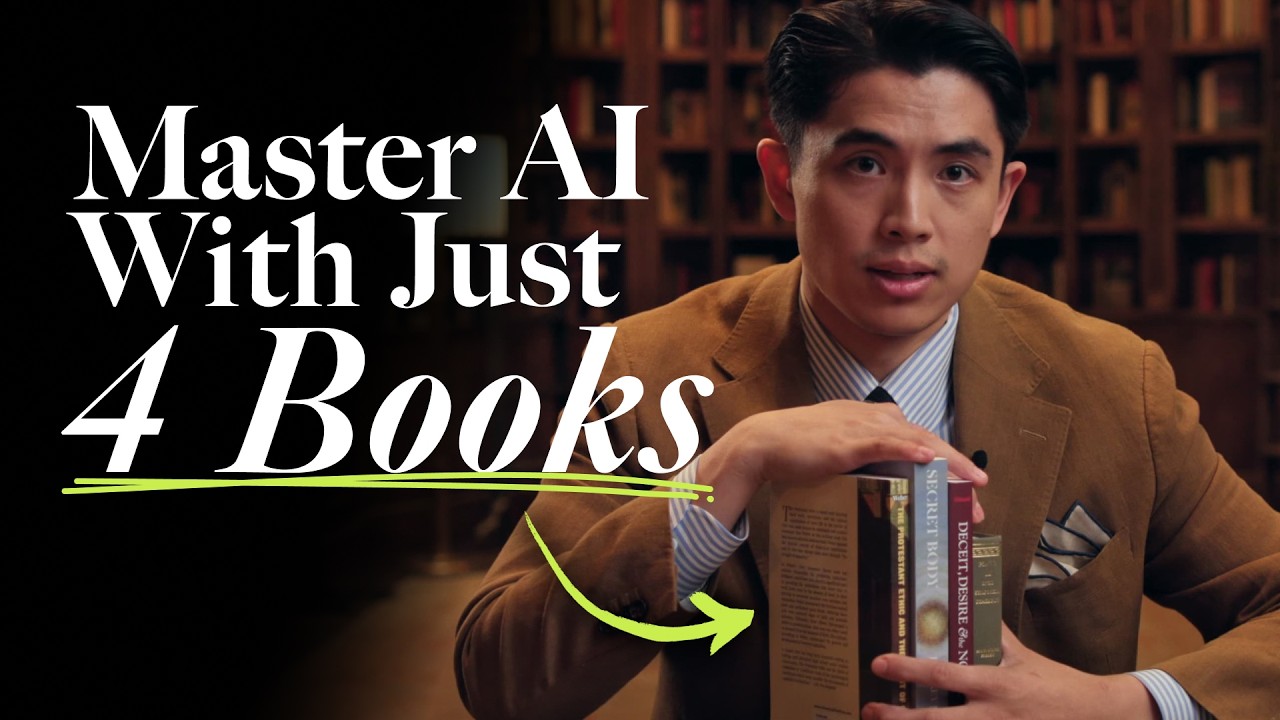
The video discusses four essential books that have helped the speaker AI-proof their career and life, emphasizing that understanding these works deeply will enable one not just to survive but thrive amid the AI revolution. The first book, by Max Weber, frames AI not merely as an economic challenge but as a profound religious threat to the dominant modern “religion” of capitalism and work. Weber’s analysis traces how Protestant ethics, particularly Calvinism’s doctrine of predestination, fostered habits like hard work and frugality, which capitalism later adopted as secular values. This connection reveals that people’s attachment to work is not just economic but existential, making the AI disruption a crisis of meaning akin to historical paradigm shifts like Darwin’s theory or the Copernican revolution.
The second book, Aristotle’s Nicomachean Ethics, offers a philosophical response by distinguishing between instrumental goods (means to an end) and intrinsic goods (valuable in themselves). Aristotle criticizes the Protestant work ethic’s elevation of work as an end in itself and instead champions leisure—defined as activities like art, philosophy, and theater that ennoble the soul—as the highest good. This perspective reframes the AI revolution as an opportunity to free humans from instrumental labor and focus on intrinsically valuable pursuits, providing a hopeful outlook that contrasts with the fear of job loss.
The third book, René Girard’s Deceit, Desire, and the Novel, introduces the concept of memetic desire, where people desire objects not for their intrinsic value but because others, especially admired models, desire them. This theory explains phenomena like celebrity endorsements and social competition in romance and predicts that as AI solves material scarcity, social scarcity driven by memetic desire will become the primary driver of economic value. The speaker uses this insight to highlight the importance of building social capital in the AI age, as value increasingly depends on social narratives and influence rather than mere production.
The fourth book, by Jeff Carreira Paul, explores the idea that human genius and creativity are not purely products of individual thought but are “received” through mystical or transcendent experiences. Historical geniuses like Nietzsche, Tesla, Ramanujan, and Descartes reportedly attributed their breakthroughs to such downloads or divine inspirations. This challenges the notion that AI can fully replicate human creativity, suggesting that humans possess a unique advantage in accessing these intuitive insights. The speaker is intrigued by this idea and is exploring ways to cultivate openness to such experiences, which may involve trauma, meditation, or psychedelics.
In conclusion, the video encourages viewers to rethink their relationship with work, value, and creativity in the face of AI’s rise. It stresses the importance of focusing on intrinsic goods and social capital while recognizing the unique human capacity for mystical insight that AI cannot replicate. The speaker offers these four books as foundational texts to navigate the profound cultural and existential shifts ahead, urging a move beyond surface-level AI skills toward a deeper philosophical understanding of humanity’s evolving role. Links to the books and related content are provided for further exploration.