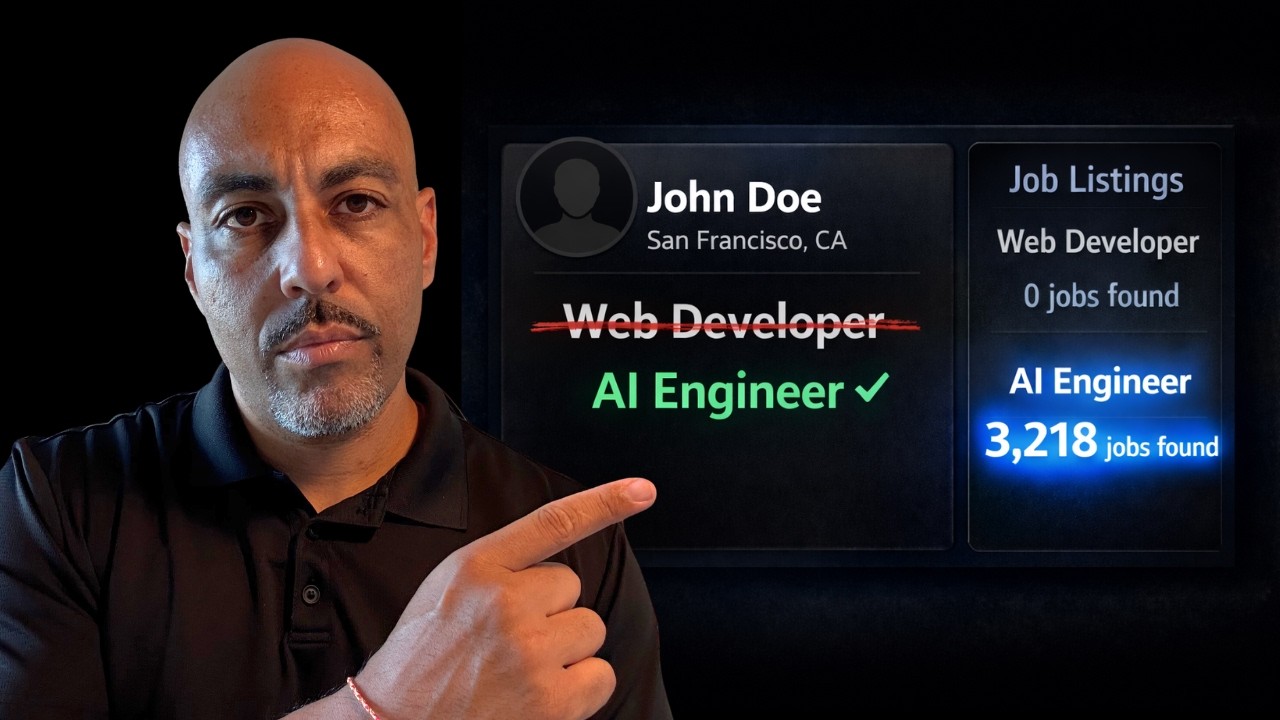
The video addresses full stack developers interested in transitioning into AI engineering, emphasizing that becoming an AI engineer doesn’t require a PhD or deep theoretical knowledge of machine learning. Instead, the fastest path is learning to build and deploy real AI features and products, similar to how startups operate. The speaker shares personal experience working at fast-paced startups, highlighting that much of AI engineering involves accessible, practical skills rather than complex research. Full stack developers already possess about 80% of the necessary skills, such as web app development, cloud deployment, and database management, needing only to add a few AI-specific capabilities.
The core skills outlined include retrieval augmented generation (RAG), agents, fine-tuning, observability, and prompt engineering. RAG is described as a beginner-friendly technique that allows AI models to use proprietary or internal data stored in vector databases to generate accurate, context-aware responses, reducing hallucinations. This method enables companies to build AI chat applications that can answer questions based on their own documents without exposing sensitive data to public AI models. The speaker illustrates this with a personal example of using RAG to search through thousands of his own articles for content generation.
Agents are explained as AI models enhanced with specific tools and context, enabling them to automate workflows by extracting relevant information and interacting with databases or APIs in a controlled manner. The speaker advises building simple, structured agents rather than relying on complex tool-calling approaches, which can be harder to manage. Fine-tuning, while often overrated, is still a useful skill for customizing AI responses to match specific tones or niche requirements, though it is generally not necessary for most applications.
Observability is emphasized as a crucial skill where traditional software engineering meets AI, involving monitoring token usage, prompt effectiveness, and system behavior to ensure cost control and prevent misuse. Tools like Helicone and Langsmith are recommended for tracking AI system performance and providing actionable insights. Prompt engineering is also highlighted as essential, focusing on crafting system prompts with constraints, managing context windows, and obtaining structured outputs to improve AI response quality.
Finally, the speaker suggests a practical project for learners: building an AI system that ingests content into a vector database and uses agents and possibly fine-tuning to generate responses in a specific voice or style. Adding an observability layer and experimenting with modern AI frameworks and streaming interfaces can enhance the project. The speaker encourages experimentation and continuous learning, noting the high demand for AI engineering skills in the job market and offering additional resources and cohorts for deeper engagement. The overall message is that practical application and hands-on coding are key to successfully transitioning into AI engineering.