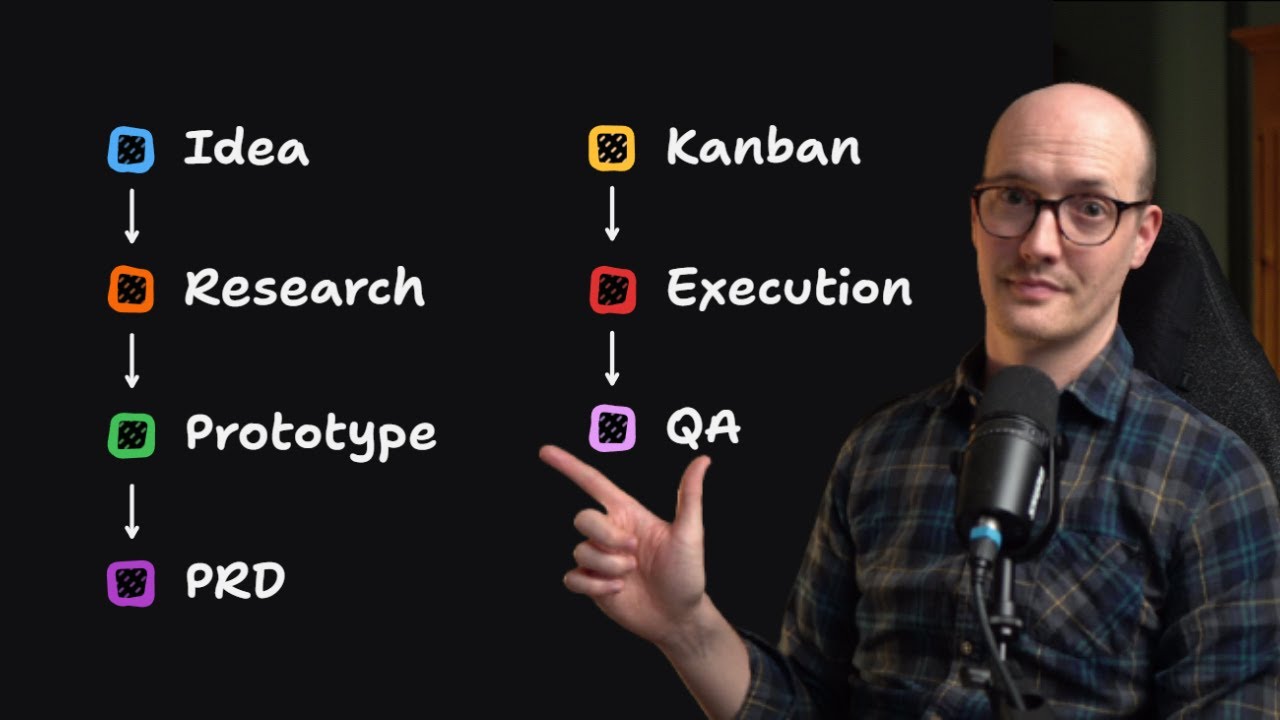
The video outlines a structured approach to AI-driven software development, breaking the process into seven distinct phases. The creator emphasizes that these phases are applicable regardless of the specific workflow or tools used, such as Ralph loops, GSD, or SpecKit. The goal is to help developers, especially those serious about engineering fundamentals, to consistently ship high-quality, maintainable code with the assistance of AI coding agents like Claude. The speaker positions this methodology as a disciplined alternative to more casual or “vibe” coding, aiming to foster robust application development in the AI era.
The first phase is the “Idea” stage, where a developer identifies what they want to build, whether it’s a new app, a feature, a bug fix, or a refactor. This idea can be broad or narrowly focused. The process is flexible enough to accommodate both large-scale projects and small, targeted changes. The idea is eventually broken down into actionable tasks or tickets that the AI agent will execute, either sequentially or in parallel, depending on the complexity and requirements of the project.
If the project involves unfamiliar territory, such as integrating with a new API or conducting significant research, the next phase is “Research.” Here, developers gather and cache relevant information—often in a research.md file—so the AI agent can access it efficiently during development. This step is crucial for projects that require external knowledge or have complex dependencies, ensuring that the agent doesn’t waste time repeatedly searching for the same information.
The third phase is “Prototyping,” where the developer and AI agent collaboratively explore different implementation options. This stage is particularly important when design choices or user experience are still uncertain. By quickly generating and iterating on prototypes, developers can impose their preferences and make informed decisions before committing to a final direction. Once a satisfactory prototype is chosen, it is integrated into the codebase, providing a concrete foundation for further development.
Subsequent phases include writing a Product Requirements Document (PRD) to clearly define the project’s end state, breaking the PRD into a Kanban board of actionable tickets, executing those tickets (often in a loop with the AI agent), and finally, conducting Quality Assurance (QA). The QA phase involves both automated and human review, generating additional tasks as needed until the product meets the desired standards. The speaker notes that these phases may evolve over time and acknowledges the importance of code review, which can be integrated into the QA or execution phases. The overall message is that following this structured, iterative process leads to better, more reliable AI-assisted software development.