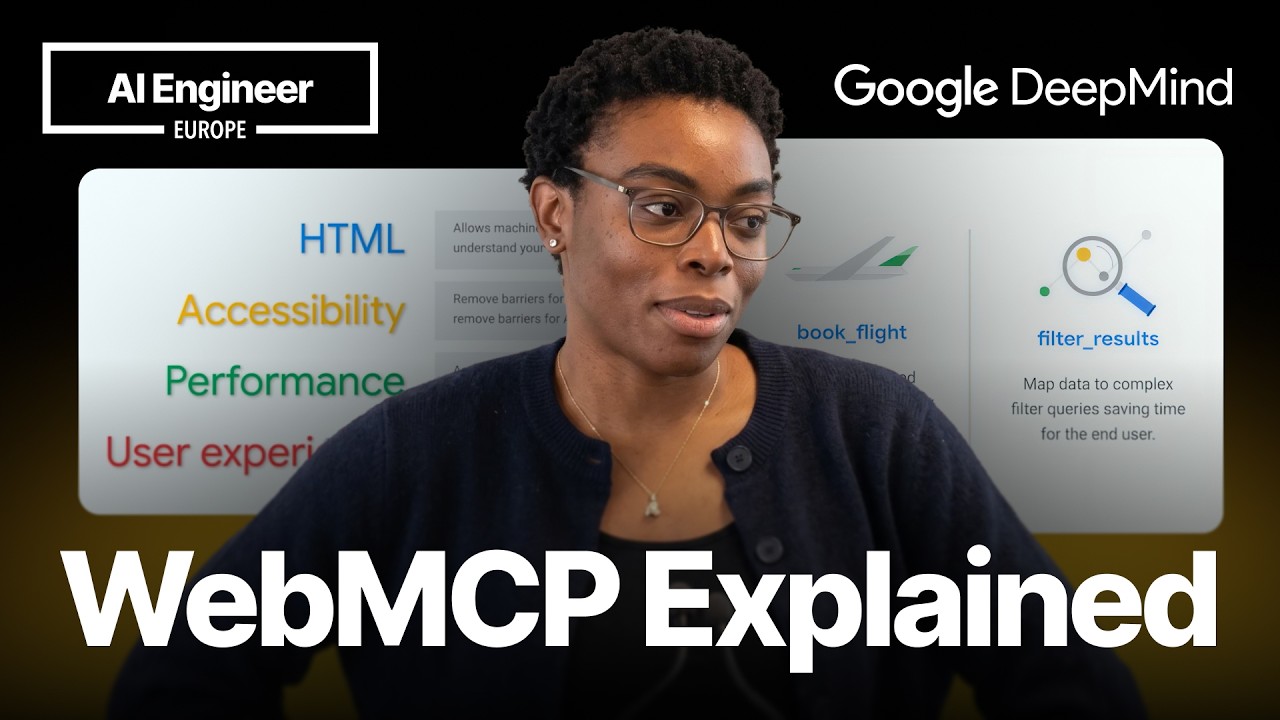
In this presentation, Tara Agyemang from the Google Chrome team introduces Web Model Context Protocol (WebMCP), a proposed web standard designed to simplify interactions between AI agents and websites. Traditionally, websites have been built primarily for human users, but with the rise of AI agents acting on behalf of humans, there is a growing need to optimize web experiences for these agents. Currently, AI agents face challenges such as parsing complex HTML, accessibility trees, and dynamic page elements, which makes their interactions brittle and inefficient. Tara emphasizes that improving web accessibility, semantic HTML, and performance lays the groundwork for making websites more agent-ready before adopting WebMCP.
WebMCP allows developers to define their website’s capabilities as structured tools that AI agents can directly use, rather than forcing agents to guess how to interact with the site. This approach is likened to a “USB-C for AI agent interactions,” providing a standardized menu of actions that agents can reliably execute. Tara demonstrates this with a maze game where AI agents use defined tools to navigate and interact with the game environment efficiently. The tools enable the agent to understand and perform complex multi-step actions, improving reliability and user experience by allowing users to switch seamlessly between manual browsing and AI-assisted navigation.
The protocol offers two main APIs for implementation: a declarative API for standard HTML forms, which automatically generates JSON schemas for AI agents, and an imperative API for more complex, custom UI flows where developers manually define tools and their behaviors. The imperative API is particularly useful for intricate workflows, such as booking tickets or filtering products, where AI agents can perform tasks on behalf of users by calling these registered tools. Tara showcases a demo where an AI agent successfully purchases concert tickets by sequentially calling tools to search, open pages, and complete purchases, highlighting how WebMCP keeps the UI in sync with agent actions.
Tara clarifies the distinction between WebMCP and the broader Model Context Protocol (MCP). While MCP enables AI agents to connect with server-side applications via custom services, WebMCP focuses on client-side interactions within the browser, requiring the browser window to be open. This makes WebMCP particularly suited for enhancing user experiences on complex websites by automating multi-step processes and reducing manual input. Use cases include booking flights, filling out forms, or shopping, where AI agents can simplify user journeys by handling repetitive or complicated tasks.
Currently in early preview, WebMCP is experimental and evolving, with support available in Chrome Canary and through a Chrome extension called the Model Context Tool Inspector. Tara encourages developers to try out the protocol, provide feedback, and contribute to its development. By adopting WebMCP, websites can transform into high-performance APIs for AI agents, enabling more efficient, reliable, and user-friendly interactions that move beyond brittle screen-scraping methods. The ultimate goal is to create a web that is truly agent-ready, enhancing both AI capabilities and human user experiences.