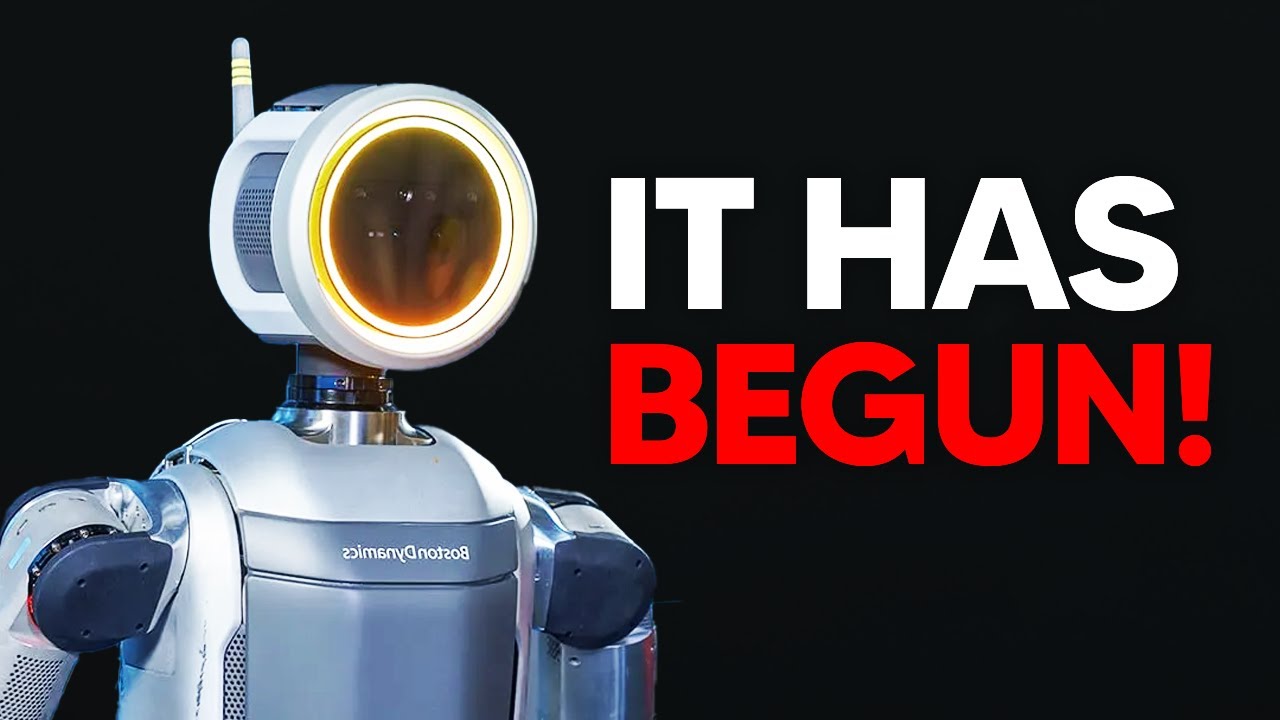
Boston Dynamics has made a groundbreaking advancement with their humanoid robot, Atlas, teaching it to think and act like a human. Unlike traditional robots programmed for specific tasks, Atlas can listen to simple spoken instructions and independently figure out how to perform complex jobs. A striking example is Atlas disassembling another robot, Spot, by coordinating precise hand movements, body balance, and obstacle avoidance simultaneously. This level of versatility is achieved by developing a “robot brain” capable of handling a wide range of tasks rather than specializing in just one.
The training process for Atlas involves a novel four-step method. First, human operators control the robot using VR headsets, effectively becoming the robot and demonstrating tasks in both real and simulated environments. Next, the recorded data is meticulously organized and labeled to ensure only high-quality examples are used. Then, this data trains a sophisticated neural network with 450 million connections, enabling the robot to interpret camera images, proprioceptive feedback, and spoken commands. Finally, the robot is tested on new tasks to confirm it has learned generalizable skills rather than just memorizing specific actions.
Three core principles underpin this success. The first is teaching the robot a broad range of skills, from fine finger movements to full-body locomotion, through an immersive VR control system. The second is creating a single, unified brain for all tasks, which improves adaptability and problem-solving, much like a human with diverse experiences. The third is enabling the robot to handle unexpected situations by learning from human demonstrations of problem-solving, allowing it to adapt in real-time without needing reprogramming.
Atlas demonstrates remarkable capabilities, such as disassembling the Spot robot in a multi-step process triggered by simple English commands. It can also perform complex tasks involving flexible objects like rope, cloth, and tires, which are traditionally difficult for robots due to their unpredictable behavior. Additionally, once trained, the robot’s performance speed can be increased up to two or three times without losing accuracy, allowing it to work faster than the humans who taught it.
This breakthrough marks a major milestone in robotics, introducing robots that understand natural language, combine complex movement with precise manipulation, and learn new tasks from human demonstration. The system is powered by advanced simulations that accelerate development and training. Researchers are already working on improvements like better force control, faster manipulation, and enhanced reasoning, paving the way for truly general-purpose robots capable of performing a wide array of physical tasks with human-like intelligence.