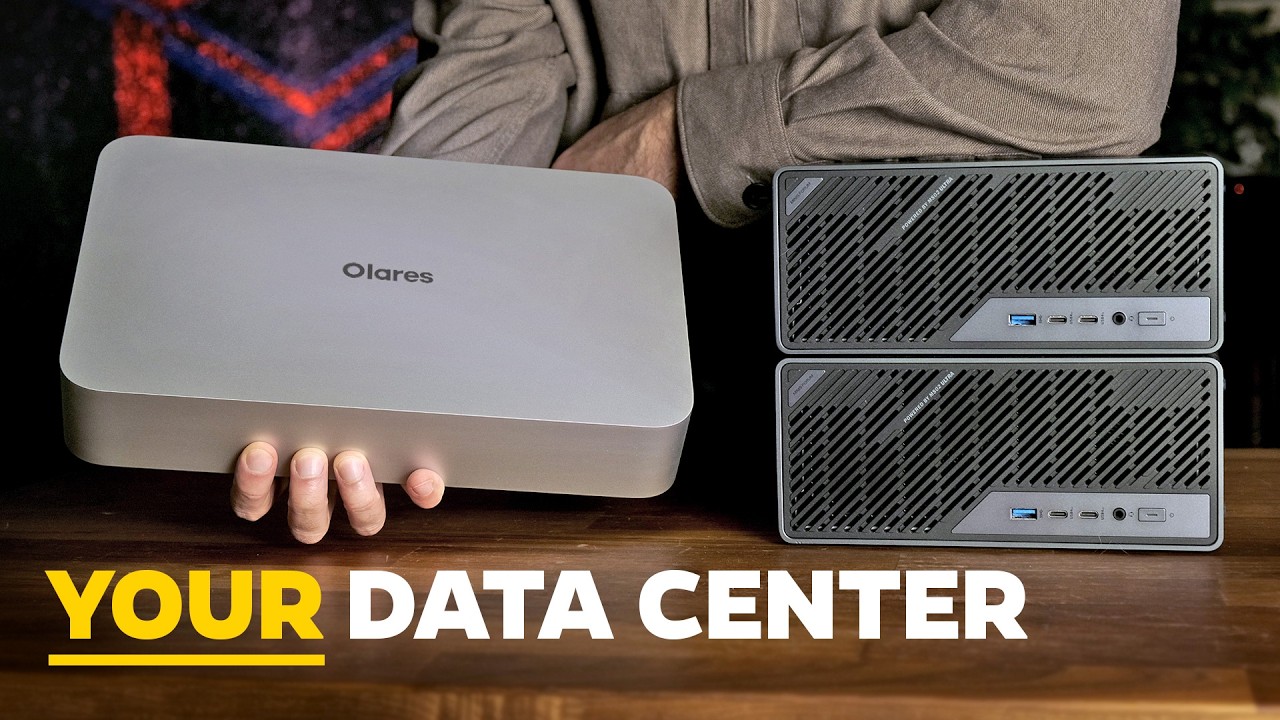
The video introduces the Olaris 1, a powerful local AI and cloud computing device designed to give users full control over their personal cloud and AI tools. Unlike traditional cloud services controlled by big tech companies, Olaris 1 allows users to own and operate their own AI cloud infrastructure, accessible anywhere. The presenter emphasizes the freedom and versatility this system offers, including replacing subscription-based AI and entertainment services with local alternatives running on a headless device. The core idea is to empower users with genuine computing freedom by managing their own cloud environment.
The presenter demonstrates setting up a multi-node cluster using the Olaris 1 as the master orchestrator and two Minis Forum MS2 Ultra mini PCs as worker nodes. These worker nodes handle the heavy computational tasks, while the Olaris 1 manages orchestration and other day-to-day tasks. The cluster runs on Ubuntu LTS, with file sharing managed by JuiceFS, enabling seamless communication and resource sharing between nodes. The setup process is straightforward, and the presenter highlights that any machine can serve as a master node, though the Olaris 1 is recommended for its powerful RTX 590 GPU optimized for AI workloads.
A key use case showcased is solving the localization problem for foreign media content, particularly Japanese and Korean movies and series that lack English subtitles in the EU. The presenter uses the built-in AI agent, LRS, to develop custom applications that scan a media library, check for subtitles, search online for existing subtitles, and if none are found, generate English subtitles locally using speech-to-text models. This pipeline runs primarily on the worker nodes, freeing the master node for other tasks. The generated subtitles are then integrated into the media library, which is served via JellyFin, a local media server accessible on all devices both inside and outside the home network.
The video also highlights the creation of a hardware monitoring app by the LRS agent, which provides real-time graphs of CPU, RAM, and VRAM usage across the cluster nodes. This app runs on the master node and offers insights into resource consumption, helping optimize cluster performance. The presenter notes that the coding of these custom apps took several hours but was largely automated by the AI agent, requiring minimal manual intervention. The entire system operates fully locally without relying on cloud services like ChatGPT, ensuring privacy and control.
Finally, the presenter discusses future plans for the cluster, including turning one worker node into a passive income source and expanding the cluster with additional nodes. They also mention potential applications such as local research assistants, note-taking apps, and game streaming. A special discount offer for the Olaris 1 is shared exclusively for the audience, emphasizing the value and affordability of the device compared to alternatives. The video concludes with a strong recommendation for the Olaris 1 as a game-changing tool for personal AI cloud computing and media management.
Useful Links