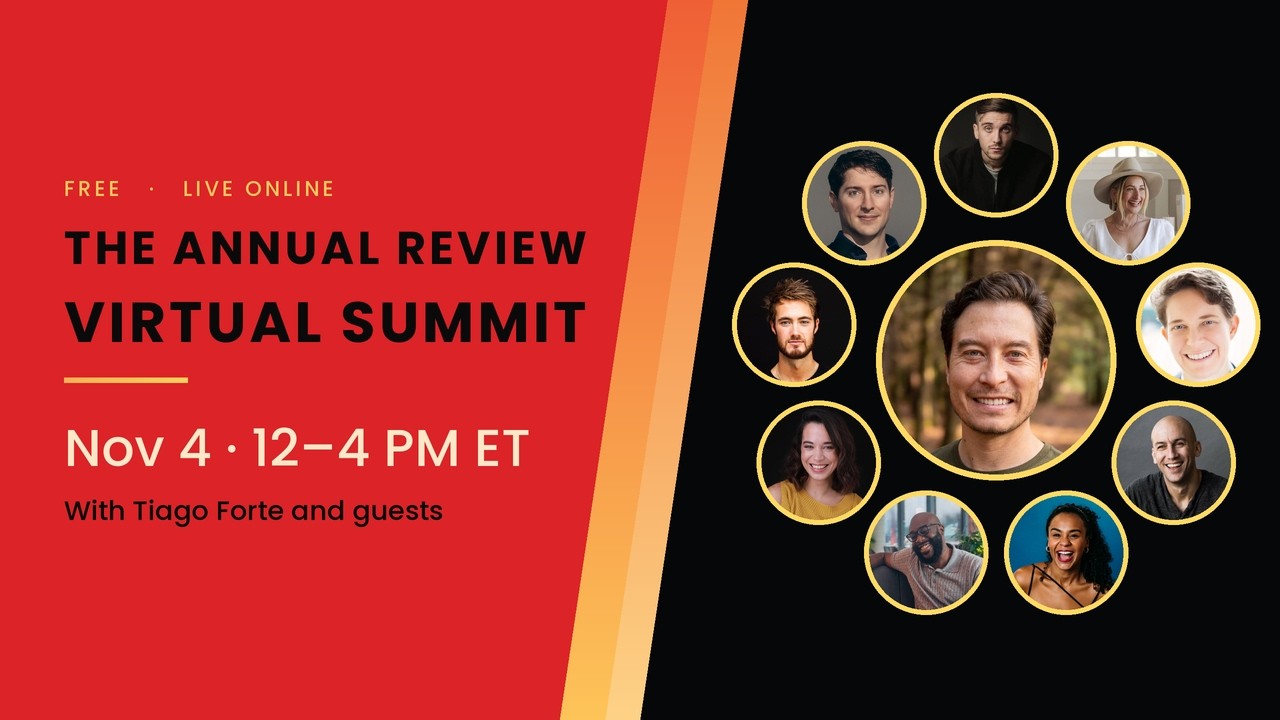
The Annual Review Virtual Summit, hosted by Thiago Forte, celebrated the release of his book “Life in Perspective,” which focuses on the practice of the annual life review—a ritual of reflection conducted typically at the end of the year to gain clarity and intentionality for the future. Thiago emphasized that the value of such reviews lies not in rigid adherence to a specific method but in the personal, creative process of turning inward and listening to one’s internal voice. The summit featured ten diverse experts who shared their unique approaches to structured reflection, annual reviews, and reflective practices, highlighting the flexibility and individuality inherent in these rituals.
Among the speakers was Laura Lump, who has been conducting annual reviews for eight years, advocating for the use of a consistent framework to guide the process and emphasizing the importance of separating private reflection from public sharing. She also highlighted the power of turning insights from reviews into tiny experiments—small, manageable actions that test new behaviors or ideas. Ari, another expert, shared his experience of frequent, AI-assisted daily and weekly reviews across multiple organizations, underscoring the importance of continuous small improvements (Kaizen) over long-term goal setting, and the value of data-driven, real-time feedback to make micro-adjustments.
Shira Gill brought a minimalist perspective, focusing on decluttering both physical spaces and life obligations to create room for what truly matters. She described her annual review as a life audit across key areas such as health, relationships, and personal development, coupled with setting one focused goal for the year. Joe Franco shared a deeply personal origin story of transformation through journaling and reflection, emphasizing the power of consistent journaling to identify patterns and make intentional changes. He also discussed the social aspect of journaling, where sharing reflections in a community enhances accountability and deepens insight.
Rian, a flow state expert, connected the practice of reflection to achieving flow by stressing the importance of clarity and goal shielding—focusing singularly on clear objectives to enter deep, productive states. He offered practical tools like the flow state breath to help prepare the nervous system for focused work. David Allen, known for his decision-making insights, described his reflective practice as akin to reviewing game film in sports, using a decision diary to analyze past choices and employing premortem techniques to anticipate potential pitfalls. He advocated for setting flexible objectives rather than rigid goals to accommodate life’s unpredictability.
The summit concluded with insights from Kelly Wild, who emphasized the somatic or embodied dimension of reflection, encouraging gentle body awareness and physical rituals to integrate emotional experiences during reviews. Nick Milo highlighted the synergy between personal knowledge management and reflection, advocating for nonlinear thinking and the use of digital tools like Obsidian to organize and visualize ideas, thereby enhancing clarity and creativity. Throughout the event, the speakers collectively underscored that the true benefit of annual reviews and reflective practices comes from active engagement and personal adaptation, encouraging attendees to move beyond theory into consistent, embodied practice for meaningful life transformation.
Useful Links