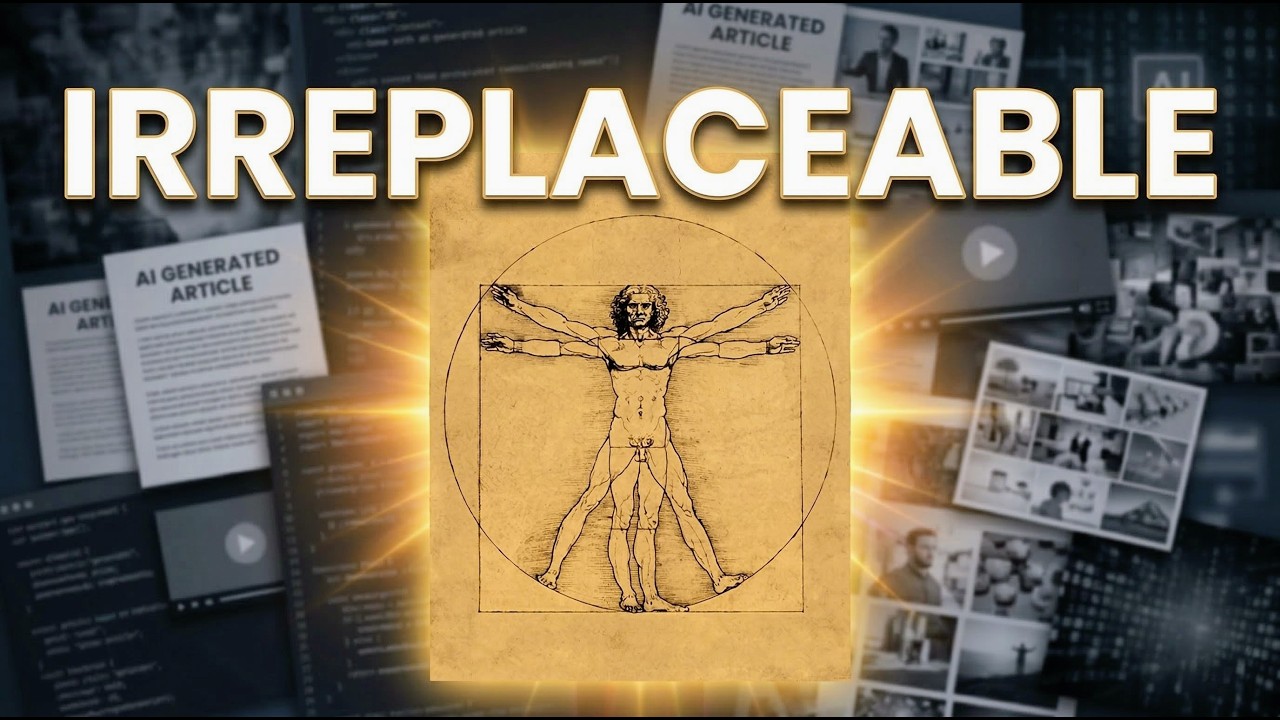
Certainly! Here’s a five-paragraph summary of the video transcript:
The speaker, who has worked with over 150 business leaders on integrating AI into their companies, observes a dramatic shift in the value of workplace skills. As AI rapidly automates and commoditizes cognitive labor, many traditional skills are losing value, while those that AI cannot easily replicate are becoming much more valuable. This shift is likened to a sudden drop in the cost of a universal resource, fundamentally changing the landscape of work and career development.
In response to this transformation, the speaker urges individuals to rethink their approach to learning and career growth. Rather than focusing on specialized knowledge that AI can easily access or generate, people should seek out rare, obscure, or hard-to-find sources of information and inspiration. For creators, this means drawing from unique experiences or offline sources that are not part of AI training data, making their work stand out in an increasingly automated world.
The speaker also emphasizes the importance of higher-order thinking skills, such as problem framing and question formulation. While AI excels at generating answers and first drafts, humans remain essential for defining the right problems and refining final outputs. Additionally, creating physical, in-person experiences and tangible artifacts—whether for customers, employees, or collaborators—adds unique value that virtual or AI-driven interactions cannot replace.
Networking and credentialing are also evolving. Instead of amassing large but shallow professional networks or relying on traditional resumes and credentials, individuals should focus on building deep, authentic relationships and assembling portfolios that provide concrete evidence of their skills and accomplishments. Tacit knowledge—subtle, embodied expertise gained through experience, like a surgeon’s intuition or a manager’s sense of team morale—remains uniquely human and highly valuable.
Finally, the speaker highlights the enduring importance of soft skills such as emotional intelligence, communication, and self-awareness. These abilities, along with a sense of purpose and meaning, cannot be automated and will be crucial for future career success. The key takeaway is not to avoid AI, but to use it as a tool to amplify one’s uniquely human strengths. Reflecting on these ideas and integrating them into one’s career strategy will help individuals thrive in an AI-driven world.